In the U.S., renewable energy is spreading rapidly. But, despite the progress, the new clean energy projects are facing challenges and are stuck waiting for grid connections. The major problem behind this delay is the outdated power systems, which are unable to handle the rapidly growing number of renewable energy sources. This is where Google’s AI Grid Initiative comes into play. This article will discuss “How Google Uses AI to Accelerate Grid Connections in the U.S.” and how it is helping speed up planning and reduce delays. It also describes some technical details on Google’s AI Grid Initiative and its future scope. Let’s break it down in simple words.
Current State of the U.S. Renewable Projects
The U.S. renewable energy sector is continuously growing, and it has become a national priority. Over 20% of total U.S. electricity is now generated from renewable resources. It is spreading fast in the country. According to the World Resources Institute, in 2024, solar installations led with a capacity of 40 Gigawatts (GW), up from 27.4 GW in 2023. With this, the total solar installation capacity has reached up to 220 GW, which is almost 7% of the nation’s electricity. The Battery storage capacity has also increased and has doubled to 29 GW. When the renewable resources are unavailable, the battery storage system helps in keeping the grid stable. However, the wind energy installation capacity has relatively decreased, and the total capacity has reached 153GW in 2024.
Over 160 new clean energy manufacturing projects have been announced by the U.S. since 2022, including 47 in 2024. This represents continuous progress in building a domestic clean energy supply chain.
The Grid Connection Crisis in the U.S.
In the U.S., several renewable energy projects, including solar panels, wind farms, etc., are ready to generate power. But one of the major problems that all the projects are facing is getting them connected to the grid. This is also known as the grid connection crisis, where the grids are not ready to handle all the new resources. This is slowing down the country’s renewable energy transition process.
The new renewable energy projects are facing a 3 to 5-year delay just to get approval, whereas some are getting rejected due to the expensive connection process. The Grid connection crisis is mainly due to the following reasons.
- The outdated and overloaded grid infrastructure.
- The new projects go through detailed studies so that they will not cause destabilization of the power system, which is time-consuming.
Google’s Energy Goals
The main energy goal of Google is to achieve a “fully carbon-free operation by 2030”. In 2023, Google announced its goal to operate all its data centers and campuses entirely on carbon-free energy (CFE). And with significant progress towards its goal, by 2023, Google had achieved a global average of 64% CFE across its operations.
In 2024, Google partnered with Kairos Power to develop small modular nuclear reactors (SMRs). Its goal is to add 500 MW of carbon-free power by 2035.
Another agreement was made with Element Power, which was announced in May 2025. The main goal behind this partnership was to construct three advanced nuclear sites, each projected to generate 600 MW.
In India, Google is also collaborating with CleanMax and the Adani Group to develop solar and wind capacities totaling over 125 MW.
Reference: 24/7 by 2030: Realizing a Carbon-free Future
What Is Google’s AI Grid Initiative?
The new renewable energy projects are facing delays in approval to connect to the grid. The manual assessment takes time to evaluate a large amount of grid data, which causes a delay, also known as the interconnection queue.
To solve this issue, Google has launched a powerful solution known as “Google’s AI Grid Initiative,” which is a combination of AI, data science, and advanced technology to optimize clean energy production.
Google’s AI Grid Initiative is designed to speed up the process of getting approval to connect to the grid. It uses machine learning algorithms to analyze the vast amount of grid data, predict congestion, and optimize energy production. The advanced AI technique helps in making quick decisions about where and how the new renewable energy projects can be connected to the grids.
This advanced technology, launched by Google, is helping the U.S. get closer to its carbon-free electricity goals by 2035.
Reference: Our investment in AI-powered solutions for the electric grid
Technical Details on Google’s AI Grid Initiative
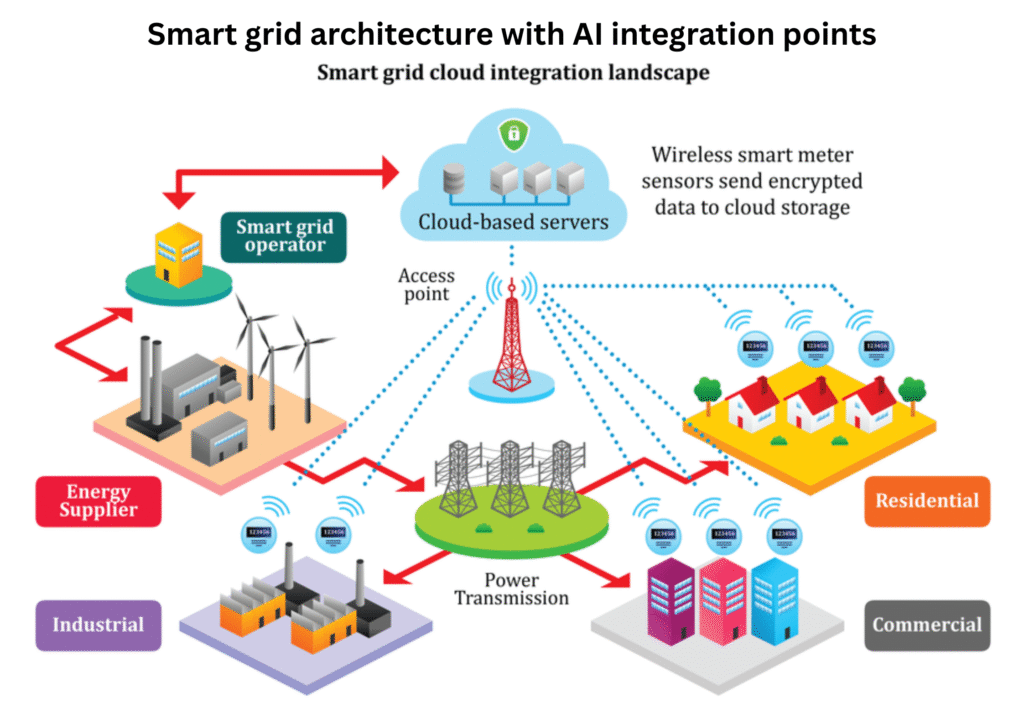
The main goal of the “Google’s AI Grid Initiative” project is to build a smart, efficient, reliable, and more sustainable energy planning. Let’s discuss some technical details about this project.
1. Predictive Modelling through Machine Learning
A grid infrastructure consists of massive datasets from power utilities, satellite imagery, weather forecasting, grid infrastructure layouts and constraints, and real-time information on energy usage patterns. Whereas the new renewable energy projects also contain a large dataset on renewable resources, solar and wind production patterns, weather conditions, the sensor inputs, and generated output patterns, the real-time data and historical data, etc.
The core of Google’s AI Grid Initiative is machine learning algorithms that predicthow the power grid will behave under different scenarios. It can also simulate how the variations in renewable resources and load demand will affect the grid stability.
2. Real-Time Decision Making Through Reinforcement Learning
The major role of the implementation of reinforcement learning in Google’s system is to improve its performance through the trial-and-error method. This advanced technology empowers the system to test thousands of possible grid configurations and make a decision on which option is best in maintaining grid stability and improving performance. Integration of the reinforcement learning technique in the system helps in speeding up interconnection approvals.
This technique helps AI systems to learn by trial and error in a simulated environment. It also helps in determining
- The ideal locations to connect new energy sources
- How to balance the real-time energy demand and production
- How to react to power outages
- How to route the excess power and store it to reduce energy losses.
Future Scope
In the future the Google’s AI Grid Initiative will build a more connected, clean, stable, and more resilient power grid.
- With faster simulations and real-time insights, the new clean energy projects will not have to wait for years to get approval to connect to the grid.
- In the future, with Google’s AI Grid Initiative, automatic grid adjustment will be done by using data based on real-time load demand and power supply.
- This advanced technology can also predict and prevent blackouts.
- With the changes in weather conditions and usage patterns, the grids will automatically and more efficiently balance electricity loads.
Conclusion
Google’s energy goal is not about efficiency; it’s all about generating 100% carbon-free electricity safely and affordably. And Google’s AI Grid Initiative is a major step to help the U.S. unlock a clean energy future. Advanced algorithms such as machine learning, reinforcement learning, and simulations are implemented to solve real-world problems such as analyzing a vast amount of data, real-time energy balancing, and faster renewable integration. Thus, Google’s AI Grid Initiative is helping to keep up with the pace of renewable energy innovation and a broader transition toward a carbon-free future.
FAQS:
- What is Google’s AI Grid Initiative?
Google has launched a powerful solution known as “Google’s AI Grid Initiative,” which is a combination of AI, data science, and advanced technology to optimize clean energy production. Google’s AI Grid Initiative is designed to speed up the process of getting approval to connect to the grid.
Also Read:
- Case Study: How Duke Energy Uses AI for Grid Stability?
- How AI Strengthens Cybersecurity in Smart Grids? A Complete Guide
- How AI Is Used to Design the Perfect Rooftop Solar System? A Complete Guide
- How Is AI Used to Develop Advanced Materials for Renewable Energy Technologies?
- How AI is Revolutionizing Predictive Maintenance in Smart Grids? A Complete Guide
- How AI Is Powering Smart Grids for Efficient Energy Distribution?
- A practical case study: How AI Enhances Microgrid Performance in Rural Areas?
- Hidden Microcracks in Solar Panel? How does AI Detect Early?
- Floating Solar Panel: The New Way to Produce Clean Energy on Lakes and Reservoirs
- AI-Powered Forecasting: A Powerful Technique to Enhance Grid Stability
- Importance of an AI-Driven Energy Pricing Model in Pricing Optimization
- Building-Integrated Solar Panels: How They Turn Walls and Windows into Clean Energy Generators?
- AI-Driven Predictive Maintenance in Wind Energy Systems
- How AI Is Used in the Renewable Energy Sector?
- AI and Microgrids: Empowering Remote Communities with Smart Energy
- AI Applications in Renewable Energy Trading and Market Optimization
Pingback: How Smart Inverters Help Balance Solar Power and Grid Supply? A Complete Guide - science2energy
Pingback: How to Enhance Solar Panel Efficiency with AI-Based Analytics? - science2energy
Pingback: Tandem Solar Panels: The Future of Rooftop Solar - science2energy