
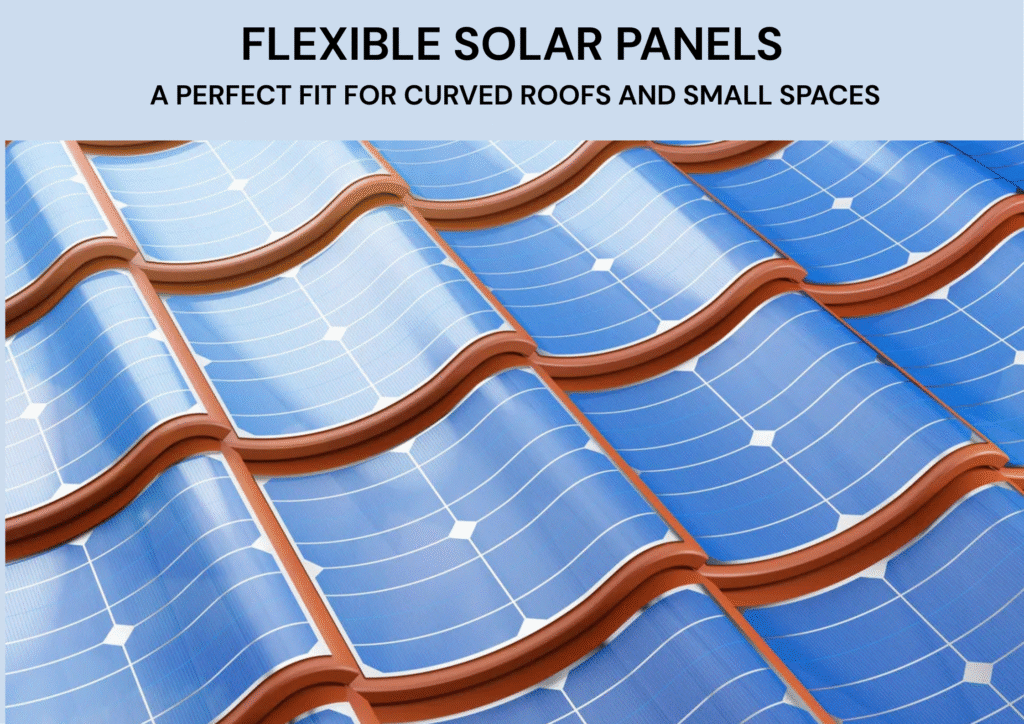
Flexible solar panels are the ideal choice for users seeking lightweight, portable, and space-saving solar power solutions. These are the best alternatives to traditional solar panels, particularly for areas where rigid solar panels cannot be installed. Flexible solar panels are designed to bend and fit onto uneven or curved roofs and small surfaces. These solar panels are an ideal choice for RV (Recreational Vehicles) users, campers, and for smaller and unconventional installations. So, let’s discuss flexible solar panels, their working principle, applications, advantages, and some real-life case studies on this topic.
What Are Flexible Solar Panels?
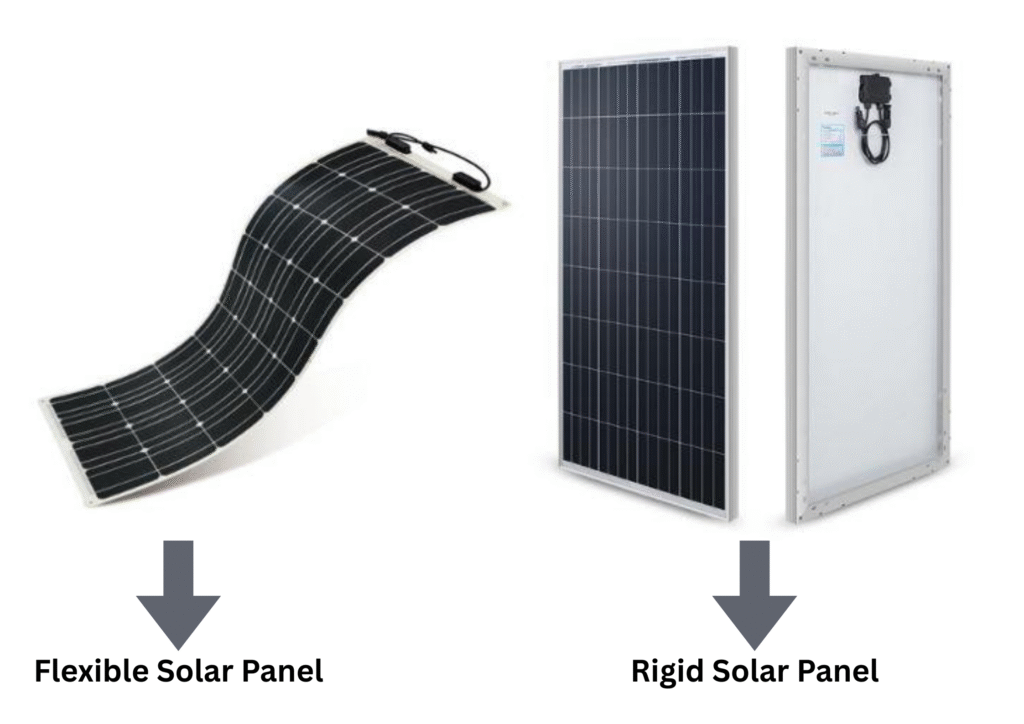
Flexible solar panels are thin, flexible, lightweight, and bendable photovoltaic modules designed to produce electricity from sunlight. These solar panels are ideal for curved, uneven, or portable surfaces.
Flexible solar panels are 80% lighter than traditional rigid crystalline solar panels. Their bendable structure allows them to be used on curved surfaces such as RV roofs, tents, and boats. Their thickness ranges from 1mm to 5mm. But their efficiency is lower than traditional panels and ranges between 10% to 17%.
How Does a Flexible Solar Panel Work?

Flexible solar panels are made of thin-film photovoltaic materials. The ultra-thin layers of solar cells are placed on flexible plastic or metal to form a flexible solar panel. The common materials that make the solar panels flexible are
- Amorphous Silicon (a-Si)
- Organic PV
- CIGS (Copper Indium Gallium Selenide)
Flexible solar panels have 5 layers.
- Protective top layer that is made from plastic or Teflon, which protects the panel from dust, UV rays, and water.
- A transparent conductive layer that allows light to enter and reach the solar cells.
- A thin-film solar cell layer that converts sunlight into electricity.
- A flexible substrate that allows the panel to bend. It is usually made from plastic or metal foil.
- A back sheet layer that offers mechanical support and holds all the components together.
The working principle of a flexible solar panel is the same as that of a traditional rigid solar panel. It works on the principle of the photovoltaic effect, which is explained below.
- When the sunlight hits the solar panel, the solar cell absorbs the photons.
- Photons knock electrons loose inside the material.
- The freed electrons flow in a single direction inside the electric field and create direct current (DC) electricity.
- The inverter converts the DC to AC (Alternating Current) electricity, which home appliances or electronics can use.
Reference: Design and development of flexible curved-shaped solar photovoltaic panel: A conceptual framework
Applications of Flexible Solar Panels
- Recreational Vehicles (RV)
The flexible solar panels are used in recreational vehicles. Theycan be easily curved to fit the roof of an RV without adding much weight. The solar energy generated by the panel can power lights, appliances, and electronics.
- Boats
Marine-grade flexible panels are available in the market, which are ideal for the marine environment. They are waterproof and corrosion-resistant. As the roof space of boats is always exposed to sunlight and moisture, flexible solar panels can be easily mounted over them to generate electricity.
- Camping Gear
Flexible solar panels are attached to backpacks and laid over tents. The generated electricity is used to charge smartphones, cameras, LED lights, and small fans.
- In Disaster Zones
Flexible solar panels can be deployed within minutes with no tools required. So, these solar panels can be used in disaster zones to provide a power supply. They can also be used in field hospitals and emergency shelters to charge electronic equipment.
- Wearable Devices
Some flexible solar panels are used in wearable devices and portable gadgets. They can be installed into jackets, bags, or even drone surfaces.
Advantages of Flexible Solar Panels
- Lightweight
Flexible solar panels are lightweight. So, they are easier to handle and easier to transport for mobile use. These are an ideal choice for RVs, boats, and portable setups.
- Bendable
These solar panels can bend around curved or uneven surfaces. So, they can be used in boat roof spaces, camper vans, tents, and curved roofs.
- No need for Mounting Frames
Flexible solar panels are thin and lightweight. To install these panels, you don’t need any mounting frames or metal racking systems. These can be attached to the surface using adhesives, tape, or Velcro.
- Portable
Flexible solar panels are portable. They can be folded, rolled, and packed in a bag, backpack, or stored in a vehicle without taking up much space.
- Durable
Flexible solar panels are highly durable. They are designed with high-quality materials to resist water, UV radiation, and minor impacts. So, they are an ideal choice for outdoor use, harsh marine environments, and sunny locations.
- Requires Low Maintenance
Flexible solar panels don’t need frequent maintenance. They operate silently and offer hassle-free energy.
- Cost-effective
For short-term projects, flexible solar panels are cost-effective and a cheaper alternative to installing a full solar system.
Reference: Flexible Photovoltaic System on Non-Conventional Surfaces: A Techno-Economic Analysis
5 Reasons You Should Go for Flexible Solar Panels for Your Home
- If your roof is curved, uneven, or made with delicate materials such as metal, tiles, etc., flexible solar panels are a great solution. It can be easily bendable and does not require any mounting structures, so less risk of damage to the roofing.
- If you are living in a remote or rural area, a flexible solar panel is a great option. It is a lightweight system and can be easily installed without the requirement of any specialized tools or roof reinforcements.
- For small energy applications like running garden lights, attic fans, powering a detached garage, and charging battery systems for backup, a flexible solar panel is a cost-effective option.
- Flexible solar panels work well with a small battery system. If you are living in a remote location, you can use this solar panel for emergency uses such as lighting, charging phones, running water pumps, etc.
- If you want a cleaner, quieter, safer, and environmentally friendly energy solution, go for flexible solar panels. They don’t produce noise, fumes, or heat during operation.
A Guide on the Installation of Flexible Solar Panels
- First, select the best spot to install a solar panel that receives the most sunlight. The spot must be an unshaded area with no trees, antennas, or obstructions.
- Flexible solar panels are installed with adhesive, Velcro, or mounting tape. So, clean the surface with a clean cloth, remove all the dust, and dry it completely before applying adhesive.
- Lay out the panels on the surface so that the panels don’t overlap or shade each other, and wires can easily reach the charge controller.
- To attach the flexible solar panel, select between adhesive tape, Velcro strips, and grommets according to the type of your surface.
- Place the solar panels correctly, and wire the panel’s positive and negative leads to the charge controller. Then connect the controller with a battery. If you want to power AC appliances, connect them with an inverter.
- After connecting everything, test the output using a multimeter. Let the system run for a few hours to ensure stable operation before regular use.
Cost of Flexible Solar Panel
The cost of a 100-watt flexible solar panel ranges approximately between $100 and $250. Its cost depends on the technology, brand, and features you choose.
Reference: Flexible Solar Panels
Case Studies
Case study 1: Off-grid Cabin in San Juan Mountains, Colorado
A 400 W eco-friendly off-grid cabin is built deep in the woods of the San Juan Mountains, Colorado, where grid power is not available. Flexible solar panels are installed on its curved metal roof. The solar panel can fully power LED lighting, a small fridge, and phone charging. It can also withstand cold weather and snow slide-off.
Case Study 2: Marine Use on a Sailing Yacht, Australia
In Whitsunday Islands, Queensland, Australia, a flexible solar system of 300 Watts capacity has been installed on the top of a sailing yacht using adhesive. Solar energy is used to power GPS, lighting, radio, and USB charging. This is a perfect solar solution for harsh marine conditions and curved surfaces.
Conclusion
A flexible solar panel is a practical tool for people who need portable, lightweight, and easy-to-use solar solutions. It offers a reliable and versatile solution to people who need solar power in remote locations and in places where traditional panels won’t work. It is a simple and cost-effective option for small and mobile setups such as powering a boat, a cabin, and a mobile food truck. SO, for small setups, flexible solar panels are a smart investment with long-term value.
FAQS
- What are flexible solar panels?
Flexible solar panels are thin, flexible, lightweight, and bendable photovoltaic modules designed to produce electricity from sunlight. These are 80% lighter than traditional rigid crystalline solar panels. These solar panels are ideal for curved, uneven, or portable surfaces. Their bendable structure allows them to be used on curved surfaces such as RV roofs, tents, and boats.
2. What is the cost of flexible solar panels?
The cost of a 100-watt flexible solar panel ranges approximately between $100 and $250. Its cost depends on the technology, brand, and features you choose.
3. What is the efficiency of flexible solar panels?
The efficiency of flexible solar panels is lower than that of traditional panels and usually ranges between 10% to 17%.
Also Read:
- Crystalline Vs Thin-Film Solar Panels: Which One Is The Best for Your Modern Smart Homes?
- Tandem Solar Panels: The Future of Rooftop Solar
- Self-Cleaning Solar Panels: No More Manual Cleaning from Now On
- Dual Glass Solar Panel: A Simple and Long-Lasting Investment for Homeowners
- Anti-Reflective Solar Panels: A Smart Way to Maximize Rooftop Efficiency
- Graphene-Coated Solar Panels: The Next Big Thing in Residential Solar Panels
- Utilization of AI in Optimal Site Selection of Renewable Energy Projects: A Complete Guide
- A Practical Guide to Transparent Solar Panels: How Home Windows Can Produce Electricity?
- Smart Meters for Solar: The New Real-Time Energy Monitoring System in Rooftop Solar Systems
- Intelligent Solar Tracker: The Secret to More Solar Energy
- How to Optimize Energy Storage with AI Algorithms in Renewable Energy Systems?
- How to Enhance Solar Panel Efficiency with AI-Based Analytics?
- How Smart Inverters Help Balance Solar Power and Grid Supply? A Complete Guide
- Case Study: How Google Uses AI to Accelerate Grid Connections in the U.S.
- Case Study: How Duke Energy Uses AI for Grid Stability?
- How AI Strengthens Cybersecurity in Smart Grids? A Complete Guide
Pingback: Performance of Tandem Solar Cells in Real Pilot Solar Farms: A Case Study - science2energy
Pingback: Case Study: How Bifacial Solar Panels Improved Output in the Nevada Desert? - science2energy
Pingback: TOPCon Vs HJT Vs Tandem Solar Panels: Make The Best Purchase for Your Project - science2energy
Pingback: Portable Solar Panel Kits: Best Uses for RVs and Camping - science2energy
Pingback: How Wind Direction and Speed Affect Wind Turbine Performance? A Complete Guide - science2energy