
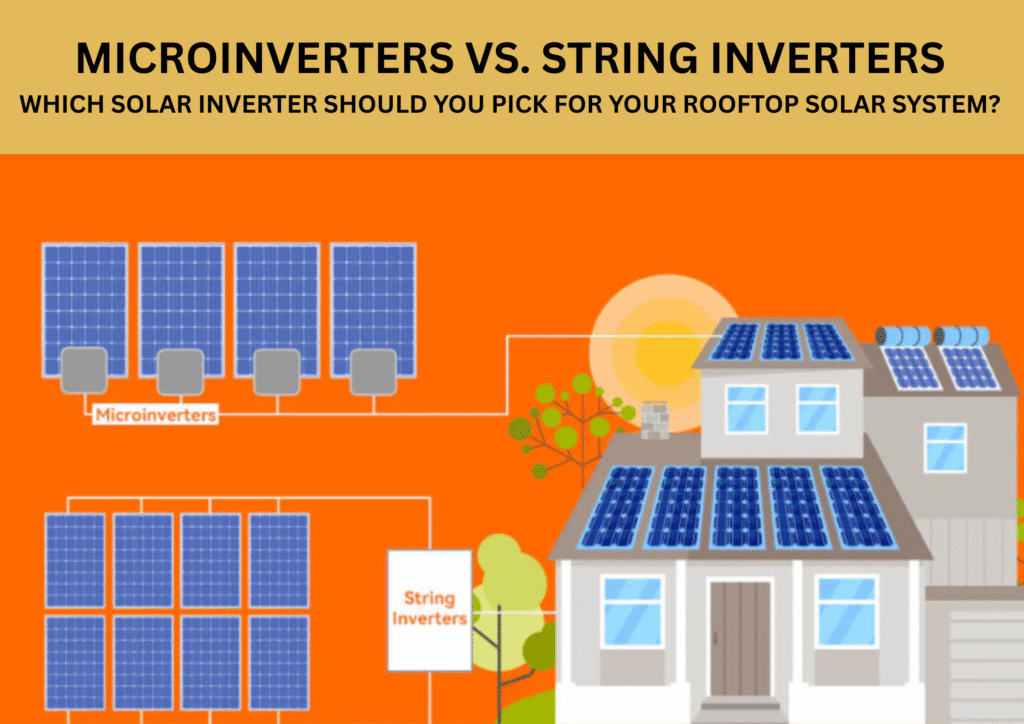
When installing a solar system for your home or business, selecting the right equipment is crucial. Among them, one of the most important decisions is to select the right inverter for your solar panel. There are mainly two types of inverters available in the market, i.e., microinverters and string inverters. So, understanding the differences between them can help you make a better decision. This article provides detailed information on “Microinverters vs string inverters” and helps you understand which solar inverter to choose for your rooftop solar system. Let’s break it down in simple language.
What Is a Microinverter?
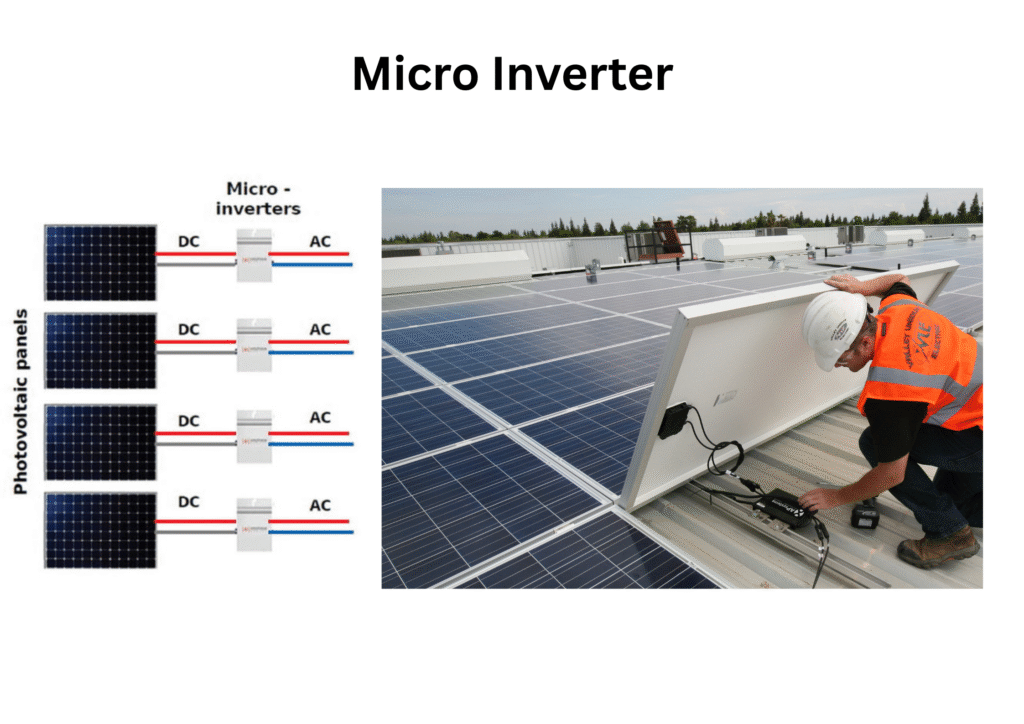
A microinverter is installed behind each solar panel and operates independently for that panel. It converts direct current (DC) electricity generated by the solar panel to alternating current (AC). This means each solar panel has its own inverter.
When sunlight hits the solar panel, the photovoltaic effect takes place, and it converts the solar energy into DC electricity. The microinverter connected to that panel converted DC to AC electricity. The AC power is then used by the home’s electrical system or sent to the utility grid. The microinverter also sends real-time data to the monitoring system, allowing you to view the panel’s performance.
The microinverters are generally used in residential rooftop systems, solar farms, and buildings with multiple orientations.
What Is a String Inverter?
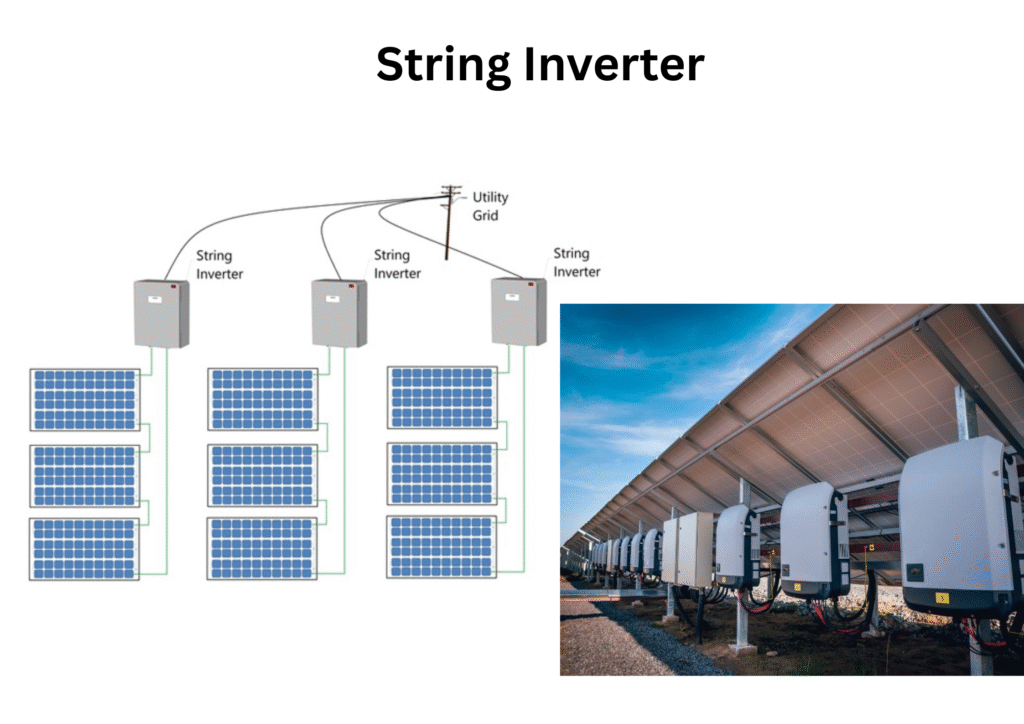
The string inverter is the most commonly used in a solar system. It is usually mounted on a wall or placed near your electrical panel. It connects a group or “string” of solar panels and converts the combined DC electricity from all the panels into AC electricity at a single central point.
When sunlight falls on the surface of the solar panels, they generate DC electricity by the photovoltaic effect. The solar panels are connected in series to form a string. The string inverter converts the DC to usable AC power, which is then used by home appliances or sent back to the grid.
Microinverters vs String Inverters
| Microinverters | String Inverters | |
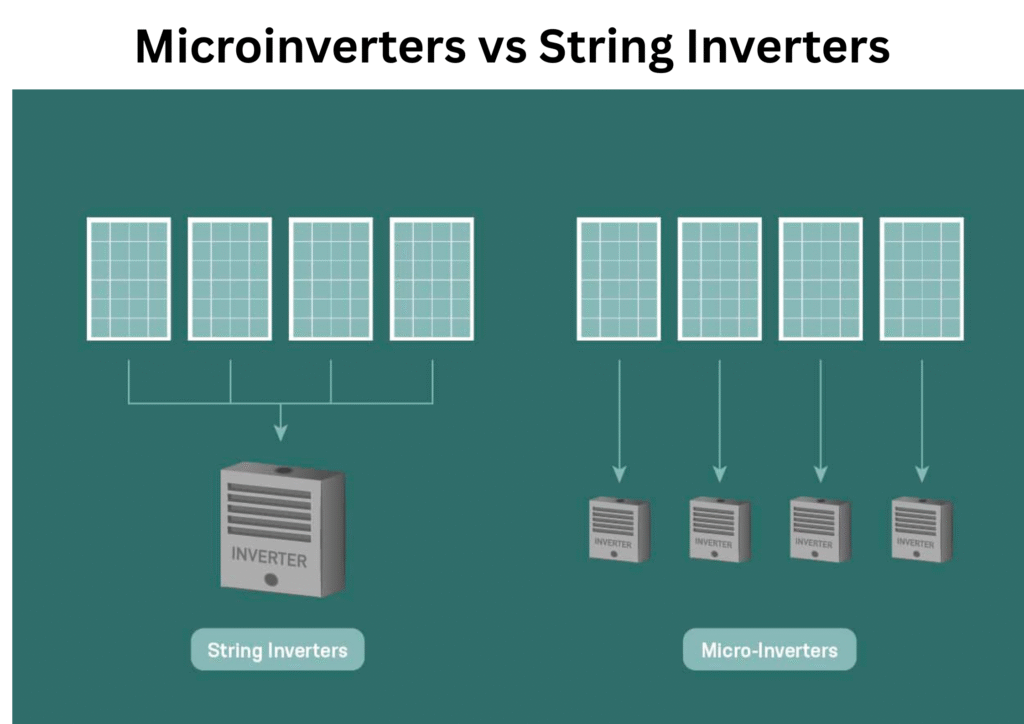
| Definition | These are compact or small inverters. Here, each solar panel has its own inverter, known as a microinverter, which works independently. | These are traditional inverters. Here, the DC electricity produced by solar panels connected in a string comes to one centralized inverter known as a string inverter. |
| Working Principle | The microinverter converts the electricity generated by each panel from DC to AC. | A string inverter converts power from an entire array at once. |
| Placement | Typically placed behind each solar panel. | Usually mounted on a wall or in a central location. |
| Performance | It provides individual panel-level monitoring. | It provides system-level or string-level monitoring. |
| Installation Cost | Higher installation cost. It increases system cost by 15% to 25%. | Lower installation cost. These are more affordable. |
| Flexibility | These are highly flexible. In case you want to add more panels in the future, it would be easy. | Design flexibility is limited to a similar orientation or tilt. It is harder to expand. |
| Maintenance | Maintenance is difficult. | Maintenance is easy. |
| Safety | Microinverters are safe, as they have less DC wiring. | Due to the higher DC voltage, the wiring risk is very high. |
| Warranty | Typically come with a 25-year warranty. | It offers a 10-15-year warranty. |
| Ideal for | Great for complex rooftops. It supports mixed orientations | Ideal for simple rooftops. It works best in a uniform direction. |
When to Choose a Microinverter?
1. If your roof has partial shading due to trees, nearby buildings, poles, chimneys, etc., then a microinverter is an ideal option for you. As the microinverter works independently, it will not degrade the performance of all solar panels.
2. The microinverter allows each solar panel to optimize its power output. So, if your roof has multiple angles or orientations, the solar panels must face different directions. In this situation, installing microinverters is a better option.
3. Microinverters allow you to monitor the performance of individual solar panels. So, if you want panel-level monitoring, consider a microinverter.
4. If you want long-term efficiency, microinverters are a great option for you. They allow each panel to operate at its maximum potential, which also enhances the energy production level.
5. If you want to add more solar panels in the future, microinverters are a great option for you as they offer flexibility. Adding new panels doesn’t require major system changes.
6. Based on safety, microinverters are a better option. They offer lower fire risk as compared to string inverters.
7. If you want a longer warranty, go for microinverters as they offer warranties of 20-25 years.
When to Choose a String Inverter?
1. If your roof gets uninterrupted sunlight throughout the day, then a string inverter can work better. For ground-mounted solar panels, open fields, south-facing roofs, and buildings without any shading problem string inverter is a great option.
2. If all the panels in a string have the same tilt and orientation and face the same direction, then the string inverter works best in these cases.
3. A single string inverter can handle all the panels connected in the string. You don’t have to spend money on multiple inverters. If you want to maximize return on investment, then string is a better option as it is highly cost-efficient.
4. String inverters are easier to maintain, repair, or replace. So, if you prefer easy maintenance, go for a string inverter.
5. If you are not concerned about panel-level monitoring, the string inverter is a good option for you.
6. String inverters are highly reliable and come with warranties up to 10-15 years. They are well-tested and widely supported. So, if you want a long-lasting system, you must consider a string inverter.
Cost Differences Between a Microinverter and a String Inverter
- Upfront Equipment Cost:
| Microinverter | String Inverter |
| The upfront cost of microinverters is higher. The cost of a single microinverter ranges between $150 to $250. SO, for a solar system with 20 panels, it costs between $3000 to $5000. | The string inverter has a lower initial cost. The price of a typical residential string inverter ranges between $1000 to $2500. |
2. Installation Cost
| Microinverter | String Inverter |
| The installation of microinverters needs more electrical connections and mounting hardware, which increases the installation charges. | The installation of a string inverter is faster and easier, and the overall installation cost is lower. |
Maintenance Differences
| Microinverter | String Inverter |
| The microinverter requires panel-level diagnostics. So, it is difficult to identify the faults and issues present in the system. Repairing microinverters can also be tricky because you have to lift the panel to identify the faulty unit. | The string inverter is a single unit. So, the maintenance is simple. |
| If one microinverter fails, it does not affect the other parts of the system. You don’t have to shut down the full array. | If the string inverter fails, the repair may need to shut down the full array. |
Warranty Differences
| Microinverter | String Inverter |
| 1. The microinverter offers a 20 to 25-year warranty. The Long-term coverage reduces the replacement expenses. | String inverters offer a standard warranty of 10 to 12 years, whereas the replacement cost can range from $1,000 to $2,000. |
Conclusion
The upfront cost of microinverters is higher. But their performance, monitoring, safety, and long-term return can outweigh the price. They deliver higher energy production, greater control, and enhanced and a smart choice for many homeowners. They are ideal for shaded, complex, and multi-directional roofs.
For uniform roofs with plenty of sunlight throughout the day, string inverters are a practical and cost-effective solution. The installation and maintenance are easier and faster. They are also budget-friendly and a trusted choice for many homeowners and businesses.
Select the right inverter for your solar panel based on the layout of your roof, budget, and energy goals.
FAQS
- What Is a Microinverter?
A microinverter is placed behind each solar panel and works independently for each panel. It converts direct current (DC) electricity generated by the solar panel to alternating current (AC). This means each solar panel has its own inverter.
- What Is a String Inverter?
The string inverter is the most commonly used in a solar system. It is usually mounted on a wall or placed near your electrical panel. It connects a group or “string” of solar panels and converts the combined DC electricity from all the panels into AC electricity at a single central point.
Also Read:
- Are DIY Solar Panel Kits Worth It? A Complete Guide
- Portable Solar Panel Kits: Best Uses for RVs and Camping
- Breaking Down Each Component of a 5kW Solar Panel Kit
- What Size Solar Panel Kit Do You Need? Find the Right Solar Kit for Your Home
- Perovskite Solar Panels: The Future of Home Solar
- High-Wattage 450W Solar Panels: Are They Worth It for Your Home Roof Space?
- The Rise of 600W+ High-Power Panels in Commercial Solar Farms
- HJT Solar Panels: A Right Solar Investment for Large Businesses
- N-Type TOPCon Solar Panel: A Complete Guide
- TOPCon Vs HJT Vs Tandem Solar Panels: Make The Best Purchase for Your Project
- Case Study: How Bifacial Solar Panels Improved Output in the Nevada Desert?
- Performance of Tandem Solar Cells in Real Pilot Solar Farms: A Case Study
- Flexible Solar Panels: The Ideal Solution for Small and Irregular Spaces
- Crystalline Vs Thin-Film Solar Panels: Which One Is The Best for Your Modern Smart Homes?
- Tandem Solar Panels: The Future of Rooftop Solar
- Self-Cleaning Solar Panels: No More Manual Cleaning from Now On
- Dual Glass Solar Panel: A Simple and Long-Lasting Investment for Homeowners
- Anti-Reflective Solar Panels: A Smart Way to Maximize Rooftop Efficiency
- Graphene-Coated Solar Panels: The Next Big Thing in Residential Solar Panels
Pingback: Can Solid-State Batteries Keep the Lights on at Night? A Complete Guide - science2energy
Pingback: Thermal Stability of Solid-State Batteries in Harsh Renewable Energy Environments - science2energy
Pingback: Solid-State Batteries vs. Lithium-Ion: Which Battery is Truly Safer in Renewable Energy Storage? - science2energy