
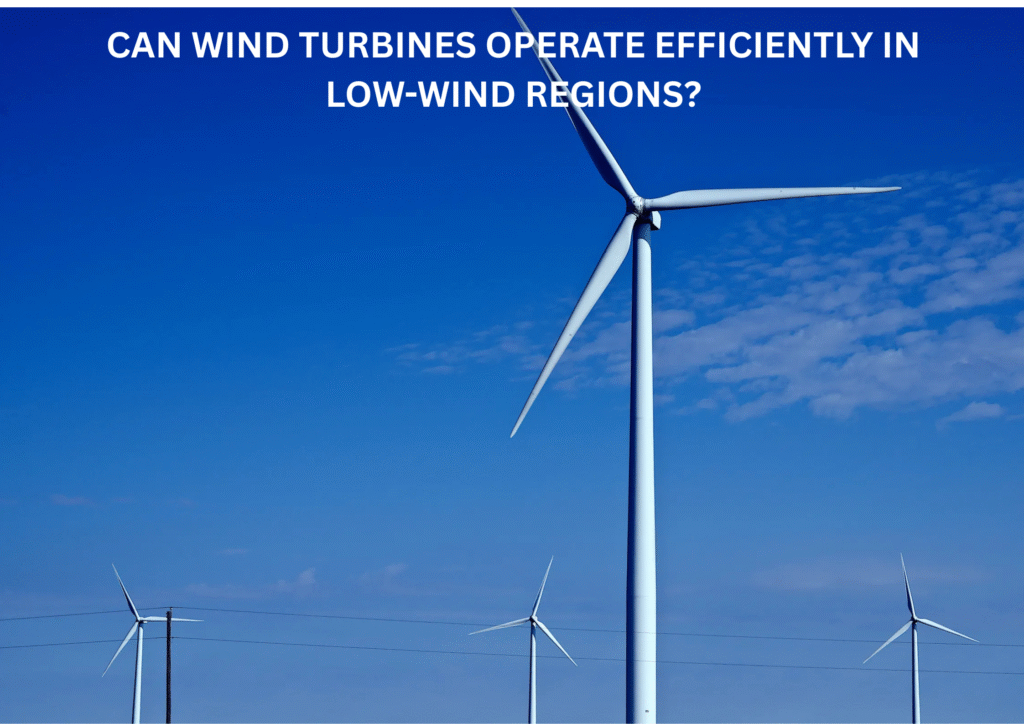
Have you ever wondered if a gentle wind is enough to rotate a wind turbine and produce electricity? With the increasing demand for renewable energy, researchers and engineers are developing wind turbines that operate efficiently even in low-wind regions. It’s a fact that a small increase in wind speed can multiply energy output. But what happens if your location does not offer strong and steady winds? Today’s low-wind turbines can start generating power at speeds as low as 2.5 m/s. This article explains how modern wind turbines are designed for low-wind areas, and how the small turbines are adapted for low-wind conditions. Read the full article to know “Can wind turbines operate efficiently in low-wind regions? “
Relationship Between Wind Speed and Energy Production
Besides the direction and consistency of the wind, it is the speed of the moving air that directly influences the amount of power produced. The mathematical relationship between wind speed and power available in the wind is explained below.
P=ρ×A×V^3
Here, P = Power (Watts)
ρ= Air Density (kg/m³)
A = Area covered by the turbine blades (m²)
V = Wind Speed (m/sec)
The formula represents that as rho and A are constant values, the output power increases with the cube of the wind speed. This means that the power increases exponentially with wind speed, and small speed changes can lead to significant variations in power output.
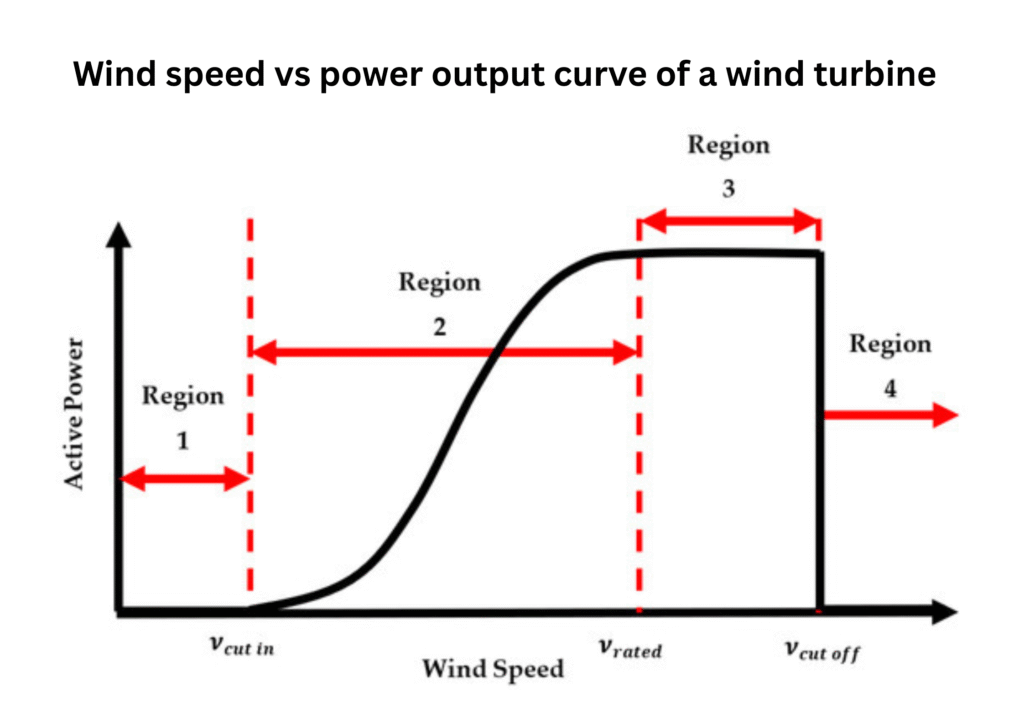
The power curve graph of wind turbines has 3 main regions. It represents how much power the wind turbine produces at different wind speeds.
- Cut-in Speed: Here, the wind speed usually ranges between 3 to 4 m/sec. This is the minimum amount of wind speed required to start turning the blades and generate power.
- Rated Speed: The rated speed falls between 12 to 15 m/sec. At rated speed, the wind turbine generates maximum power and maintains a constant output even if the wind speed continues to increase.
- Cut-out Speed: The cut-out speed is usually around 25 m/sec. If the wind speed reaches above this safe limit, the wind turbine automatically stops operating to prevent mechanical damage.
At low wind speed, the wind turbine operates at a reduced efficiency and generates very little power. At moderate wind speeds, the turbines operate efficiently and generate stable electricity. Whereas, at high wind speeds, the turbines must limit their rotation speed to avoid damage.
Reference: A review on modern control applications in wind energy conversion system
What is a Low-Wind Region?
A location where the average wind speed is not enough to generate high amounts of wind power is considered a low-wind region. In these locations, the annual average wind speed at standard measurement height is below 4 to 5 meters / second.
Locations surrounded by tall buildings, high hills, and dense forests etc. are considered low-wind regions. Additionally, areas with warm and stable weather, areas close to large bodies of water, and lower-altitude plains tend to have lower wind speeds.
The low-wind regions also have some windy days, but the wind speed is not consistent enough to produce electricity efficiently using traditional wind turbines. However, advanced low-wind turbines have been designed with larger rotor blades, lightweight materials, and taller towers to generate power.
How Modern Turbines Are Designed for Low-Wind Areas?
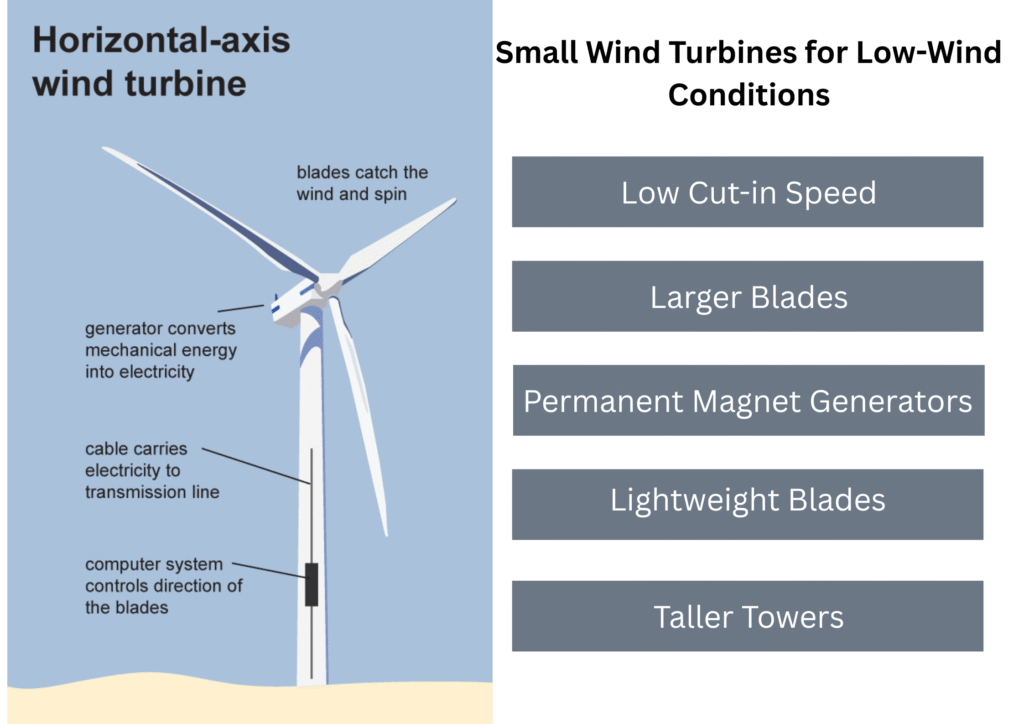
Some important design features for low-wind turbines are described below.
- Larger Rotor Diameter:
Wind turbine blades with a larger rotor diameter can sweep a wider area. A larger swept area leads to more energy capture and more power production.
- Light-Weight Blade Materials:
For low-wind regions, the wind turbine blades are designed with lightweight materials so that they start rotating even at lower wind speeds. For this, the manufacturers use lightweight fiberglass composites or carbon fiber. The wind turbine with lightweight blades can produce electricity even when the wind speed is low.
- Taller Towers:
Wind speed increases with height. So, wind turbines are installed at taller towers to capture stronger and more consistent wind.
- Optimized Blade Profile:
The aerodynamic shape of turbine blades is crucial as it allows the blades to rotate smoothly under low wind pressure. Modern turbine blades are designed with tapered blade tips and curved leading edges to improve wind energy capture.
Again, some advanced control and monitoring systems are installed to improve the turbine’s performance in low wind regions.
- Pitch Controller: To adjust the blade pitch angle to capture maximum energy at varying wind speeds.
- Variable-Speed Generator: To adjust the rotation speed of the generator to improve efficiency and reduce mechanical stress.
- Advanced Sensors: To track wind speed, turbine output, vibrations, and faults present in the system.
How are small turbines adapted for low-wind conditions?
- Low Cut-in Speed: The small turbines are designed with a low cut-in speed (Minimum speed required to generate electricity) of 2 to 3 m/s. This adaptation allows the small turbines to work efficiently in low wind conditions.
- Larger Blades: The blades of small turbines are often longer to sweep a larger area, and wider to increase lift. These adaptations allow the turbine to spin even when the wind pressure is weak.
- Permanent Magnet Generators: The small turbines with PMGs can produce power at low rotational speeds. These are ideal for regions with low wind speeds. These generators help reduce energy loss and improve performance during variable wind conditions.
- Lightweight Blades: The blades of small wind turbines are designed with lightweight materials such as composite fiberglass, reinforced plastics, and carbon fibers. These lightweight materials allow the turbine to rotate smoothly in low-wind conditions.
- Taller Towers: As the wind speed increases with height, the small turbines are installed in taller towers to enhance performance even at low wind speeds.
Reference: Small wind turbine effectiveness in the urban environment
Hybrid Systems for Low-Wind Conditions
Hybrid systems are designed by integrating two or more renewable energy sources, such as wind, solar, and sometimes energy storage systems, to balance power generation. In these systems, when wind speed drops, the solar panels continue producing energy during daylight hours. At night, the small wind turbines or stored battery power can take over.
Hybrid systems work well in low-wind regions. In low-wind areas, small wind turbine systems are not sufficient to generate the power required for homes or small businesses. In this situation, a combination of solar and wind energy systems or hybrid systems ensures continuous energy availability.
The important components required to design a hybrid system are a small wind turbine, solar panels, battery storage, an inverter, a charge controller, and an energy management system.
A hybrid system reduces dependence on a single energy source, offers higher energy efficiency, scalability, and lowers energy cost.
Importance of Site Assessment Before Installation
- A wind turbine system needs a steady wind flow to operate efficiently. So, a proper site selection is necessary to capture the maximum available energy.
- Obstacles like tall buildings and big trees can reduce energy production by 20–30%. Site assessment helps in the early detection of such obstacles and improves the system’s efficiency.
- Site assessment ensures structural safety and long-term durability.
- A proper site assessment helps in understanding local weather conditions and energy needs. This helps installers select the right equipment capacity.
Can Wind Turbines Operate Efficiently in Low-Wind Regions?
Wind turbines can efficiently operate in low-wind regions provided they are specifically engineered and properly sited. Modern wind turbines are designed with longer blades, larger rotor diameters, lightweight blade materials, highly efficient permanent magnet generators, and advanced control and monitoring systems. These wind turbines can generate power in low-wind regions, too. However, hybrid systems are considered a smart, sustainable solution for areas with low wind speeds.
What to Expect from Turbines in Low-Wind Areas?
- In low-wind areas, the modern low-wind turbines designed with advanced techniques will generate less energy as compared to high-wind areas.
- As the energy production in low-wind areas is less, it leads to a longer payback period. It takes more years for the system to recover its installation cost.
- Efficiency of the wind turbines in low-wind areas depends on the system’s design.
- For consistent power generation in low wind areas, you may need to install hybrid systems that combine both solar and wind systems.
Conclusion
The wind turbine systems can efficiently generate power in low-wind regions only if the installation site is properly assessed and the turbines are specifically engineered with advanced techniques. Technological improvements are continuously enhancing the performance of wind turbines in low-wind areas. Modern turbine designs are focusing on larger rotors, taller towers, lightweight blades, and intelligent control and monitoring systems to capture maximum energy from the available wind in that area. In the future, the low-wind turbines are expected to play a significant role in sustainable wind energy development worldwide.
FAQS
- What is the rated speed of a wind turbine?
At rated speed, the wind turbine generates maximum power and maintains a constant output even if the wind speed continues to increase.
2. Can wind turbines operate efficiently in low-wind regions?
Wind turbines can efficiently operate in low-wind regions provided they are specifically engineered and properly sit
Also Read:
- Why Taller Wind Turbines Produce More Power? The Real Reason Behind It
- A Step-by-Step Guide to Design a Small Wind Turbine System
- Can a Small Wind Turbine System Power Your Entire House? A Practical Guide
- The Evolution of Wind Power: How Wind Power Is Shaping the Future of Renewable Energy Grids?
- How Wind Direction and Speed Affect Wind Turbine Performance? A Complete Guide
- A Complete Guide to How a Wind Turbine Turns Air into Electricity: From Blades to Grid
- Importance of AI-Driven Predictive Maintenance in Wind Energy Systems
- Are DIY Solar Panel Kits Worth It? A Complete Guide
- Portable Solar Panel Kits: Best Uses for RVs and Camping
- Breaking Down Each Component of a 5kW Solar Panel Kit
- What Size Solar Panel Kit Do You Need? Find the Right Solar Kit for Your Home
- Perovskite Solar Panels: The Future of Home Solar
- High-Wattage 450W Solar Panels: Are They Worth It for Your Home Roof Space?
- The Rise of 600W+ High-Power Panels in Commercial Solar Farms
- HJT Solar Panels: A Right Solar Investment for Large Businesses
- N-Type TOPCon Solar Panel: A Complete Guide
- TOPCon Vs HJT Vs Tandem Solar Panels: Make The Best Purchase for Your Project
- Case Study: How Bifacial Solar Panels Improved Output in the Nevada Desert?
Pingback: A Technical Look at Offshore Wind Farms - science2energy
Pingback: How Smart Wind Turbine Blades Are Redefining the Future of Wind Energy? - science2energy
Pingback: Bikaner 1.4 GW Solar Project by Tata Power in Rajasthan - science2energy
Pingback: For the First Time, Renewables Beat Coal - science2energy