
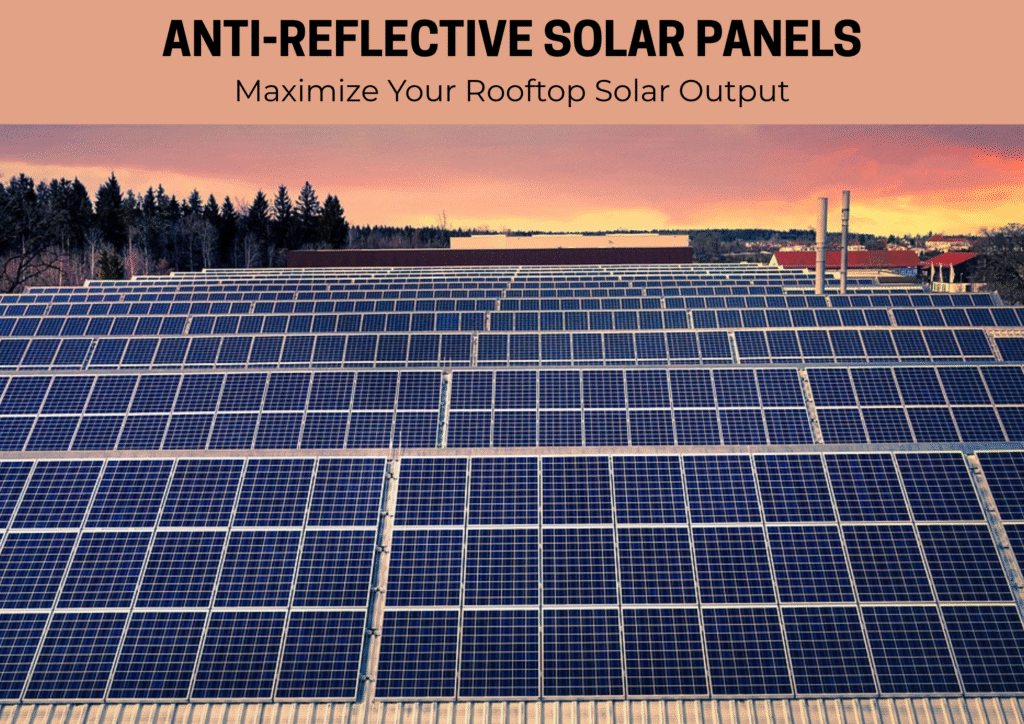
When sunlight hits the traditional solar panels, a small amount of light reflects off the glass, known as reflection loss, which causes a significant drop in efficiency. To minimize the light reflection and to maximize light absorption, standard solar panels are designed, which are called anti-reflective solar panels. The anti-reflective layer forms a thin, transparent film over the panel’s surface. These types of solar panels offer higher efficiency, energy savings, and better performance in real-world conditions. So, these solar panels are becoming the standard for new installations. Let’s explore anti-reflective solar panels in detail and how they can maximize your rooftop solar output.
What Are Anti-Reflective Solar Panels?
The solar panels that utilize a special coating or are designed with a specific surface structure can minimize light reflection or maximize light absorption, and are known as anti-reflective solar panels. This anti-reflective layer is applied to the solar panel surface during the manufacturing process.
The manufacturer uses a thin-film interface or a Nano-textured surface as an anti-reflective coating. The coatings are made of materials with different refractive indices. When the light hits the upper layer of the panel, the anti-reflective coatings help capture maximum incoming light falling on the surface and prevent it from escaping back into the air.
How does Light Reflection reduce solar Efficiency?
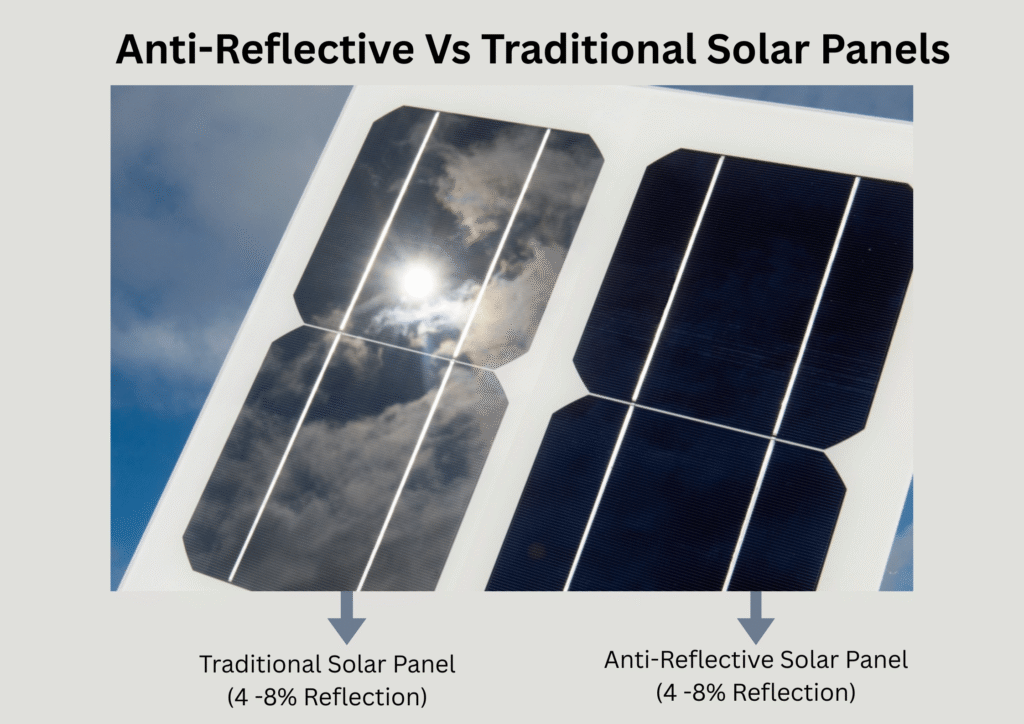
The solar panels have glass surfaces that cover the photovoltaic cells (PV). When the sunlight hits the solar panel surface, a small portion of the sunlight bounces away instead of being absorbed or passing through it. The sunlight absorbed by the PV cells is converted into electricity, whereas the reflected light cannot reach the solar cells underneath the surface. Thus, reflection losses can range from 4% to 10% and over the years, this small portion of loss can lead to significant energy loss.
The reflection loss occurs due to the following reasons.
- If the panel surface is made of smooth glass, it reflects more light than the textured or coated surface.
- In the early morning or late afternoon, the sunlight strikes the panel’s surface at a steep angle, which increases light reflection.
- On cloudy days, the diffused light reflects more than the direct sunlight.
- If the panel’s surface is covered with dust or dirt, it scatters sunlight and increases reflectivity.
How Do Anti-Reflective Solar Panels Work?
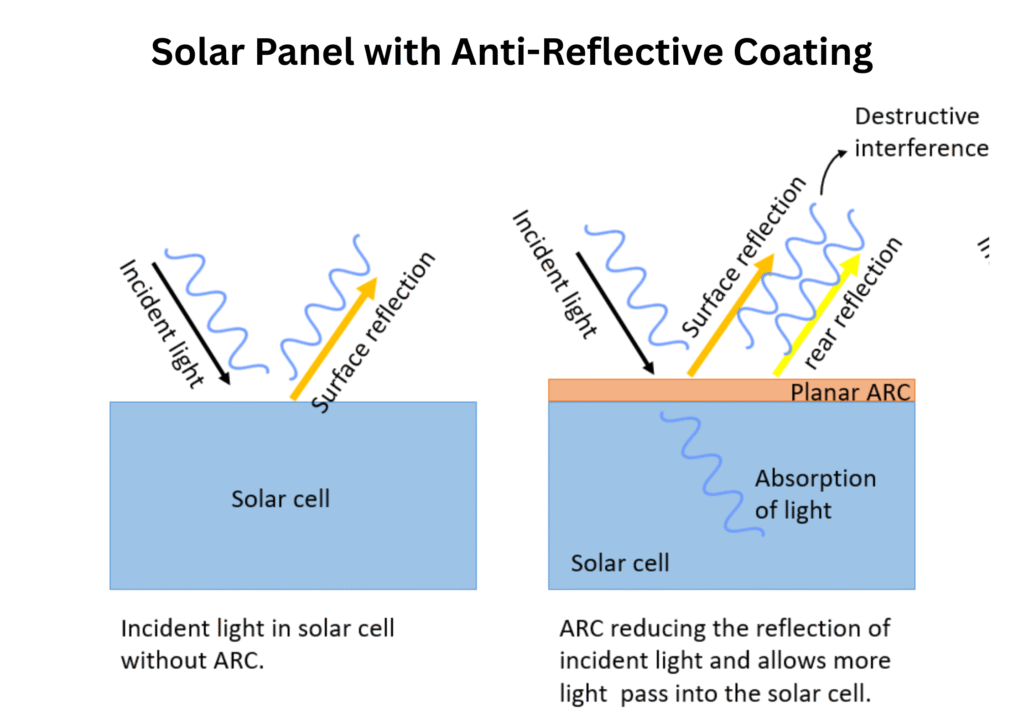
The core concept behind anti-reflective coatings is the phenomenon of light interference. These anti-reflective layers are made of materials with a particular refractive index so that when the sunlight hits the surface, a minimum of it reflects off and the maximum amount of it passes through deeper into the panel.
The anti-reflective coatings are designed in such a way that the lights reflected from the top and bottom of the coating cancel each other out. This technology is called destructive interference. It causes less light to be reflected into the air and more light to be trapped by the PV cell for energy conversion.
The commonly used materials in making anti-reflective coatings are
- Silicon Nitride (Si₃N₄)
- Titanium Dioxide (TiO₂)
- Magnesium Fluoride (MgF₂)
Reference: Anti-reflective coatings: A critical, in-depth review
Advantages of Anti-Reflective Solar Panels
Reduced Light Reflection and Increased Light Absorption:
The traditional solar panel loses 4% to 10% of incoming sunlight due to reflection. Whereas the anti-reflective solar panels reduce sunlight reflection and increase sunlight absorption by allowing more sunlight to pass through the glass. This results in more electricity production from the same amount of sunlight.
High Energy Efficiency:
The increased light absorption by the anti-reflective solar panel improves energy production. Even a 2% to 4% increase in efficiency can make a big difference in the total lifespan of a solar panel. This is also a big advantage for residential roofs with limited space.
Performs Better in Low Light:
The anti-reflective solar panels can also capture diffused light, which ensures a steady energy output throughout the day. They also perform efficiently in low-light conditions, such as in cloudy weather, early mornings, late afternoons, and in winter months.
Enhanced Return on Investment (ROI):
The increase in power production by anti-reflective solar panels leads to faster payback periods and better long-term returns. So, those who are considering solar energy, these types of solar panels are a smart financial choice.
Enhances Aesthetics:
The anti-reflective solar panel features a uniform and non-glossy appearance. It makes the system look cleaner and more integrated with rooftops or building surfaces.
Needs No Extra Maintenance:
Anti-reflective solar panels are durable and weather-resistant. So, they don’t need any special maintenance. Normal routine maintenance is enough to keep them clean and efficient.
Compatible with Advanced Technology:
The anti-reflective solar panels can also be integrated with advanced solar projects, including bifacial solar panels, Passivated Emitter Rear Contact technology (PERC) cells, and solar tracking systems.
Anti-Reflective Solar Panels Vs Traditional Solar Panels
| Traditional Solar Panels | Anti-Reflective Solar Panels | |
| Light absorption capacity | The PV cells of a traditional solar panel are covered with a layer of tempered glass. It reflects off some of the sunlight and results in a loss of 4% to 10% of incoming light. | The special coating or textured surface of anti-reflective solar panels reduces reflection and improves light capture. It improves energy absorption. |
| Energy Efficiency | The traditional solar panels’ efficiency decreases in low-light or shaded conditions, especially in early mornings and late afternoon hours. | It provides better performance throughout the day. |
| Energy Output | These panels lose some sunlight due to reflection, which also reduces the overall energy output. | These solar panels generate more energy (kilowatt-hours) per day from the same area. |
| Appearance | These solar panels offer a shiny, reflective surface, which may cause glare. | These panels offer a more matte or uniform finish, reducing unwanted glare. |
| Cost | Lower upfront cost | These solar panels are more expensive due to anti-reflective coating technology. |
| Maintenance | Traditional solar panels require standard cleaning to remove dust and dirt. | These panels are durable and weather-resistant. They require routine cleaning and offer a consistent performance. |
| Performance in Limited Space | Traditional solar panels are not an ideal option for areas with limited rooftop space. | It offers higher efficiency per square foot and is an ideal option for roofs with limited space. |
Are Anti-Reflective Panels Worth It for Your Home?
The anti-reflective solar panels are a great choice for your home, if
- Your home’s roof space is limited, and you need more energy output per panel.
- You live in a cloudy area with low sunlight conditions
- You are planning for a long-term investment in a solar project, and you want better ROI
- You want to produce more power to reduce electricity bills.
In these cases, the anti-reflective solar panels offer a smart upgrade as compared to traditional solar panels. These types of solar panels are an ideal choice for a rooftop with limited space and partially shaded areas. They also help in lowering your electricity bills by generating more kilowatt-hours (kWh) produced every month.
Are Anti-Reflective Panels Currently Available in the Market?
The anti-reflective solar panels are available in the market for residential installations, commercial buildings, and utility-scale solar farms. Many leading solar manufacturers are providing these types of solar panels as highly efficient and standard models.
Reference: Global Anti-Reflective Solar Panels Coating Market Research Report, 2029
Conclusion
Anti-reflective solar panels are a simple but powerful advancement in solar technology. It is a smart solution to one of the oldest problems in solar technology, i.e., sunlight reflection. If you are living in areas with variable weather or limited installation space, the installation of anti-reflective solar panels is an ideal and smart option. Whether you are a homeowner seeking to reduce electricity bills, a solar farm owner, or a renewable energy developer looking to increase yields, anti-reflective panels are a crucial step towards enhanced solar efficiency, energy savings, and long-term returns.
FAQS
- What Are Anti-Reflective Solar Panels?
The solar panels that utilize a special coating or are designed with a specific surface structure can minimize light reflection or maximize light absorption, and are known as anti-reflective solar panels. The manufacturer uses a thin-film interface or a Nano-textured surface as an anti-reflective coating.
2. Are Anti-Reflective Panels Worth It for Your Home?
Yes, the anti-reflective solar panels are a smart upgrade for your home. These types of solar panels are an ideal choice for a rooftop with limited space and partially shaded areas.
3. Are Anti-Reflective Panels Currently Available in the Market?
Yes, the anti-reflective solar panels are available in the market for residential installations, commercial buildings, and utility-scale solar farms.
Also Read:
- Graphene-Coated Solar Panels: The Next Big Thing in Residential Solar Panels
- Utilization of AI in Optimal Site Selection of Renewable Energy Projects: A Complete Guide
- A Practical Guide to Transparent Solar Panels: How Home Windows Can Produce Electricity?
- Smart Meters for Solar: The New Real-Time Energy Monitoring System in Rooftop Solar Systems
- Intelligent Solar Tracker: The Secret to More Solar Energy
- How to Optimize Energy Storage with AI Algorithms in Renewable Energy Systems?
- How to Enhance Solar Panel Efficiency with AI-Based Analytics?
- How Smart Inverters Help Balance Solar Power and Grid Supply? A Complete Guide
- Case Study: How Google Uses AI to Accelerate Grid Connections in the U.S.
- Case Study: How Duke Energy Uses AI for Grid Stability?
- How AI Strengthens Cybersecurity in Smart Grids? A Complete Guide
- How AI Is Used to Design the Perfect Rooftop Solar System? A Complete Guide
- How Is AI Used to Develop Advanced Materials for Renewable Energy Technologies?
- How AI is Revolutionizing Predictive Maintenance in Smart Grids? A Complete Guide
- How AI Is Powering Smart Grids for Efficient Energy Distribution?
- A practical case study: How AI Enhances Microgrid Performance in Rural Areas?
- Hidden Microcracks in Solar Panel? How does AI Detect Early?

Pingback: Dual Glass Solar Panel: A Simple and Long-Lasting Investment for Homeowners - science2energy
Pingback: Self-Cleaning Solar Panels: No More Manual Cleaning from Now On - science2energy
Pingback: Tandem Solar Panels: The Future of Rooftop Solar - science2energy
Pingback: High-Wattage 450W Solar Panels: Are They Worth It for Your Home Roof Space? - science2energy
Pingback: Perovskite Solar Panels: The Future of Home Solar - science2energy