
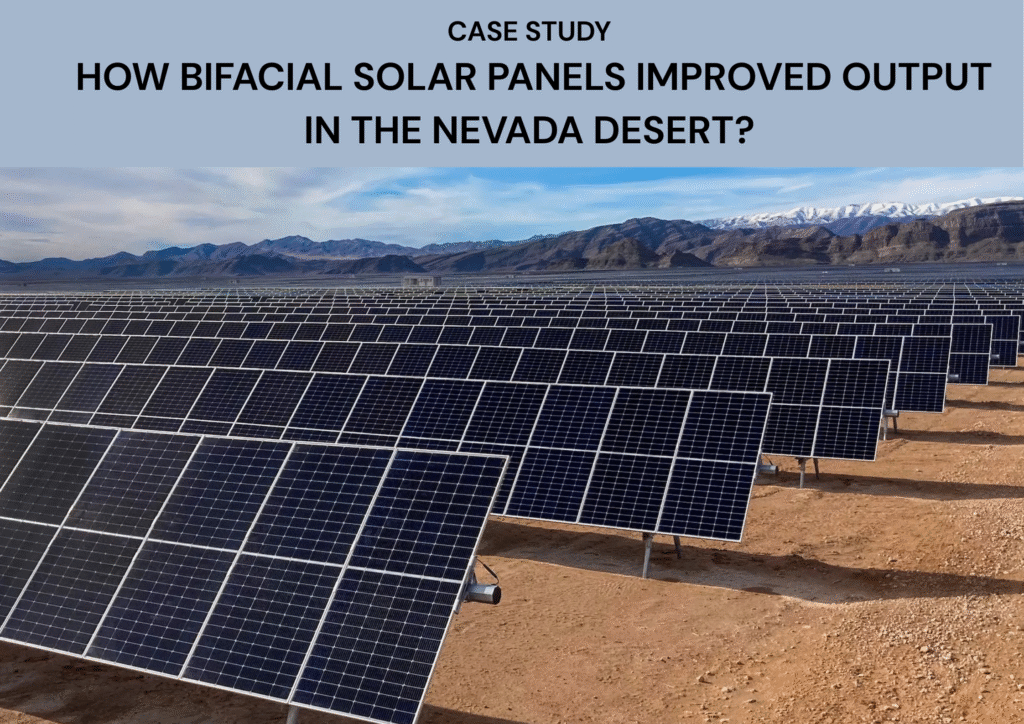
The installation of solar systems in desert regions has always shown strong potential. Among them, the Nevada desert is one of the most prominent locations that has been used as a testing ground for new solar technologies. The installation of bifacial solar panels in the Nevada desert has recently grabbed much attention. Bifacial solar panels can capture sunlight from both their front and back surfaces, thereby enhancing overall energy production. In this article, we will discuss the Nevada bifacial solar panel project, including its energy goals, design and layout, performance analysis, and various environmental and economic benefits.
The Nevada Project Overview
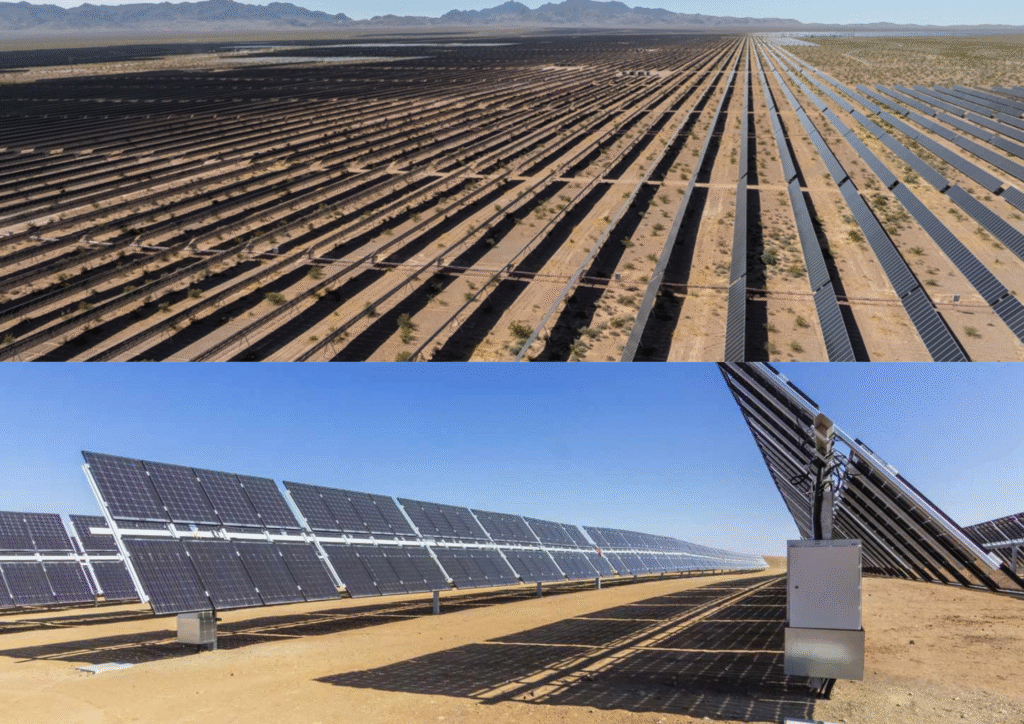
The Nevada Desert is located outside Las Vegas. It is known for its dry climate, clear skies, and high solar irradiance. The area is covered with light-colored sand and gravel. It has high surface reflectivity due to sandy terrain, which is also known as the Albedo effect.
It is an ideal place to install solar panels due to its average solar irradiance of over 6.5 kWh/m²/day, which is very high for generating solar power. Due to their high solar reflectivity, bifacial solar panels are tested for enhanced solar performance.
In this project, bifacial monocrystalline silicon solar panels are installed to generate electricity. The rating of each solar module is 440W. To adjust the tilt according to the direction, a single-axis solar tracker is installed. After 12 months of operation, the total energy yield from the bifacial solar panel is approximately 1900–2000 kWh/kWp/year.
Energy Goal of Nevada Bifacial Solar Panels Project
The Nevada Desert is an ideal place for solar investment. The traditional solar panels have already reached near maximum efficiency. But because of high surface reflectivity, engineers looked for a solar system that can work efficiently in a high-reflection environment and also enhance power production without using more land.
The key energy goals of the Nevada bifacial solar panel project are
- To increase the solar power production without using more land. The bifacial solar panels can generate more energy from both sides of the panel. It can also generate power from the sunlight reflected from the desert surface. This can increase the energy output by 8% to 10%.
- The next goal is to reduce the cost per kilowatt-hour. Though bifacial solar panels are costlier than traditional solar panels, they can reduce the cost of energy per unit over time.
- To achieve Nevada’s ambitious goal to reach 100% clean energy by 2050 and 50% renewable energy by 2030.
- To maintain consistent energy production in the desert’s high temperatures.
Why Are Bifacial Solar Panels Chosen for The Nevada Project?
- The Nevada desert gets strong direct sunlight throughout the day and over 300 sunny days per year. To completely use this high solar irradiance, engineers chose a bifacial solar panel that can produce electricity from both sides of the panel.
- The desert terrain in Nevada is made up of light-colored sand and gravel, which reflects sunlight naturally. This is known as the “Albedo effect”. It can enhance the power production of bifacial solar panels by 8 to 15%.
- The Nevada desert is an open area with no shading from trees or buildings. This allows maximum sunlight exposure to both sides of the bifacial solar panel.
Design and Layout
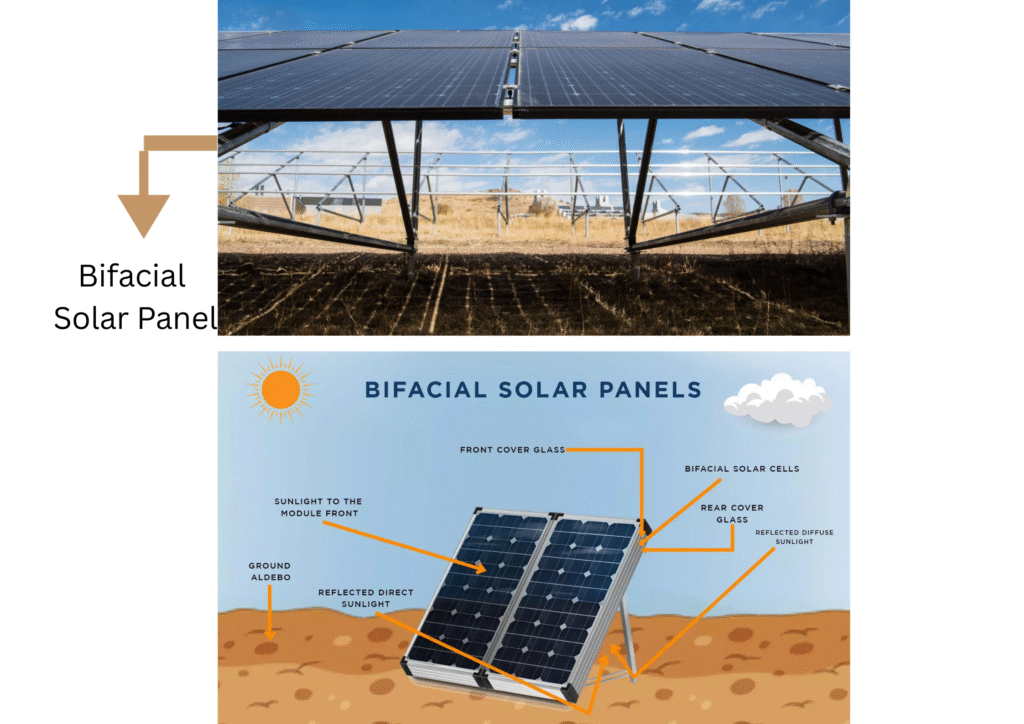
Bifacial Panel Design Structure:
The bifacial solar panel is made up of monocrystalline silicon with a power output of 435–450 watts per module. The dual glass structure of the bifacial solar panel is designed with a backside transparency of 70-80% light transmittance.
Mounting Structure:
- To maximize direct sunlight exposure, the project uses horizontal single-axis trackers (HSAT), which rotate from east to west throughout the day.
- The height of the solar tracker is 1.2 to 1.5 meters above ground, and the tilt range is ±60 degrees throughout the day.
- The ground’s high surface reflectivity allows sunlight to bounce off the desert surface and hit the back of the panels.
- The row-to-row spacing is optimized to avoid shadows on rear surfaces. The ground coverage ratio (GCR) is set between 0.35 and 0.45 to balance land use and energy gain.
Electrical Layout
- Each string of the layoutincludes 26–28 solar modules. All the strings are connected to string inverters.
- Inverters are placed close to the panel arrays and mounted on elevated platforms to handle high ground temperatures.
- The cables used for wiring are UVtemperature-resistant.
Monitoring System:
Smart solar monitoring systems and IoT-based systems are attached to the solar systems to collect real-time data of both front and rear-side generation. The tracking controllers are integrated with weather stations.
Performance Analysis of Traditional and Bifacial Solar Panels in the Nevada Project (Installed Capacity: 100MW)
| Traditional Solar Panel | Bifacial Solar Panel | |
| Energy Output (Approximate Value) | 1750 kWh/kWp/Year | 1950 – 2000 kWh/kWp/Year |
| Energy Density (MWh/acre) | Lower | Higher |
| Cost per kWh | Higher | Lower |
Environmental and Economic Benefits
Environmental Benefits:
- This project has reduced carbon emissions by over 20,000 metric tons of CO₂per year.
- As the power-generating capacity of a bifacial solar panel is more than that of a traditional solar panel, it offers better land efficiency. Its energy density per acre is 10–14% higher than the traditional setups.
- The bifacial systems require no water for daily operation.
- Bifacial solar panels offer high durability and last longer due to their dual-glass build. Glass-glass construction is more recyclable than polymer backsheets.
Economic Benefits:
- The high energy output due to the rear-side energy capture adds revenue. They deliver 10–12% more electricity than traditional modules, which boosts long-term profitability.
- The overall cost of generating each unit of electricity is lower than traditional solar panels. This shortens the payback period by 8–12 months.
- This project has created hundreds of jobs in Nevada, including engineering, construction, and logistics.
Operational Challenges
- The dry air and frequent winds in the Nevada desert accumulate on the front and back surfaces of the panels, which reduces light absorption and energy generation of the solar panels. To avoid this problem, dry cleaning equipment and dust monitoring sensors are implemented in the system.
- The Nevada desert experiences high daytime temperatures, often above 100°F (38°C). The high heat can reduce panel efficiency.
- Strong desert winds can raise structural stability issues. It can stress the mounting structures and tracking systems.
- In Nevada, albedo levels can change with weather, dust buildup, or ground treatment changes.
Reference: Optimizing Bifacial PV Systems (Q3 FY2020 Project Report)
Conclusion
From the Nevada bifacial solar panel project, it has been proven that bifacial solar panels are not only a theoretical development, but also are capable of delivering real-world energy gains. With ideal site locations, smart layout, utilization of advanced technologies, and proper maintenance, these solar panels can significantly improve power production. The powerful performance of the Nevada project also proves that bifacial solar panels paired with optimized layout design have a strong future in large-scale renewable energy.
Also Read:
- Performance of Tandem Solar Cells in Real Pilot Solar Farms: A Case Study
- Flexible Solar Panels: The Ideal Solution for Small and Irregular Spaces
- Crystalline Vs Thin-Film Solar Panels: Which One Is The Best for Your Modern Smart Homes?
- Tandem Solar Panels: The Future of Rooftop Solar
- Self-Cleaning Solar Panels: No More Manual Cleaning from Now On
- Dual Glass Solar Panel: A Simple and Long-Lasting Investment for Homeowners
- Anti-Reflective Solar Panels: A Smart Way to Maximize Rooftop Efficiency
- Graphene-Coated Solar Panels: The Next Big Thing in Residential Solar Panels
- Utilization of AI in Optimal Site Selection of Renewable Energy Projects: A Complete Guide
- A Practical Guide to Transparent Solar Panels: How Home Windows Can Produce Electricity?
- Smart Meters for Solar: The New Real-Time Energy Monitoring System in Rooftop Solar Systems
- Intelligent Solar Tracker: The Secret to More Solar Energy
- How to Optimize Energy Storage with AI Algorithms in Renewable Energy Systems?
- How to Enhance Solar Panel Efficiency with AI-Based Analytics?
- How Smart Inverters Help Balance Solar Power and Grid Supply? A Complete Guide
- Case Study: How Google Uses AI to Accelerate Grid Connections in the U.S.
Pingback: TOPCon Vs HJT Vs Tandem Solar Panels: Making the Right Call for Your Solar Business Project - science2energy
Pingback: HJT Solar Panels: A Right Solar Investment for Large Businesses - science2energy
Pingback: Are DIY Solar Panel Kits Worth It? A Complete Guide - science2energy
Pingback: The Future of Renewable Energy Storage: Can Solid-State Batteries Deliver 24/7 Clean Energy? - science2energy
Pingback: Solid-State Batteries vs. Lithium-Ion: Which Battery is Truly Safer in Renewable Energy Storage? - science2energy