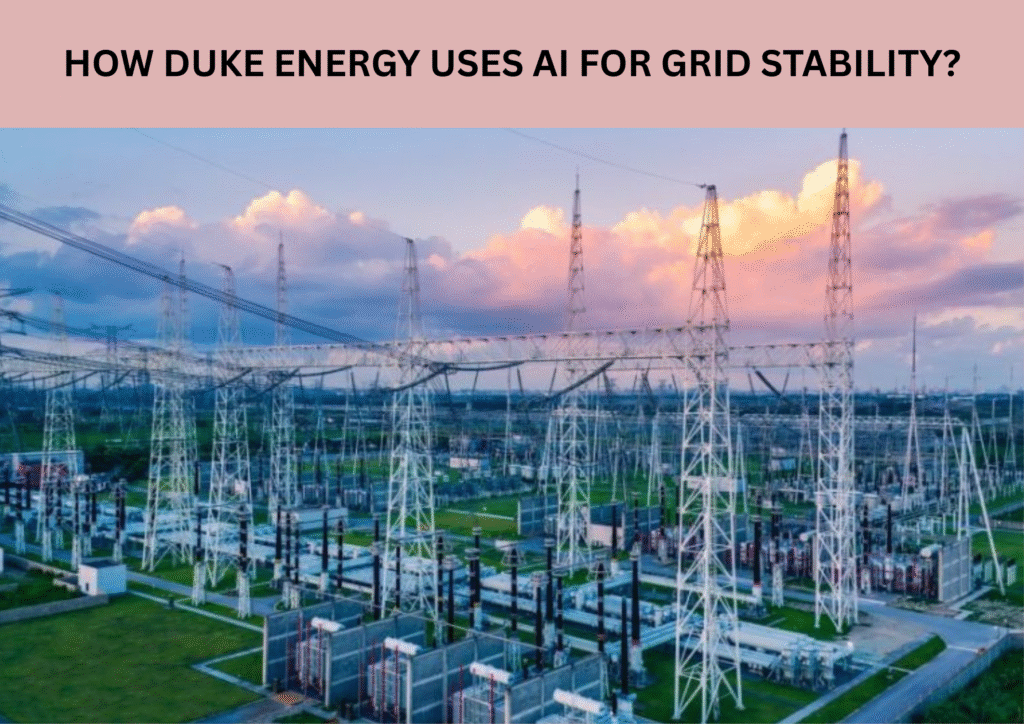
With more renewable energy, growing electricity demand, aging infrastructure, and extreme weather, America’s power grid has become more complex. In this situation, Duke Energy, one of the largest energy providers in the U.S., has introduced artificial intelligence (AI) to manage the modern power grid. It is actively investing in AI-driven technologies to ensure grid stability. This article explains how Duke Energy uses AI for grid stability and the advanced technologies used in it.
What is Grid Stability?
The ability of the power grid to maintain balance between electricity supply and demand is known as grid stability. A stable power grid ensures the power system operates smoothly, delivering electricity at a consistent frequency (60 Hz in the U.S.) and within a stable voltage range. Instability of the grid leads to blackouts, fluctuations, and serious equipment damage.
The grids maintain stability by striking a balance between supply and demand, utilizing spinning reserves such as backup generators, employing energy storage systems, and temporarily reducing large electricity usage.
There are three main types of grid stability.
1. Frequency Stability: Keeps the grid’s frequency at a constant level.
2. Voltage Stability: Maintains a stable voltage across all the regions.
3. Transient Stability: The ability of the power grid to bounce back after a lightning strike or, large demand surge.
Why Grid Stability Is a Challenge in the U.S. Energy Sector?
1. Integration of Renewable Energy Resources:
The renewable energy resources, like the sun, wind, etc., are clean and low-cost but unpredictable due to weather conditions. The traditional U.S. grids are designed for predictable energy sources like coal or gas plants. So, these power grids face difficulty in integrating renewables without losing stability.
2. Weather Conditions:
The changing weather conditions put sudden stress on the grid, which makes it difficult to maintain a stable system.
3. Old Infrastructure:
The older infrastructure, worn-out transformers, power lines, etc., are more likely to fail. Whereas upgrading infrastructure takes time. During Sudden demand spikes and disruptions, the old power grids face difficulty in maintaining stability.
4. Rising Distributed Energy Sources:
The rising distributed energy sources and electric vehicles produce unpredictable loads on the grid, which leads to instability.
5. Supply-Demand Imbalance:
When a power grid cannot maintain a balance between energy production and energy consumption, the grid becomes unstable in seconds. It occurs when the weather conditions change suddenly, or during high peak demand periods.
A Quick Overview of Duke Energy
“Duke Energy,” which is one of the largest energy companies in the United States, is playing a prominent role in America’s Energy Future. It is based in Charlotte, North Carolina. According to Duke Energy, with 55,100 Megawatts of power generation capacity, Duke Energy supplies electricity to over 8.6 million customers across six states, including North Carolina, South Carolina, Florida, Indiana, Ohio, and Kentucky. Along with this, it is also a natural gas utility provider to 1.7 million customers in the Carolinas.
The main goal of Duke Energy is to achieve net-zero carbon emissions by 2050. From grid modernization, decarbonization, to expanding sustainable energy sources like renewables, nuclear, natural gas, and energy storage, it is playing a great role in building a safe, reliable, and sustainable energy infrastructure.
Reference: DUKE Energy
How Duke Energy Uses AI for Grid Stability?
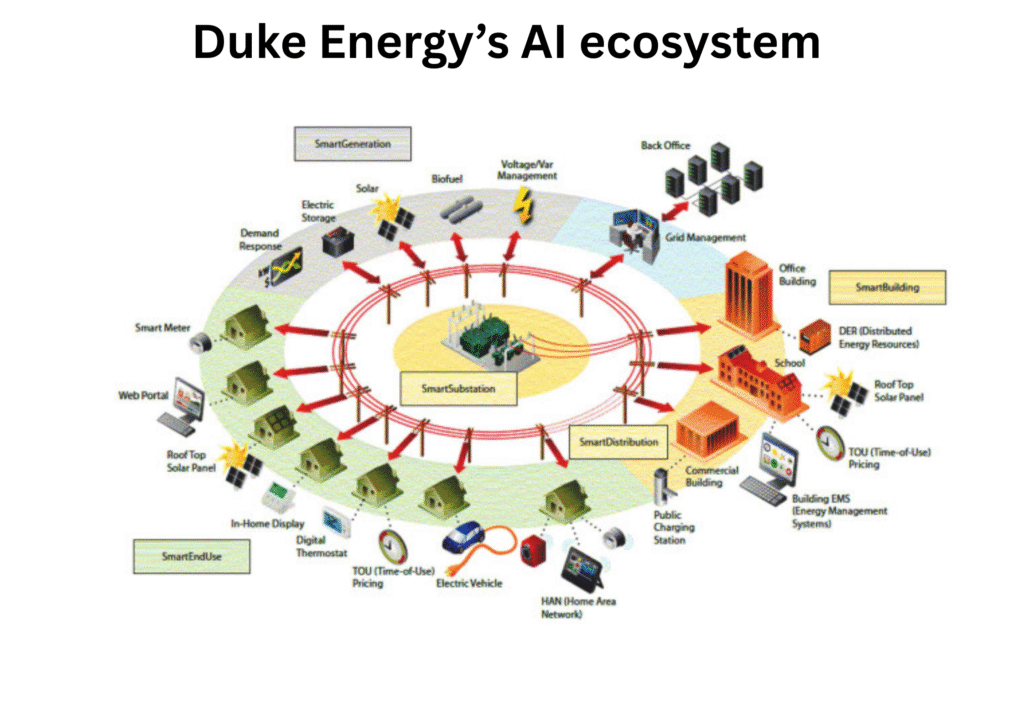
Duke Energy is investing in AI-driven technologies to ensure grid stability. Some key technologies used in achieving grid stability are
Advanced Technologies Used by Duke Energy to Achieve Grid Stability
1. Artificial Intelligence (AI) and Machine Learning:
The data collected from various parts of the grid needs to be analyzed. The AI and machine learning methods are utilized to analyze the large amount of data, to forecast electricity demand, to predict faults, and to help balance power supply from various sources, including both renewable and nonrenewable resources.
2. Phasor Measurement Units (PMU)
The devices known as synchro phasors can track the voltage and frequency 30 times per second. Thus, these machines provide a real-time analysis of the grid’s behavior. This helps in the early detection of grid instabilities and prevents cascading failures.
3. Digital twin technology
A digital twin is the virtual model of the entire grid. These models are used to simulate scenarios and to test responses to faults, which helps in the early detection of faults.
4. Distributed Energy Resource Management Systems (DERMS)
The DERMS is a software that coordinates and controls these distributed energy resources, such as solar panels, batteries, and wind turbines.
5. FLISR (Fault Location, Isolation, and Service Restoration)
FLISR is an automated system that detects faults, isolates the fault from the unaffected parts of the system, and restores power to unaffected parts of the grid within seconds. This technology makes the grid more resilient and reduces outage duration.
6. Advanced Storage Systems and Smart Inverters
Duke Energy uses advanced storage systems and smart inverters to store excess energy and to provide backup during peak demands.
Reference: How Duke Energy used generative AI for DER growth and grid reliability
A Step-by-Step Process: How Duke Energy Uses AI for Grid Stability?
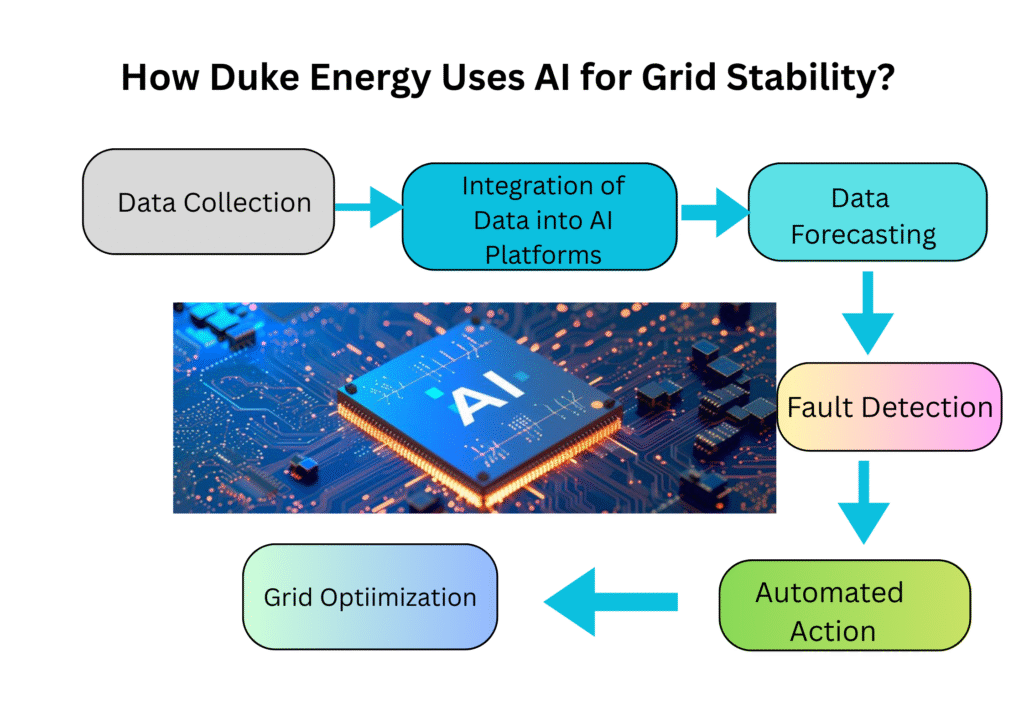
1. Data Collection
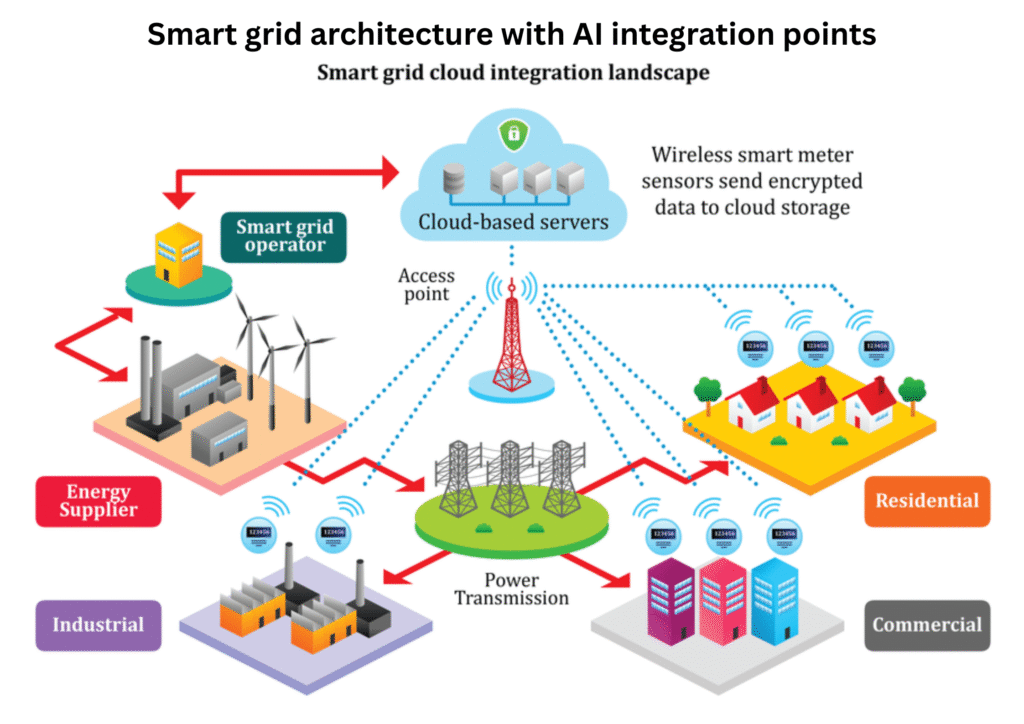
The AI-powered tools collect data from the sensors placed at various parts of the grid, smart meters, substations, solar farms, wind turbines, weather stations, etc. These data are based on power usage, generated power, grid conditions, fault conditions, etc.
2. Integration of Data into AI Platforms
The raw collected data are fed into an AI-powered energy management system, which consists of tools such as cloud-based analytics and predictive modeling engines. This process combines all the data and organizes it to provide a comprehensive view of what’s happening inside the grid.
3. Data Forecasting:
The machine learning algorithms are used to analyze the historical data and real-time data to forecast future energy demand, usage, and maintenance. By using weather conditions and energy usage patterns, it can predict energy demand. Based on the sunlight, wind speed, and temperature, it forecasts renewable energy generation.
4. Fault Detection:
The AI-powered tools continuously monitor the grid’s operating conditions to detect any unusual patterns in it. If the AI tools find any unusual patterns, like a sudden spike in voltage or temperature, they alert the operator about it.
5. Automated Actions
If the AI tools detect any types of faults, they automatically isolate the faulty parts, reroute the power to un unaffected area, and trigger maintenance.
6. Grid Optimization
The AI-powered tools help balance the energy supply and energy demand in real time. To optimize the grid condition, the AI tools can turn on/off the energy storage system, adjust power from renewable resources, and reduce load in non-critical areas.
Real-World Impact of Duke Energy on North Carolina
1. Duke Energy has installed solar panels with a total capacity of 5000 MW. For real-time monitoring, the AI-driven tools are installed to predict solar output hour by hour.
2. It has installed advanced software like a SCADA system to track emissions at power plants and CEMS (Continuous Emissions Monitoring Systems) for real-time pollution tracking.
3. Duke Energy operates Brunswick, McGuire, and Catawba nuclear stations, which provide around 50% of North Carolina’s carbon-free electricity.
4. The Carbon emissions have decreased by 44% from 2005 to 2023.
5. The Grid reliability has increased to 99.97% uptime for customers.
6. Over 1 million smart meters have been provided.
7. Duke Energy has invested over $1 billion in renewables in NC alone.
8. Duke Energy is supplying electricity to over 3.7 million customers in North Carolina.
9. Duke Energy owns around 21000 MW of generation capacity in the Carolinas.
10. It is investing over $75 billion in grid modernization.
Advantages of Using AI in Grid Stability
1. The AI systems can detect faults or disturbances instantly.
2. AI-powered tools can predict energy demand with high accuracy.
3. AI makes the renewable integration process smooth and efficient.
4. The AI tools analyze vibration, heat, and electrical signals from transformers, substations, and lines and schedule repairs before breakdowns occur.
5. The automatic grid control makes the grid more resilient and less dependent on manual operations.
Conclusion
As the U.S. energy sector moves toward decarbonization and decentralization, Duke Energy is playing a key role in it. Its investment in smart technologies, including artificial intelligence, smart sensors, digital twins, DERMS, etc., is setting a benchmark for modern utilities. With the real-time data collection and forecasting, to respond in seconds, Duke Energy is representing how technology can create a more stable and sustainable energy system. Its scientific and technical strategies are reshaping North Carolina’s energy future.
FAQS
- What is Digital Twin technology?
A digital twin is the virtual model of the entire grid. These models are used to simulate scenarios and to test responses to faults, which helps in the early detection of faults.
2. What is Distributed Energy Resource Management Systems (DERMS)?
The DERMS is a software that coordinates and controls these distributed energy resources, such as solar panels, batteries, and wind turbines.
3. What is FLISR?
FLISR is an automated system that detects faults, isolates the fault from the unaffected parts of the system, and restores power to unaffected parts of the grid within seconds. This technology makes the grid more resilient and reduces outage duration.
Also Read:
- How AI Strengthens Cybersecurity in Smart Grids? A Complete Guide
- How AI Is Used to Design the Perfect Rooftop Solar System? A Complete Guide
- How Is AI Used to Develop Advanced Materials for Renewable Energy Technologies?
- How AI is Revolutionizing Predictive Maintenance in Smart Grids? A Complete Guide
- How AI Is Powering Smart Grids for Efficient Energy Distribution?
- A practical case study: How AI Enhances Microgrid Performance in Rural Areas?
- Hidden Microcracks in Solar Panel? How does AI Detect Early?
- Floating Solar Panel: The New Way to Produce Clean Energy on Lakes and Reservoirs
- AI-Powered Forecasting: A Powerful Technique to Enhance Grid Stability
- Importance of an AI-Driven Energy Pricing Model in Pricing Optimization
- Building-Integrated Solar Panels: How They Turn Walls and Windows into Clean Energy Generators?
- AI-Driven Predictive Maintenance in Wind Energy Systems
- How AI Is Used in the Renewable Energy Sector?
- AI and Microgrids: Empowering Remote Communities with Smart Energy
- AI Applications in Renewable Energy Trading and Market Optimization
Pingback: Case Study: How Google Uses AI to Accelerate Grid Connections in the U.S. - science2energy
Pingback: How Smart Inverters Help Balance Solar Power and Grid Supply? A Complete Guide - science2energy
Pingback: How to Enhance Solar Panel Efficiency with AI-Based Analytics? - science2energy
Pingback: Self-Cleaning Solar Panels: No More Manual Cleaning from Now On - science2energy
Pingback: Crystalline Vs Thin-Film Solar Panels: Which One Is The Best for Your Modern Smart Homes? - science2energy
Pingback: Flexible Solar Panels: The Ideal Solution for Small and Irregular Spaces - science2energy
Pingback: Performance of Tandem Solar Cells in Real Pilot Solar Farms: A Case Study - science2energy