
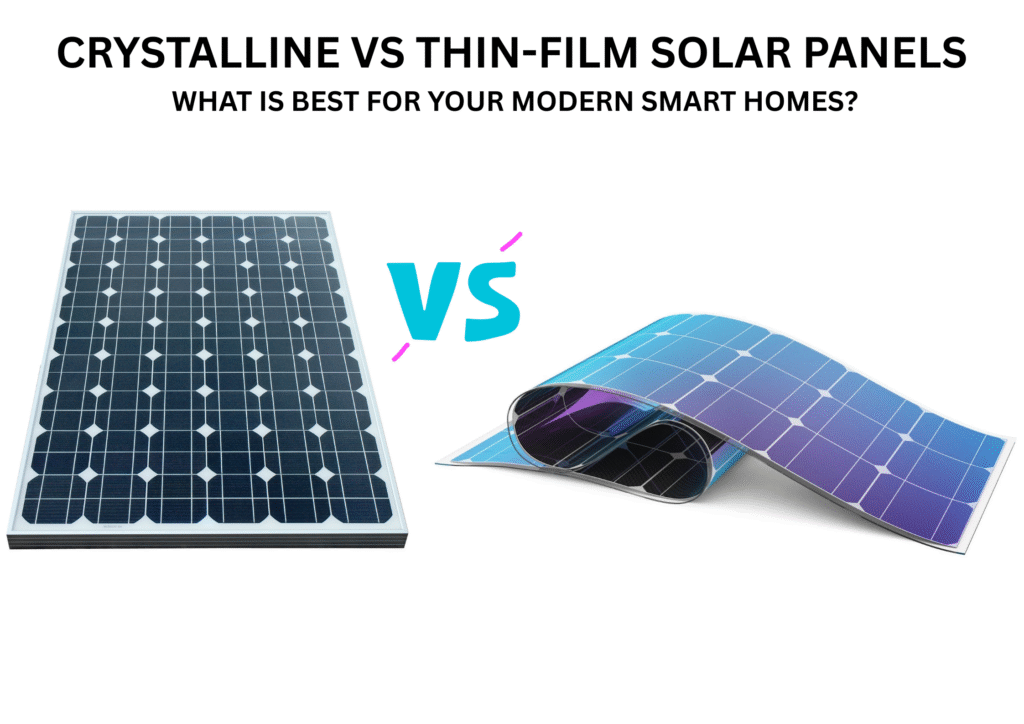
To build a reliable and efficient solar energy system, it is important to select the right solar panel. There are various types of solar panels available on the market. In today’s market, two widely used solar panels are crystalline and thin-film solar panels. But what is best for your modern smart home? For this, understanding the strengths, weaknesses, and differences is important. This article explains the basic understanding of crystalline and thin-film solar panels, their working principles, roof compatibility, affordability, and design and aesthetic integration with smart homes. Read the full article to get a clear idea about it.
Basic Understanding
What Are Crystalline Solar Panels?
Crystalline solar panels consist of silicon crystals arranged in a grid-like structure. The silicon used in these panels can be structured in two ways.
- Monocrystalline Panels:
Monocrystalline panels are made from a single pure silicon crystal. They are black and add a sleek black appearance to the panels. These are 18% to 22% efficient, and more efficient than other types of solar panels. They can produce the same amount of energy in a smaller space. These solar panels also offer a longer lifespan of more than 25 years.
- Polycrystalline Panels:
Polycrystalline panels, also known as multicrystalline panels, are made by melting fragments of silicon together. These are blue and offer a speckled look. These are less efficient than monocrystalline panels, offering a moderate efficiency of 15% to 17%.
What Are Thin-Film Solar Panels?
Thin-film solar panels are created by depositing one or more layers of photovoltaic material onto a base. They use a much thinner layer of semiconductor material instead of using thick silicon wafers. These are only a few micrometers thick. These solar panels are lightweight and flexible. They offer a sleek black finish that blends into the roof. The most common types of thin-film solar panels include
- Amorphous Silicon
- Cadmium Telluride (Widely used thin film types)
- Copper Indium Gallium Selenide
Working Principle
How Does a Crystalline Solar Panel Work?
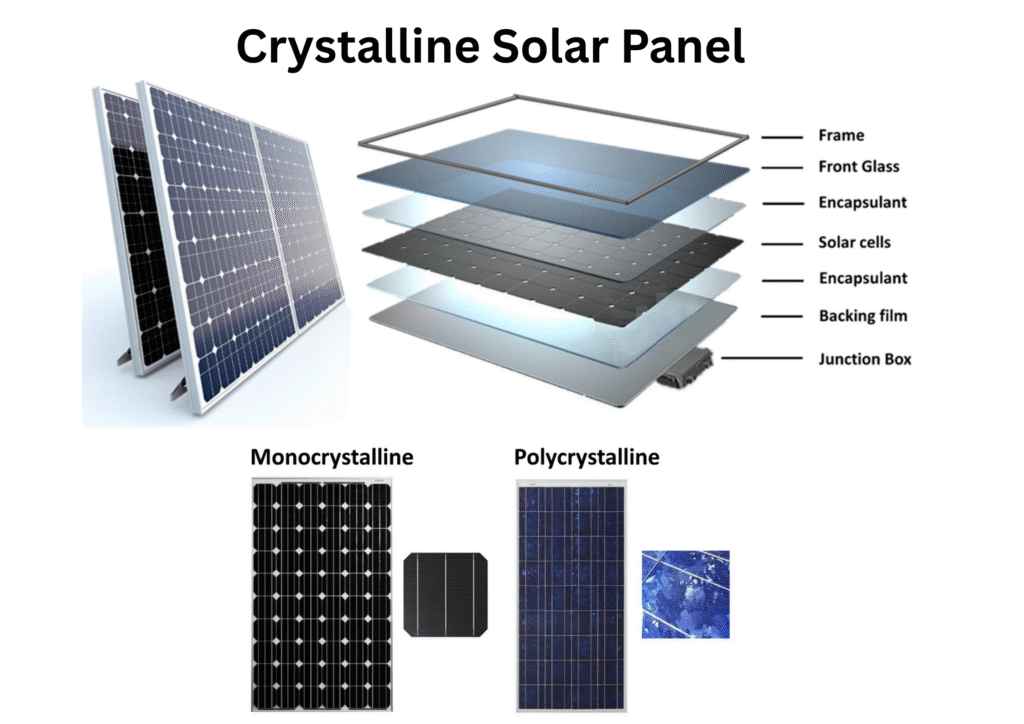
- When sunlight hits the solar panel’s surface and reaches the silicon cells beneath it, an electric field is created.
- The light particles in sunlight, known as photons, transfer energy to the silicon atoms. The electrons are knocked loose from their atoms.
- The freed electrons move in a particular direction in the electric field and generate direct current (DC) electricity.
- The current is collected by thin metal lines and moved out of the panel through wires.
- Multiple panels in an array transfer electricity to the inverter. The inverter converts DC to AC (Alternating Current). The AC is used to power appliances, lights, and electronics.
How Does a Thin-Film Solar Panel Work?
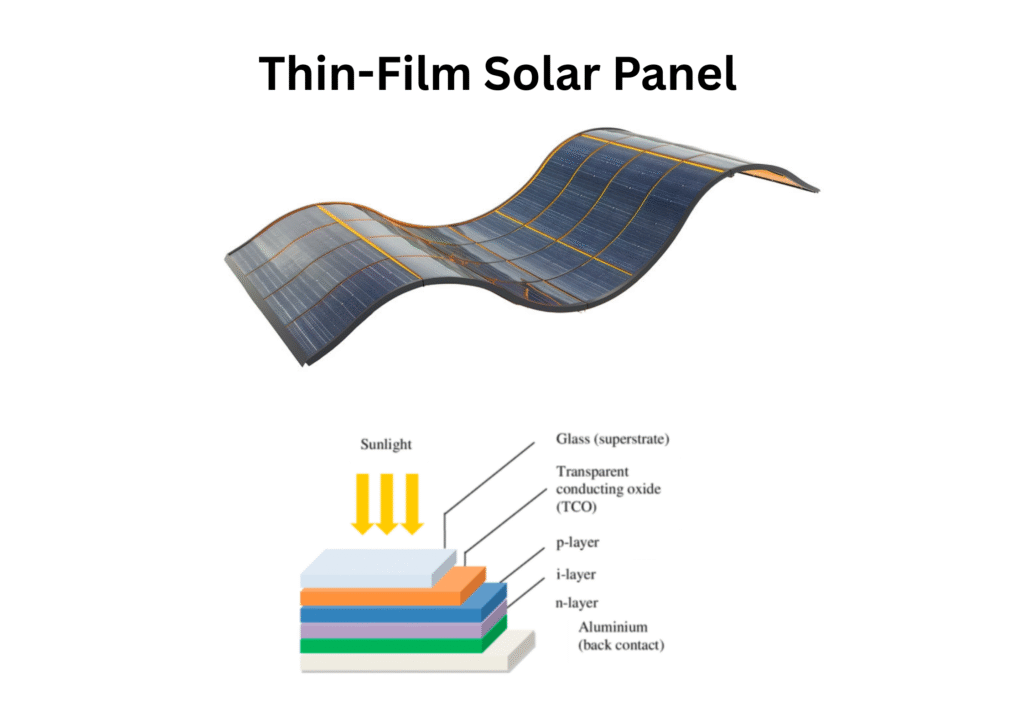
- When the sunlight hits the surface, it passes through the protective layer and reaches the solar cells beneath it.
- The thin light-absorbing layer absorbs the photons that provide the energy needed to excite electrons in the material.
- With the energy, the electrons are knocked loose from their atoms. The electric field forces these electrons to move in a single direction.
- The movement of electrons creates direct current (DC) electricity. The wires collect the DC electricity and send it out of the panel.
- The inverter converts DC to AC, which is then used by homes and appliances.
Which One Saves More on Energy Bills, Crystalline or Thin-Film Solar Panels?
Crystalline solar panels offer better long-term savings on energy bills than thin-film solar panels. The estimated lifetime savings of a crystalline solar panel are $25,000 – $40,000. Whereas, the estimated lifetime savings of a thin-film solar panel are around $15,000 – $25,000.
For example, a 5 KW system of crystalline panels in California could save around $1,200–$1,500 per year in electricity costs, depending on local rates.
Which One is Better for Design & Aesthetic Integration in Smart Homes, Crystalline or Thin-Film Solar Panels?
For aesthetics, minimalism, and modern design, thin-film solar panels are a better option. They offer flexibility, sleek appearance, high design customization, excellent roof profile matching, and advanced building-integrated options.
However, if efficiency is more important to you than appearance, go for monocrystalline panels. These are highly efficient, durable, and still look reasonably good.
Which One is Better for Roof Compatibility? Crystalline or Thin-Film Solar Panels?
Thin-film solar panels offer extensive roof compatibility due to their lightweight structure, flexible design, and easy installation on diverse roof types. They are ideal for modern, flat, or architecturally complex roofs.
However, for homeowners who have traditional sloped roofs and are looking to maximize power output per square foot, go for crystalline solar panels.
Which One is More Affordable Between Crystalline and Thin-Film Solar Panels?
Thin-film solar panels are more affordable than crystalline solar panels. They are cheaper to buy and install, but do not offer the best long-term value. Whereas crystalline solar panels require more upfront cost, their high efficiency, improved performance, and longer life span make them a smarter choice for residential and commercial users.
If you have a large installation area but have a lower upfront cost, then thin-film solar panels are a good option. But they may need replacement sooner. But if you want a long-term value, higher efficiency, and limited roof space, then go for crystalline solar panels. These solar panels come with a long-term warranty.
Which one is More future-oriented between Crystalline and Thin-Film Solar panels?
The global research is focusing more on integrated solar systems and flexible solar technologies. The thin-film solar panels are lightweight and offer integrated solutions. Advanced technologies such as perovskite-based thin films and roll-to-roll manufacturing could make these solar panels more affordable and adaptable in the future.
The lightweight structure, flexibility, and compatibility with advanced technologies make the thin-film solar panels more future-oriented than the crystalline solar panels. These solar panels are likely to take the lead in areas like smart buildings, transport, and mobile power solutions.
Crystalline Vs Thin-Film Solar Panels
| Crystalline Solar Panel | Thin-Film Solar Panel | |
| Materials Used | Crystalline solar panels are made from a single pure silicon crystal. | Thin-film solar panels are made by placing one or more layers of photovoltaic materials on a base such as glass or metal. |
| Weight | These are heavier than thin-film solar panels. | These are thinner and lighter than a crystalline solar panel. |
| Efficiency | These are highly efficient, and efficiency ranges between 15% to 22%. | These are less efficient and their efficiency ranges between 6% to 15%. |
| Space Requirement | These solar panels can generate more energy from a small space. | These solar panels require a large space to produce more energy. |
| Flexibility | These solar panels are rigid and have a fixed space. | Thin-film solar panels are flexible and lightweight. |
| Performance in Heat | These solar panels’ efficiency drops at high temperatures. They perform better in low light and shaded environments. | These solar panels perform better in the heat. |
| Life Span | Offers a longer lifespan of more than 25 years. | Their life span is between 10 and 20 years. |
| Cost | Higher upfront cost. | Lower upfront cost |
What Is Best for Your Modern Smart Homes?
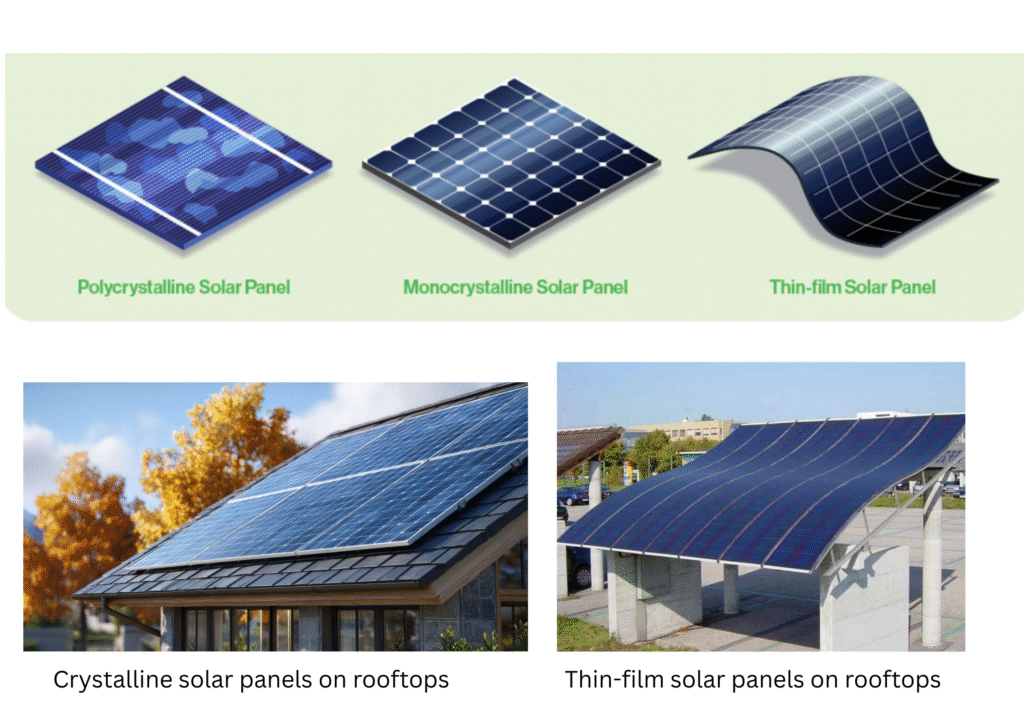
You Should Select Crystalline Solar Panels for Your Smart Home If
- If your roof space is limited and energy demand is high because of smart appliances, electric vehicles, and backup systems, crystalline solar panels are a good option for you. These are highly efficient, up to 15% to 22%, and offer higher energy output.
- If you have a smart home associated with a smart energy management system, go for the crystalline solar panels. These panels can be easily integrated into home batteries, smart thermostats, and energy management systems.
- If you are planning to stay in your homes for years and want a solar panel with long-term durability and high return on investment, then crystalline solar panels are a great option. They offer industry-standard warranties of 25 years or more.
- If your home is located in an area with consistent sunlight, then crystalline solar panels are a very good option for you. They offer excellent performance and superior conversion efficiency.
- If you want a clean, minimalist appearance and strong physical design, then go for the modern monocrystalline solar panels. They offer a solid black look that blends well with smart home architecture.
You Should Select Thin-Film Solar Panels for Your Smart Home If
- If your home has a flat, curved, or unusual roof design, thin-film solar panels can be installed with ease. These are lightweight, flexible, and can be easily integrated into building materials.
- If you live in an area with high temperatures and partial shading, thin-film solar panels are a great option. These panels handle high temperatures better.
- Thin-film solar panels offer a smooth, black, glass-like appearance. If you want a sleek and aesthetic appearance for your home with a minimalist or futuristic design, go for thin-film solar panels.
- If you are searching for a cheaper option to produce solar energy, then thin-film solar panels are a good option. They offer a lower upfront cost.
Reference: The Difference Between Crystalline and Thin Film Solar Panels Explained
Conclusion
Selecting the right solar panel is based on the available space, availability of sunlight, budget, and intended use. Crystalline solar panels are highly efficient, and they also offer excellent performance in limited space. They also offer long-term energy savings. Whereas, thin-film solar panels are flexible, lightweight, cheaper to buy and install, and hold more potential for future applications. So, select the right solar panel to enhance both energy production and energy savings.
Also Read:
- Tandem Solar Panels: The Future of Rooftop Solar
- Self-Cleaning Solar Panels: No More Manual Cleaning from Now On
- Dual Glass Solar Panel: A Simple and Long-Lasting Investment for Homeowners
- Anti-Reflective Solar Panels: A Smart Way to Maximize Rooftop Efficiency
- Graphene-Coated Solar Panels: The Next Big Thing in Residential Solar Panels
- Utilization of AI in Optimal Site Selection of Renewable Energy Projects: A Complete Guide
- A Practical Guide to Transparent Solar Panels: How Home Windows Can Produce Electricity?
- Smart Meters for Solar: The New Real-Time Energy Monitoring System in Rooftop Solar Systems
- Intelligent Solar Tracker: The Secret to More Solar Energy
- How to Optimize Energy Storage with AI Algorithms in Renewable Energy Systems?
- How to Enhance Solar Panel Efficiency with AI-Based Analytics?
- How Smart Inverters Help Balance Solar Power and Grid Supply? A Complete Guide
- Case Study: How Google Uses AI to Accelerate Grid Connections in the U.S.
- Case Study: How Duke Energy Uses AI for Grid Stability?
- How AI Strengthens Cybersecurity in Smart Grids? A Complete Guide
- How AI Is Used to Design the Perfect Rooftop Solar System? A Complete Guide
Pingback: Flexible Solar Panels: The Ideal Solution for Small and Irregular Spaces - science2energy
Pingback: Performance of Tandem Solar Cells in Real Pilot Solar Farms: A Case Study - science2energy
Pingback: TOPCon Vs HJT Vs Tandem Solar Panels: Make The Best Purchase for Your Project - science2energy
Pingback: Breaking Down Each Component of a 5kW Solar Panel Kit - science2energy
Pingback: Solid-State Batteries vs. Lithium-Ion: Which Battery is Truly Safer in Renewable Energy Storage? - science2energy
Pingback: A Complete Guide to How a Wind Turbine Turns Air into Electricity: From Blades to Grid - science2energy