
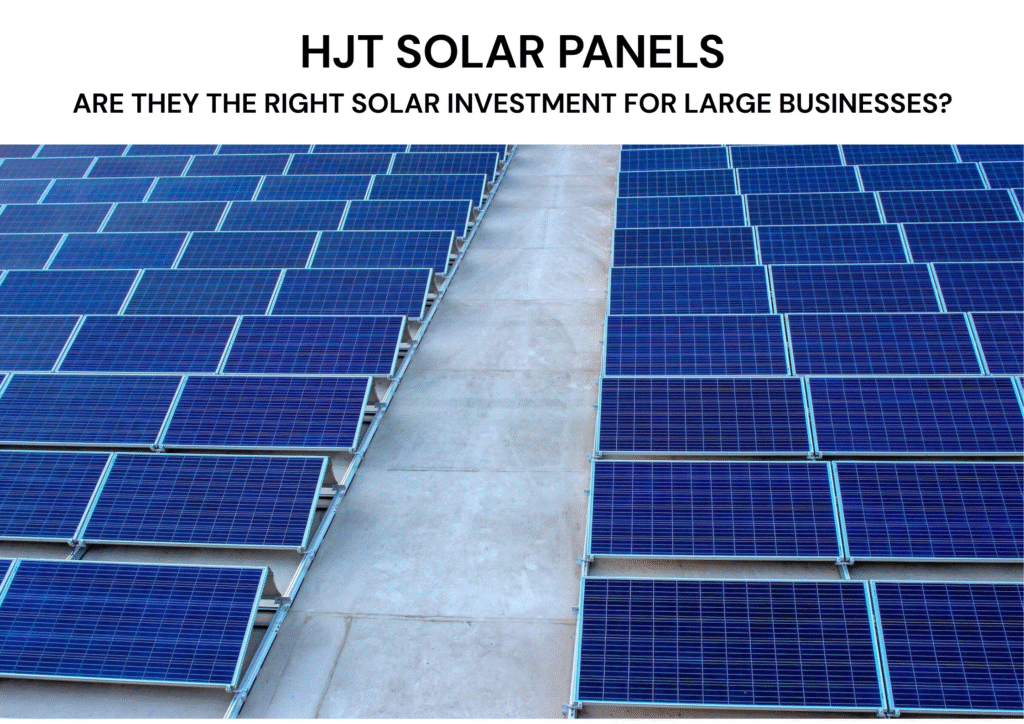
HJT or Heterojunction solar technology represents a step forward in the solar industry. Due to their high performance and reliability, they are capturing the attention of large companies seeking smarter, more efficient solar solutions. The HJT technology is helping them reduce the power cost and meet sustainability goals. The unique features of HJT solar panels are also helping commercial and industrial users to extract maximum benefits from existing tax credits and many solar incentive programs. This article explains HJT solar panels, their working principle, and why they are the right solar investment for large businesses.
What Are HJT Solar Panels?
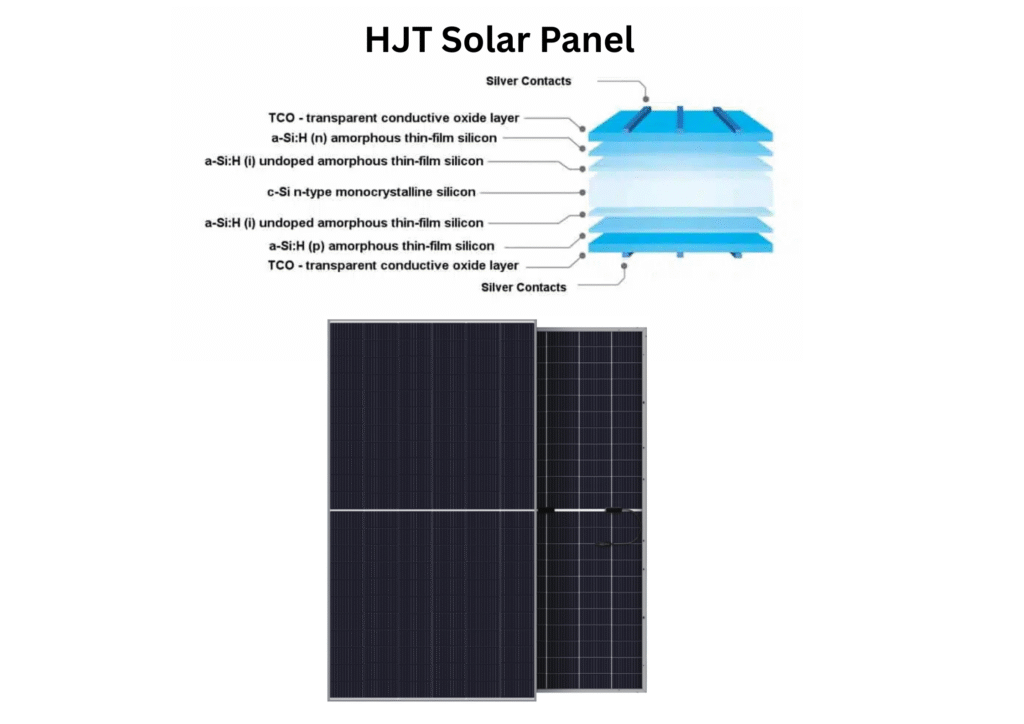
HJT represents Heterojunction solar technology. HJT solar panel is designed by combining two different types of silicon layers, i.e., crystalline silicon and amorphous silicon, and forms a hybrid solar cell.
The structural layout of the HJT solar panel looks like a sandwich-like structure. The center layer is made of a monocrystalline silicon wafer, and ultra-thin layers of amorphous silicon (a-Si) are applied on both sides of it. Two different types of semiconductor materials meet and form a heterojunction. Each side also has a transparent conductive oxide (TCO) layer and metallic contacts. These layers are used to collect and transport electricity.
The heterojunction improves the separation of electrical charges and reduces heat losses. It allows the panel to operate with high voltage output and low degradation. HJT solar panels work better in both high and low temperatures. They are highly durable and improve the efficiency and power output of the system.
How Do HJT Solar Panels Work?
- When the sunlight hits the solar panel, it first enters the top glass layer.
- After passing through the anti-reflective coating, the sunlight reaches the crystalline silicon core. The monocrystalline silicon wafer is the main absorber of sunlight.
- After absorbing the sunlight, the energy excites electrons and frees them from the atoms inside the silicon structure.
- An electric field is created at the boundary between crystalline and amorphous silicon.
- The electric field helps move electrons toward the conductive layers and holes in the opposite direction.
- The electrons travel through conductive oxide layers to the external circuit and generate Direct current (DC) electricity.
Reference: STUDY OF MODERN SOLAR TECHNOLOGIES: PERC and HJT
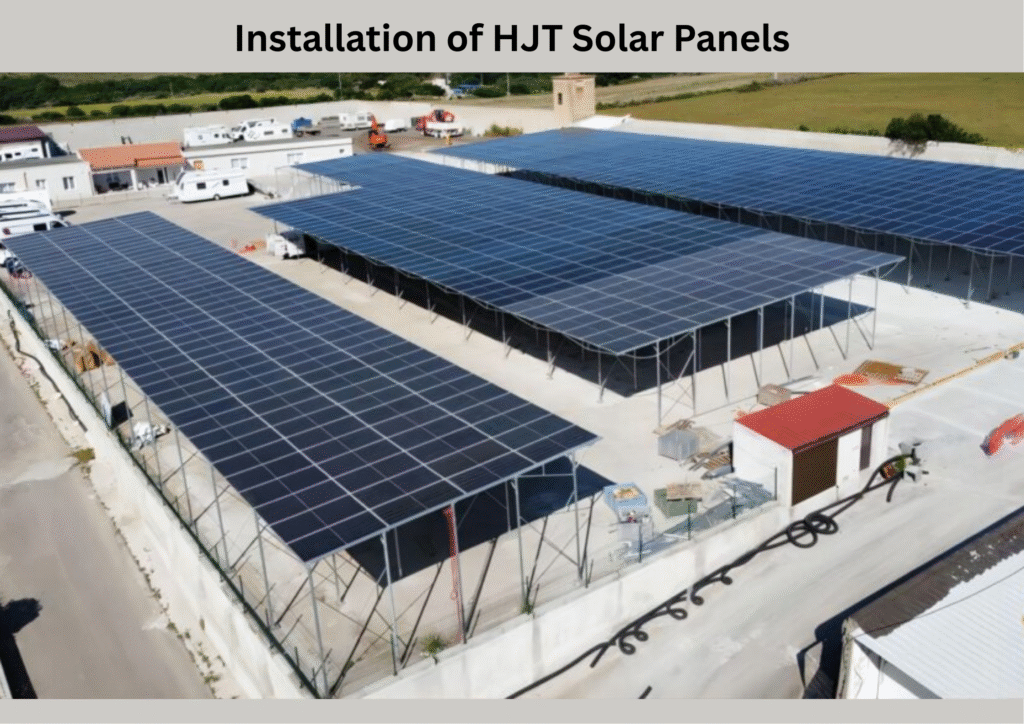
Why HJT Solar Panels are the Right Investment for Large Businesses?
- Offers Better Return on Investment (ROI)
With an efficiency rating of above 22% the HJT solar panels offer more power from less space. These are ideal for large rooftops, open lands, and also for limited roof space. The higher efficiency leads to faster return on investment.
- Offers Consistent Output Even in High Temperatures
The commercial solar farms are often installed in areas with harsh environmental conditions, especially on flat roofs or in hot climates. Due to the low temperature coefficient, the HJT panels offer consistent output in high-temperature environments. So, these solar panels are an ideal choice for large businesses in sunny regions.
- HJT Panels Are Bifacial
Most HJT solar panels are bifacial, which means they can absorb sunlight from both the front and rear sides. This adds 20% extra energy output, which leads to greater cost savings for large businesses. HJT solar panels are ideal for commercial setups installed on reflective surfaces like concrete, gravel, or white membrane rooftops.
- Long-term Power Generation
HJT solar panels experience very low Light-Induced Degradation (LID). This means their performance drops very little even after running continuously for 25 to 30 years. Their maintenance cost is very minimal, and they provide a stable, long-term power generation.
- Ideal for Net-metering
In many U.S. states, businesses benefit from net metering. The HJT solar can export excess electricity to the grid at peak production rates. It helps reduce grid reliance during business hours when tariffs are highest.
- Helps Meet ESG (Environmental, Social, Governance) Criteria
HJT solar installations help large businesses meet green building certifications (LEED, BREEAM) and qualify for clean energy incentives.
A Comparative Analysis: HJT vs PERC vs TOPCon
| PERC (Passivated Emitter and Rear Contact) | TOPCon (Tunnel Oxide Passivated Contact) | HJT (Heterojunction) | |
| Basic Structure | It is an improved version of the standard monocrystalline solar cell. It has a rear passivation layer that reflects unabsorbed light into the cell to improve energy capture. | The layered structure of a TOPCon cell includes an N-type silicon wafer, a thin tunnel oxide layer, and a passivated contact layer. | In the HJT panel, the center layer is made of a monocrystalline silicon wafer, and ultra-thin layers of amorphous silicon (a-Si) are applied on both sides of it. |
| Efficiency | Its efficiency ranges between 20% – 21.5%. | Its efficiency ranges between 21% – 23%. | Its efficiency ranges between 22% – 23.5%. |
| Temperature Coefficient | The PERC technology offers a temperature coefficient of -0.35% / °C. | The TOPCon technology offers a temperature coefficient of -0.30% / °C. | The HJT technology offers the minimum temperature coefficient of -0.25% / °C. |
| Degradation | These solar panels degrade at a rate of approximately 0.5% per year. | These solar panels offer better long-term performance than PERC types with a degradation rate of approximately 0.4% per year. | The degradation rate of HJT panels is very low, i.e., approximately 0.25% per year. |
| Manufacturing Cost | PERC solar panels cost less. | The cost of TOPCon solar panels is moderate. | The HJT solar panels are expensive due to their more complex production. |
| Availability | Widely Available | Growing Rapidly | Limited Manufacturer |
| Used in | These are used in residential rooftops, small-scale utility projects. | TOPCon solar panels are used in commercial rooftops, industrial solar farms, and high-yield applications. | HJT solar panels are used in large-scale commercial projects and in high-heat areas. |
How does HJT benefit more under the incentive structures?
- Many solar incentive programs are designed around energy production and offer per kWh performance payments. As HJT solar panels can generate more electricity per square meter, users can get higher payouts.
- Some incentive programs recognize bifacial panel output. The HJT panels can be easily integrated with bifacial technology, and the design can enhance energy production by 15-20%.
- Incentive programs like the U.S. Investment Tax Credit (ITC) permit system owners to deduct a percentage of system costs from taxes. As HJT projects offer better and long-term performance, the net benefit per dollar is higher than traditional PERC-based systems.
- HJT panels support green building certifications, carbon credits, Corporate ESG reporting, and green bond financing.
- Banks, investors, and insurance providers are more likely to finance or underwrite HJT installations due to high energy yield and lower panel failure.
Ideal Industries: Who Should Choose HJT Solar Panels?
- Data Centers and Cloud Service Providers
As these industries run 24/7 and consume so much power, HJT solar panels integrated with an energy storage system can offset peak loads and cut demand charges.
- Manufacturing Industries
The HJT solar panels perform better in dusty, high-heat, or chemical-exposed environments. These are highly reliable and offer consistent performance with a low degradation rate for above 25 years.
- Commercial Real Estate
These solar panels offer aesthetic uniformity and excellent ROI through net metering or energy resale.
- Agriculture
HJT panels can be easily integrated with bifacial technology. The bifacial solar panels can capture reflected light from soil and crops. So, HJT solar panels can be used in irrigation, cold storage, and crop shading.
- Universities, Hospitals & Research Institutions
HJT solar panels offer continuous and reliable electricity. They also help meet green certification requirements.
Conclusion
By combining the best of crystalline and thin-film technology, HJT solar panels offer high efficiency, high power conversion, low energy losses, longer lifespan, and enhanced performance. So, HJT solar panels offer one of the smartest solar investments for businesses today. These advanced solar panels can reduce energy expenses, meet sustainability targets, and future-proof their large-scale operations. Although the upfront costs of HJT solar panels are higher than traditional solar panels, the long-term financial and environmental returns are unmatched.
FAQS
- What are HJT solar panels?
HJT represents Heterojunction solar technology. HJT solar panel is designed by combining two different types of silicon layers, i.e., crystalline silicon and amorphous silicon, and forms a hybrid solar cell. The center layer is made of a monocrystalline silicon wafer, and ultra-thin layers of amorphous silicon (a-Si) are applied on both sides of it. Two different types of semiconductor materials meet and form a heterojunction. Each side also has a transparent conductive oxide (TCO) layer and metallic contacts. These layers are used to collect and transport electricity.
- What is the efficiency of an HJT solar panel?
The efficiency of an HJT solar panel ranges between 22% – 23.5%.
Also Read:
- N-Type TOPCon Solar Panel: A Complete Guide
- TOPCon Vs HJT Vs Tandem Solar Panels: Make The Best Purchase for Your Project
- Case Study: How Bifacial Solar Panels Improved Output in the Nevada Desert?
- Performance of Tandem Solar Cells in Real Pilot Solar Farms: A Case Study
- Flexible Solar Panels: The Ideal Solution for Small and Irregular Spaces
- Crystalline Vs Thin-Film Solar Panels: Which One Is The Best for Your Modern Smart Homes?
- Tandem Solar Panels: The Future of Rooftop Solar
- Self-Cleaning Solar Panels: No More Manual Cleaning from Now On
- Dual Glass Solar Panel: A Simple and Long-Lasting Investment for Homeowners
- Anti-Reflective Solar Panels: A Smart Way to Maximize Rooftop Efficiency
- Graphene-Coated Solar Panels: The Next Big Thing in Residential Solar Panels
- Utilization of AI in Optimal Site Selection of Renewable Energy Projects: A Complete Guide
- A Practical Guide to Transparent Solar Panels: How Home Windows Can Produce Electricity?
- Smart Meters for Solar: The New Real-Time Energy Monitoring System in Rooftop Solar Systems
- Intelligent Solar Tracker: The Secret to More Solar Energy
- How to Optimize Energy Storage with AI Algorithms in Renewable Energy Systems?
- How to Enhance Solar Panel Efficiency with AI-Based Analytics?
- How Smart Inverters Help Balance Solar Power and Grid Supply? A Complete Guide

Pingback: The Rise of 600W+ High-Power Panels in Commercial Solar Farms - science2energy
Pingback: How Wind Direction and Speed Affect Wind Turbine Performance? - science2energy