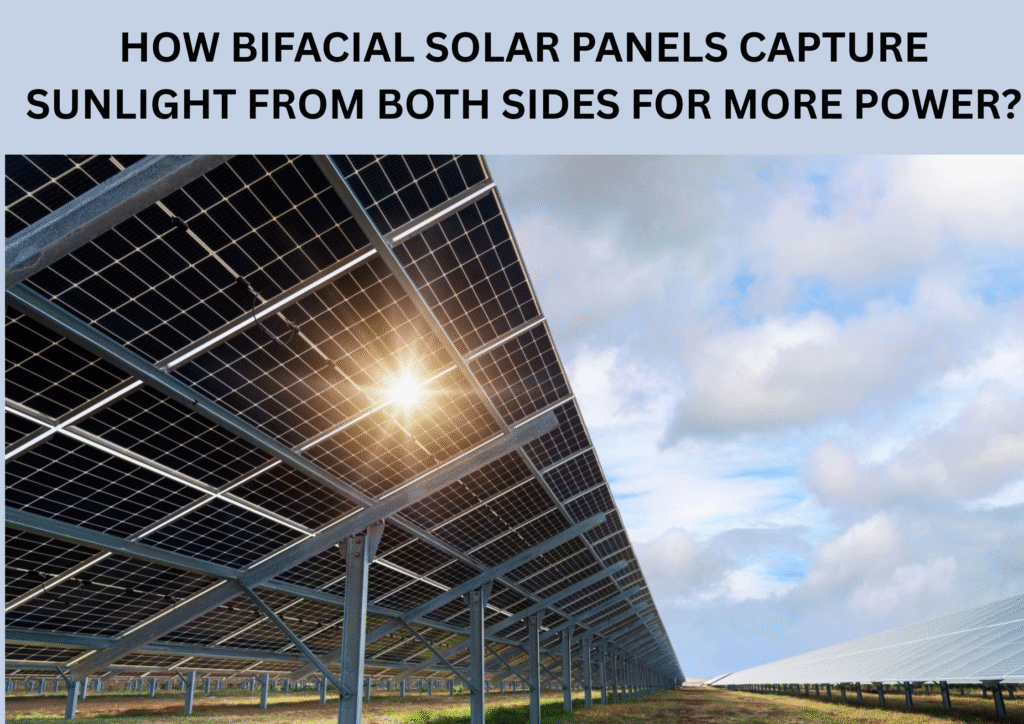
As demand for solar energy continues to grow, people are seeking more efficient solutions. Compared to traditional solar panels, the bifacial solar panels offer better performance and higher energy output. These are modern upgrades to the traditional solar panels. A bifacial solar panel is designed to capture sunlight from both sides, the front and rear surfaces. It can generate more power using the same space.
This article explains how bifacial solar panels capture sunlight from both sides for more power. It also describes some advantages of bifacial solar panels, challenges to consider, and the ideal conditions to check before installing the bifacial solar panels. Let’s break it down in simple words.
What Are Bifacial Solar Panels?
Bifacial solar panels are an advanced version of traditional solar panels that can generate electricity from both the front and back sides of the panel. A bifacial solar panel has dual-sided solar cells. It not only captures sunlight from the front but also utilizes reflected light from the ground or nearby surfaces, thereby increasing overall energy output. The key features of a bifacial solar panel are
1. Dual-sided solar cells
2. Transparent glass (It allows sunlight to pass through or reflect into the cell)
3. Frameless or thin frame to increase efficiency
Difference Between Traditional and Bifacial Solar Panels
| Bifacial Solar Panel | Traditional Solar Panel | |
| Basic Structure | It has solar cells on both sides. The back side is made of glass or a transparent material. | It has solar cells on only one side. The back side is covered with a solid, opaque material. |
| Sunlight Absorption | Only the front side can absorb sunlight. | Both sides can absorb sunlight. |
| Power Generation | It can generate power from both direct and reflected sunlight. The backside adds 10 to 30% extra power. | It can generate power from the direct sunlight hitting the front. |
| Appearance | It looks attractive and features a see-through or dual-glass design. | It comes with a solid blue or black front and an opaque back. |
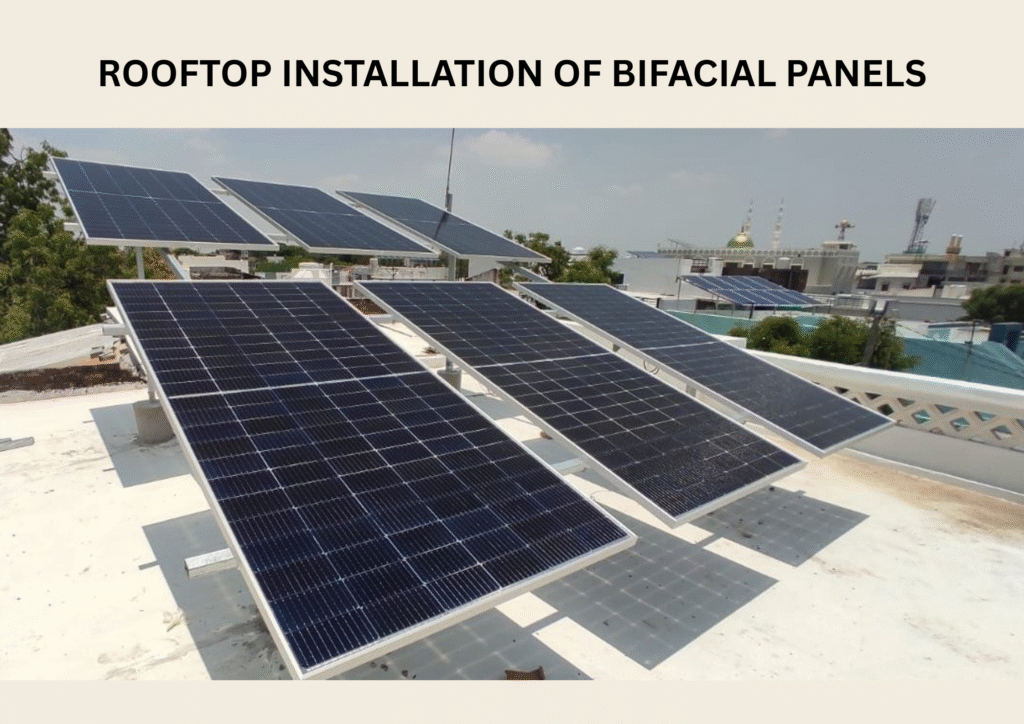
| Roof Type | It works better in elevated or angled setups with light colored surfaces. | Works well in most standard roof setups. |
| Efficiency | Efficiency is higher, i.e., up to 22-23%. | Efficiency is around 17 – 20%. |
| Durability | It is highly durable. Built with double-layer glass, it has better resistance to UV, heat, and moisture. | The plastic and polymer back sheets can wear out quickly in extreme weather. |
| Cost | Higher upfront investment. | Comparatively lower initial cost. |
How Bifacial Solar Panels Capture Sunlight from Both Sides for More Power?
Bifacial solar panels capture sunlight from both sides, generating more power. Let’s know how.
1. Direct Light Collection from the Front Side of the Solar Panel:
The front side of the solar panel is the main source of power generation. This side faces the sun and absorbs direct sunlight.
2. Reflected Light Collection from the Back Side of the Solar Panel:
Sunlight hits the ground or surrounding areas and reflects toward the underside of the panel. So, the back side of the bifacial panel is made with glass or a transparent material. This allows it to absorb the reflected light, which is also known as albedo light.
Thus, the bifacial solar panel generates power from both sides. The front side captures most of the sunlight and can generate more power. Whereas the rear side adds extra power from reflection. It increases the total power generation by 10% to 20%.
How Do Bifacial Solar Panels Work?
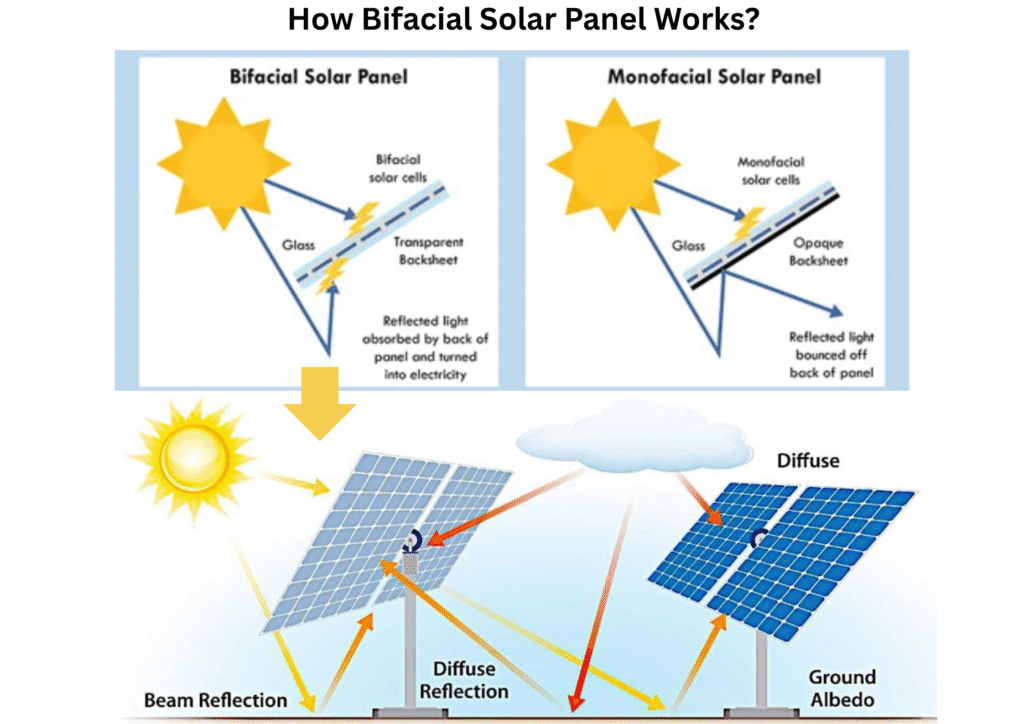
The electricity generated from both sides is still DC (Direct Current). To convert it into AC (Alternating Current), the DC electricity flows into the inverter, which transforms it into AC. Once converted to AC, it can be used in homes and businesses to power appliances. It is also used to charge an energy storage system, or can be sent back to the utility grid.
Reference: Bifacial solar panels: What you need to know
Power Output Comparison of Traditional and Bifacial Solar Panels
| Bifacial Solar Panel | Traditional Solar Panel | |
| Energy Output | The energy output of a 72-cell bifacial solar panel is approximately 450-520 Watts. | The energy output of a 72-cell traditional panel is approximately 350-400 Watts. |
| Rooftop in an Urban Area | 400W | 380W |
| Ground-Mount with White Gravel | 480W | 380W |
| Snow-Covered Region | 490W | 370W |
| Energy Output Over 25 Years | 13,000–15,000 kWh (Estimated Value) | 16,000–18,000+ kWh (Estimated Value) |
Reference: Practical Performance Analysis of a Bifacial PV Module and System
Ideal Conditions to Check Before Installing Bifacial Solar Panels
1. Ground Surface Reflectivity
For bifacial solar panel installation, the surface under the panel must be reflective and light colored. So, the panels must be installed above white concrete, sand, snow-covered ground, reflective paint coatings, etc.
2. Elevation from the Ground
The distance between the solar panel and the ground must be high. This allows light to spread and reflect better. So, install bifacial panels at least 0.5 to 1.5 meters above the ground.
3. Tilt Angle and Orientation
To allow both sides of the solar panel to get maximum exposure to light, a proper tilt angle and orientation are necessary. A tilt angle should be fixed based on latitude and season.
4. Shading
Select a site that is free from trees, nearby buildings, walls, and poles to avoid shading.
5. Racking to Support the System
Choose a bifacial-compatible racking to support bifacial technology and to enhance efficiency.
6. Climate Condition
Bifacial panels perform well in areas with high sunlight and clear skies. So, for more sun hours, select a location with high solar irradiance.
7. Roof Condition
Usually, the bifacial panels are heavier than the traditional panels. So, ensure that the roof can handle the extra weight.
Advantages of Bifacial Solar Panels
1. The bifacial solar panel absorbs sunlight from both front and back sides. The use of the rear side to collect reflected sunlight from the ground or nearby surfaces can increase the total energy output by 10 to 30%.
2. Bifacial solar panels perform best when installed over reflective surfaces such as white concrete, sand, snow, etc.
3. The higher energy output of a bifacial solar panel offers a faster payback period and greater financial returns.
4. It is designed with dual-glass construction and a transparent back sheet, which makes it highly durable.
5. They also perform very well in diffused light, such as during cloudy days, sunrise, or sunset.
6. With a sleek and transparent appearance, it offers a cleaner and more attractive look.
7. As it produces more power from the same footprint, it is ideal for areas where land is limited or expensive.
Challenges to Consider
1. Surfaces with low albedo reduce energy gain from the back side.
2. Bifacial panels need to be installed higher above the ground than regular panels. So, the standard racking system may not provide optimal height or tilt for bifacial gains.
3. The bifacial panels are more sensitive to shading and obstructions. It blocks light from reaching the back side of the panel.
4. The higher upfront cost is another major challenge.
5. The rear side of the bifacial panel is more difficult to reach and clean.
Conclusion
Bifacial solar panels are a smart upgrade to traditional solar panels. It captures sunlight from both sides and offers higher energy output. So, if you are looking for higher efficiency, modern design, and better long-term performance, then bifacial solar panels are the best choice. Whether you are planning to build a commercial solar farm or want to upgrade your rooftop solar system, go for it. It offers long-term value with cleaner, more powerful energy generation.
FAQS
- What Are Bifacial Solar Panels?
Bifacial solar panels are an advanced version of traditional solar panels that can generate electricity from both the front and back sides of the panel. It not only captures sunlight from the front but also utilizes reflected light from the ground or nearby surfaces, thereby increasing overall energy output.
2. What is the estimated energy output of a bifacial solar panel?
The estimated energy output of a bifacial solar panel in 25 years is 13,000–15,000 kWh.
Also Read:
- How AI Strengthens Cybersecurity in Smart Grids? A Complete Guide
- How AI Is Used to Design the Perfect Rooftop Solar System? A Complete Guide
- How Is AI Used to Develop Advanced Materials for Renewable Energy Technologies?
- How AI is Revolutionizing Predictive Maintenance in Smart Grids? A Complete Guide
- How AI Is Powering Smart Grids for Efficient Energy Distribution?
- A practical case study: How AI Enhances Microgrid Performance in Rural Areas?
- Hidden Microcracks in Solar Panel? How does AI Detect Early?
- Floating Solar Panel: The New Way to Produce Clean Energy on Lakes and Reservoirs
- AI-Powered Forecasting: A Powerful Technique to Enhance Grid Stability
- Importance of an AI-Driven Energy Pricing Model in Pricing Optimization
- Building-Integrated Solar Panels: How They Turn Walls and Windows into Clean Energy Generators?
- AI-Driven Predictive Maintenance in Wind Energy Systems
- How AI Is Used in the Renewable Energy Sector?
- AI and Microgrids: Empowering Remote Communities with Smart Energy
- AI Applications in Renewable Energy Trading and Market Optimization