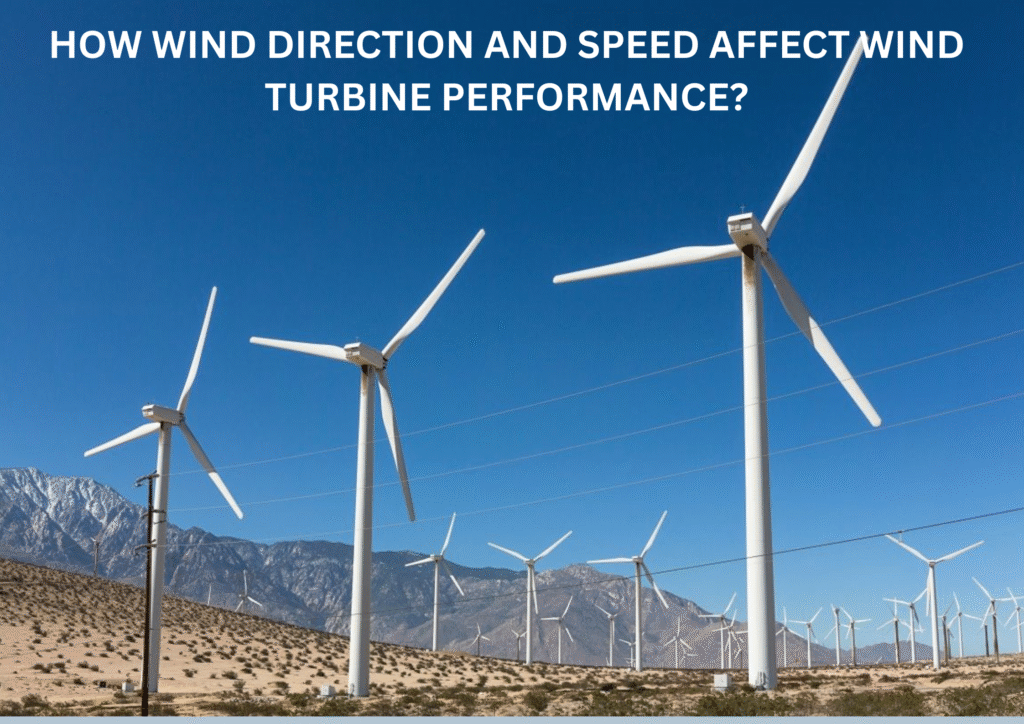
The global demand for renewable energy continues to rise. With this, wind energy has become one of the most promising renewable energy sources. Wind speed and the direction from which the wind blows are two key factors that determine a turbine’s efficiency and the amount of energy a wind turbine can generate.
Have you ever noticed why some wind turbines rotate faster even in the same wind field? The performance of a wind turbine system depends on how well it interacts with the wind. Modern turbines with intelligent control systems and optimized turbine designs can enhance maximum power generation while ensuring long-term reliability. This article provides a clear understanding of how wind direction and speed impact wind turbine performance.
The Basic Concept Behind Wind Energy Conversion
When the wind passes over the turbine’s blades, it creates a pressure difference on either side of the blades, causing them to spin. The spinning blades turn a rotor connected to a shaft inside the nacelle. This shaft is a low-speed shaft that carries the rotational energy from the rotor hub to the gearbox. The gearbox increases the rotational speed to a level suitable for the generator. The generator converts rotational motion from the shaft into electric power through electromagnetic induction.
Once the electricity is generated in the stator coils is then conditioned and is supplied to the step-up transformer to increase the voltage level. After travelling a long distance, the electricity reaches substations where the voltage is adjusted again. After all these processes, the power is supplied to homes, industries, and businesses.
In the wind energy conversion process, the movement of air is transformed into usable power. With no carbon emissions during operation, this technology leads to the generation of clean electricity.
Reference: A review on modern control applications in wind energy conversion system
Importance of Wind Direction in Wind Turbine Performance
The wind patterns are affected by the geographical position, temperature differences, and local terrain.
- The efficiency of the wind turbine increases when it faces the wind head-on. It creates the highest lift force and generates more power. If the turbine blades are not aligned with the wind, the blades can not capture more air flow, which reduces the power generation.
- If the wind turbine is aligned at an incorrect angle to the wind for a long time period, it leads to increased stress, vibration, and faster wear. Whereas a proper alignment increases the lifespan of the turbine.
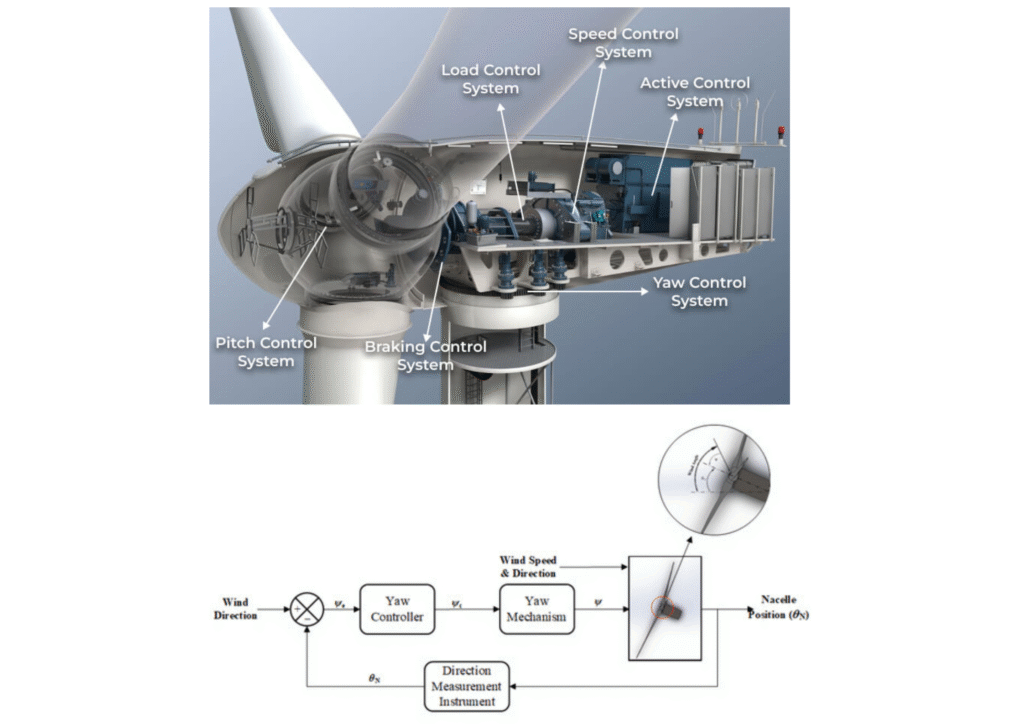
- A yaw control mechanism is integrated with modern turbines that continuously adjusts the nacelle to face the wind. This increases the turbine’s efficiency.
- The wind storms or gusts can cause a sudden change in the direction of the turbine blades. The advanced control systems continuously monitor and adjust the blade pitch and yaw to maintain the power output.
The Influence of Wind Speed on Power Output
Besides the direction and consistency of the wind, it is the speed of the moving air that directly influences the amount of power produced. The mathematical relationship between wind speed and output power is explained below.
Here, P = Power Output (Watts)
= Air Density (kg/m³)
A = Area covered by the turbine blades (m²)
V = Wind Speed (m/sec)
The formula represents that as rho and A are constant values, the output power increases with the cube of the wind speed. This means that the power increases exponentially with wind speed, and even small changes in wind speed can lead to significant variations in power output.
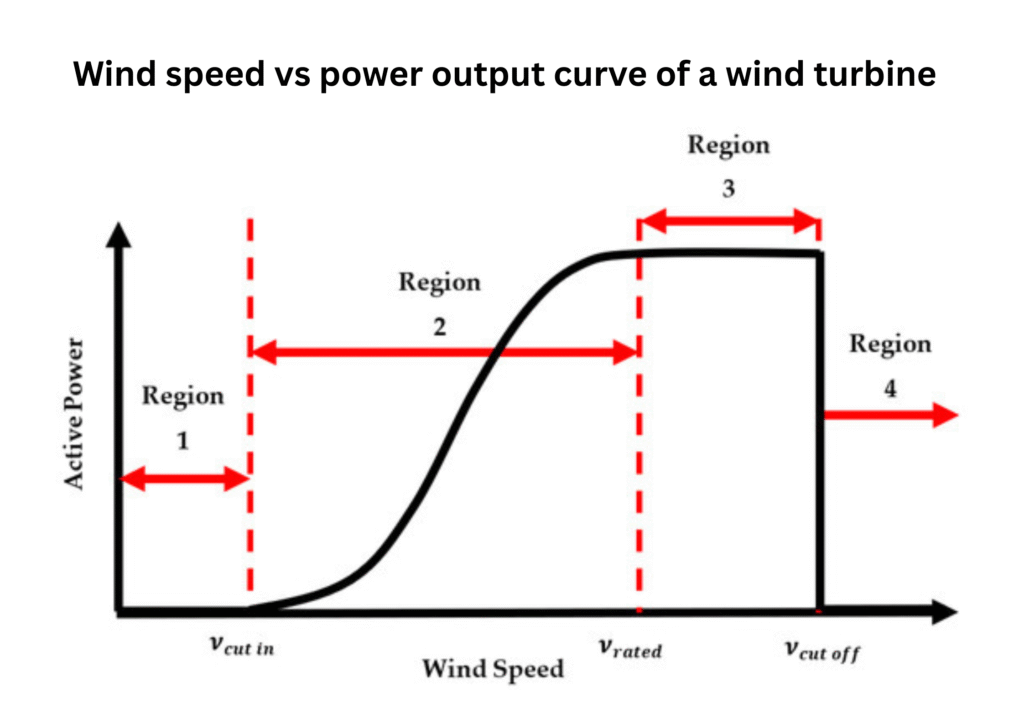
The power curve graph of wind turbines has 3 main regions. It represents how much power the wind turbine produces at different wind speeds.
- Cut-in Speed: Here, the wind speed usually ranges between 3 and 4 m/sec. This is the minimum amount of wind speed required to start turning the blades and generate power.
- Rated Speed: The rated speed falls between 12 and 15 m/sec. At rated speed, the wind turbine generates maximum power and maintains a constant output even if the wind speed continues to increase.
- Cut-out Speed: This speed is usually around 25 m/sec. If the wind speed reaches above this safe limit, the wind turbine automatically stops operating to prevent mechanical damage.
At low wind speed, the wind turbine operates at a reduced efficiency and generates very little power. At moderate wind speeds, the turbines operate efficiently and generate stable electricity. Whereas, at high wind speeds, the turbines must limit their rotation speed to avoid damage.
The modern wind turbines are integrated with intelligent systems that continuously monitor the wind speed in real time. The advanced control system attached to the wind turbines adjusts the blade pitch angle, yaw angle, and generator speed to generate maximum power safely.
Relationship Between Wind Speed, Direction, and Blade Aerodynamics
The increase in the wind speed increases lift, and it increases the output power generation. But if the wind speed becomes too high and crosses the safety limits, turbulence and drag increase, which can reduce efficiency.
Wind direction or the angle of attack is the angle at which the air strikes the blades. A slight change in this angle can significantly impact lift and drag forces, reducing the efficiency and power output of the wind turbine system.
The aerodynamic forces are balanced when the turbine is facing the wind directly, the blades are adjusted at the optimal pitch angle, and the wind is within the rated speed range. This is the condition where the wind turbine generates maximum power with minimal mechanical strain.
Reference: Comparison of adaptive pitch control strategies for a wind turbine benchmark model
Important Factors to Remember While Selecting A Site to Install a Wind Turbine System
Site selection is important to ensure maximum power generation, long-term reliability, and economic feasibility.
- While selecting a site for wind turbine installation, first find out the average wind speed in that area. So, first collect the wind speed and direction data for at least one year before installation. A small increase in wind speed can significantly enhance the power generated by the wind turbine. A site with an average wind speed of 6 to 9 m/sec is considered an ideal site.
- Next, identify the wind direction in that area. Consistent wind patterns with minimal turbulence lead to steady power generation.
- Select a site that is open and elevated. The site must have minimal obstructions within a few kilometers. An ideal site should be a smooth hilltop or open plains.
- Check the local temperature, air density, altitude, and humidity of the site. Cooler temperatures and lower altitudes provide denser air, which increases the efficiency of the turbine.
- The location must have good accessibility to transport wind turbine components such as large blades, towers, etc.
- The site must be close to existing transmission lines or substations to transmit the generated electricity to the local power grid or storage systems.
- A site with minimal ecological disruption ensures smoother regulatory approval and long-term sustainability.
- Before starting the construction, one should collect the land rights, permits, and environmental clearances.
Smart Technologies for Monitoring Wind Behavior
1. Remote Sensing Technologies:
Remote sensing systems such as LIDAR (Light Detection and Ranging) and SODAR (Sonic Detection and Ranging) are used to measure wind behavior across large areas. The LIDAR technique uses laser beams to measure the movement of air particles in the atmosphere. It calculates wind speed and direction, providing highly accurate, real-time data up to several hundred meters above the ground. Whereas the SODAR technique uses sound waves to measure wind speed and direction.
2. Smart Sensors:
The smart sensors, including anemometers and wind vanes, collect wind data such as wind speed, direction, gust frequency, temperature, air pressure variations, etc. After collection, they send data wirelessly to a central control system.
3. IoT (Internet of Things):
The wind turbine systems integrated with IoT are equipped with a network of interconnected sensors. With this technology, the engineers can receive real-time data about wind turbines, detect faults automatically, and adjust parameters remotely to optimize the performance of the turbine.
4. Artificial Intelligence:
AI algorithms and machine learning models can forecast wind speed fluctuations. The predictive maintenance systems are used to identify stress or vibration patterns. Whereas adaptive control systems automatically adjust the turbine parameters for maximum power generation.
5. Digital Twin Technology:
A digital twin is a virtual replica of a wind turbine. With this, engineers can test various operating strategies without any physical adjustments. They can also observe wind turbines’ performance and aerodynamic inefficiencies.
6. Centralized Monitoring Systems:
SCADA (Supervisory Control and Data Acquisition) systems are used to collect and display real-time data from all the turbines.
7. Satellites and Drone-Based systems:
These systems are used tomap wind patterns across vast areas. With this technology, engineers can analyze wind behavior in complex landscapes where local measurements are not possible.
Engineering Innovations to Improve Wind Turbine Performance
- To optimize aerodynamic efficiency and to reduce losses due to turbulence, engineers have developed advanced blade designs such as aeroelastic blades, winglet tips, and carbon fiber composites.
- To continuously monitor environmental and operational data, advanced control systems are developed, including a yaw control system, a pitch control system, and a condition monitoring system (CMS).
- Taller towers of approximately 100 to 160 meters in height are designed to capture more wind.
- Modern turbines are integrated with variable-speed generators that can adjust their rotational speed to match wind conditions.
- Modern turbines are equipped with direct-drive systems that eliminate the gearbox by connecting the rotor directly to the generator.
- Offshore wind turbines and floating turbine platforms are another important engineering innovation to capture stronger and more consistent winds at sea.
Case Study
Case Study 1: Horns Rev 1 Wind Farm, North Sea, Denmark
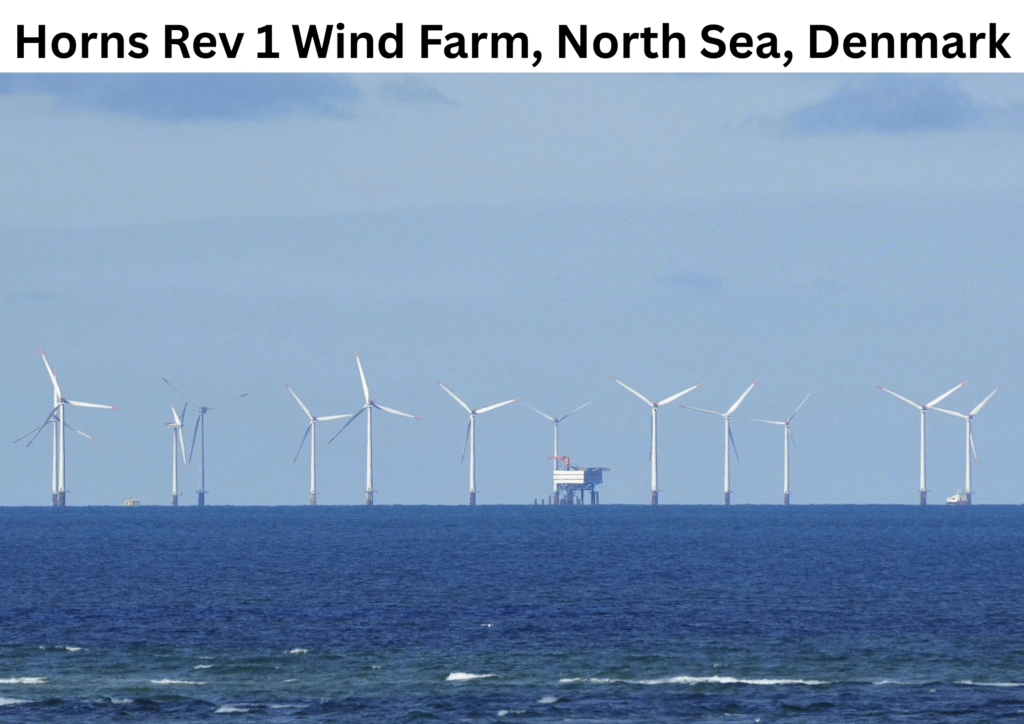
This offshore wind farm is located in the North Sea off the west coast of Denmark. It consists of 80 turbines, each rated at 2 MW. This project is constructed over an area of 20 square kilometers. The consistent wind direction and strong to high coastal wind speed make it an ideal location for wind turbine installation.
Case Study 2: Altamont Pass Wind Resource Area, California
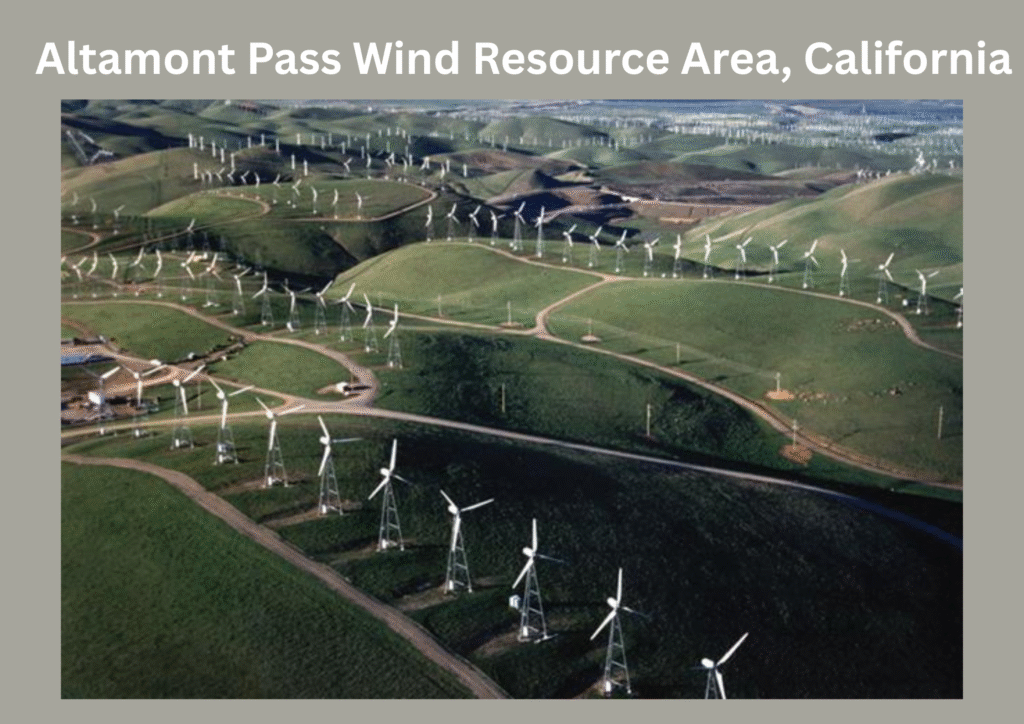
This onshore wind farm is located at Altamont Pass, California, U.S. This project consists of over 4000 wind turbines.
Conclusion
The wind turbine’s performance mainly depends on wind speed, direction of the wind flow, and blade aerodynamics. The balance condition, where the turbine faces the wind directly, the blades are pitched at the correct angle, and the wind is within the rated speed range, the turbine generates maximum power with minimal losses. Modern wind turbines are designed with smart IoT sensors, AI algorithms, predictive maintenance systems, and advanced control systems that adjust automatically with real-time wind changes. These advanced wind turbine systems are making the wind farms more efficient, reliable, and cost-effective.
FAQS
- What are remote sensing technologies in wind turbines?
Remote sensing systems such as LIDAR (Light Detection and Ranging) and SODAR (Sonic Detection and Ranging) are used to measure wind behavior across large areas. The LIDAR technique uses laser beams to measure the movement of air particles in the atmosphere. It calculates wind speed and direction, providing highly accurate, real-time data up to several hundred meters above the ground. Whereas the SODAR technique uses sound waves to measure wind speed and direction.
- What is the relationship between wind speed, direction, and blade aerodynamics of a wind turbine system?
The aerodynamic forces are balanced when the turbine is facing the wind directly, the blades are adjusted to the optimal pitch angle, and the wind speed is within the ratedrange. This is the condition where the wind turbine generates maximum power with minimal mechanical strain.
Also Read:
- A Complete Guide to How a Wind Turbine Turns Air into Electricity: From Blades to Grid
- Importance of AI-Driven Predictive Maintenance in Wind Energy Systems
- Are DIY Solar Panel Kits Worth It? A Complete Guide
- Portable Solar Panel Kits: Best Uses for RVs and Camping
- Breaking Down Each Component of a 5kW Solar Panel Kit
- What Size Solar Panel Kit Do You Need? Find the Right Solar Kit for Your Home
- Perovskite Solar Panels: The Future of Home Solar
- High-Wattage 450W Solar Panels: Are They Worth It for Your Home Roof Space?
- The Rise of 600W+ High-Power Panels in Commercial Solar Farms
- HJT Solar Panels: A Right Solar Investment for Large Businesses
- N-Type TOPCon Solar Panel: A Complete Guide
- TOPCon Vs HJT Vs Tandem Solar Panels: Make The Best Purchase for Your Project
- Case Study: How Bifacial Solar Panels Improved Output in the Nevada Desert?
- Performance of Tandem Solar Cells in Real Pilot Solar Farms: A Case Study
- Flexible Solar Panels: The Ideal Solution for Small and Irregular Spaces
- Crystalline Vs Thin-Film Solar Panels: Which One Is The Best for Your Modern Smart Homes?
- Tandem Solar Panels: The Future of Rooftop Solar
- Self-Cleaning Solar Panels: No More Manual Cleaning from Now On
- Dual Glass Solar Panel: A Simple and Long-Lasting Investment for Homeowners