
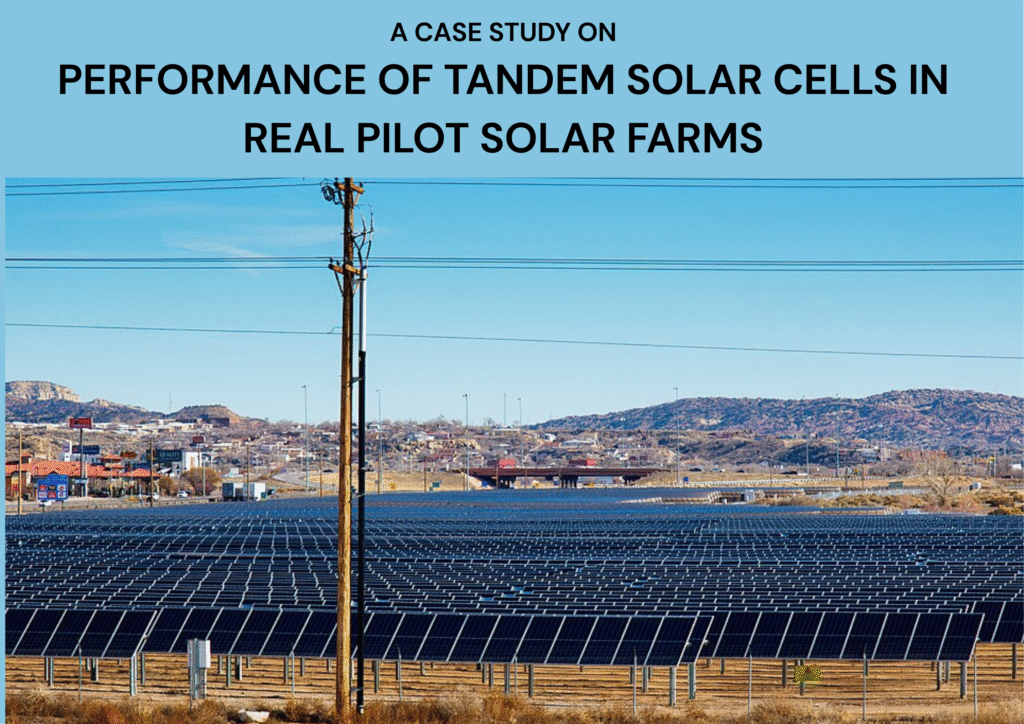
As the solar industry expands, researchers and manufacturers are seeking innovative techniques to boost energy production. In this process, pilot solar farms play a crucial role in evaluating new solar technologies before they are deployed on a large scale. Among the new developing technologies, tandem solar cells are one of the most promising breakthroughs. This article explains a real Pilot Tandem Solar Farm, located near Las Cruces, New Mexico. It will give you a project overview of the real pilot tandem solar panel, the project’s layout, the technologies used in it, and an analysis of its performance.
What Are Tandem Solar Cells?
The word “Tandem” refers to working together. A multi-layered solar cell, where each layer is made of different materials to absorb different parts of the sunlight spectrum, is known as a tandem solar cell. In a tandem solar panel, all the layers stacked one over the other work together to absorb more sunlight. Thus, it enhances the power production as compared to the traditional solar panel.
A tandem solar cell is made by splitting the solar spectrum into two layers, i.e., the top layer and the bottom layer. The top layer is usually comprised of perovskite or another wide bandgap material that can capture high-energy photons, such as ultraviolet (UV) and visible light. The bottom layer is typically made of silicon that captures the lower-energy photons that pass through the top layer.
With a high energy efficiency of above 30%, the tandem solar cells can produce more energy in less space.
Project Overview of Real Pilot Tandem Solar Farm
What Is a Real Pilot Solar Farm?
The pilot solar farm represents a small-utility-scale solar installation. It serves as a research and demonstration site. It is used as a testing ground for newly invented solar panels, new technologies, inverters, and performance tracking systems. The places selected for pilot solar farms are usually semi-arid regions with high solar exposure.
The main goal of a pilot solar farm is not just to generate renewable energy. It represents how the newly developed technology and the system can work under real-world conditions.
Project Overview of Real Pilot Tandem Solar Farm
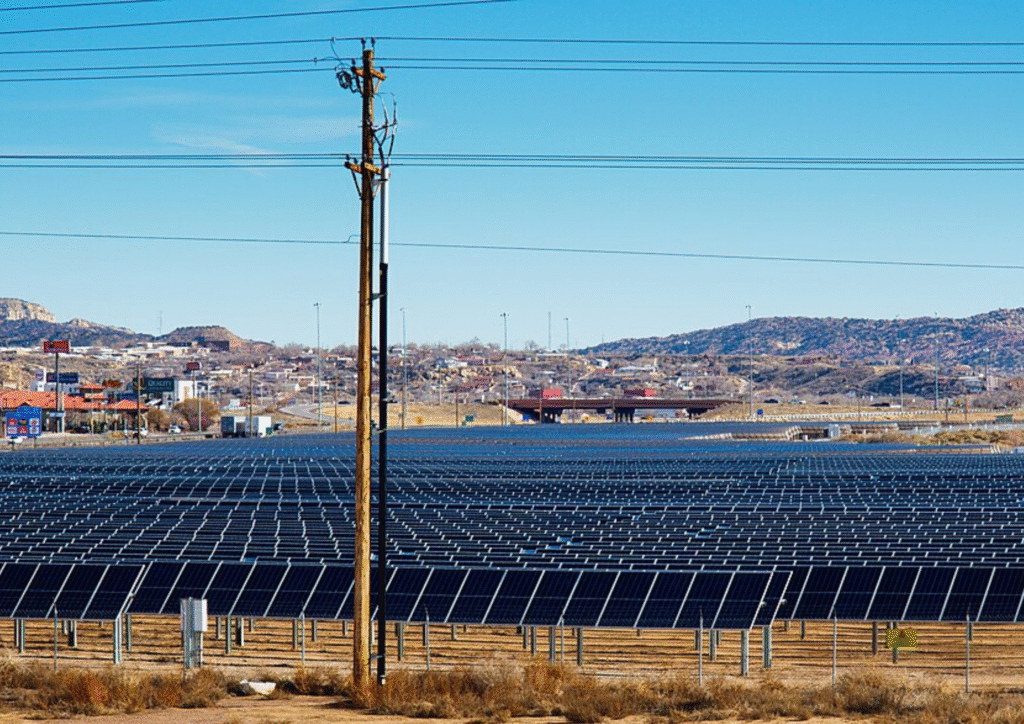
The real pilot tandem solar farm is located near Las Cruces, New Mexico. The is a location with high solar radiance and a dry climate. So, it is selected to study the performance of the tandem solar cells under intense sunlight and extreme temperature swings. It evaluates the long-term reliability and efficiency of tandem solar cells.
The average solar radiation in the Las Cruces area is 6.5 kWh/m²/day with over 320 sunny days per year. This desert area has flat terrain with minimal shading.
This small-scale solar farm covers around 15 acres of leased land. The installation capacity of the solar farm is 3 MW DC. Approximately 7500 tandem solar modules are used in this project. Aluminum racking is used as the mounting structure with a 25° tilt on fixed arrays. For comparative analysis, 2 string inverter types are used in this project. The whole site is divided into 10 zones consisting of perovskite-on-silicon, all-perovskite, and III-V hybrid structures.
| Location | Near Las Cruces, New Mexico |
| Solar radiance | 6.5 kWh/m²/day (High) |
| Installation capacity | 3 MW |
| Used Tandem Solar Modules | 7500 |
| Tilt Angle | 25° |
Real Pilot Tandem Solar Panel Layout
The layout of a real pilot tandem solar panel involves different technologies, precise monitoring, and real-world weather conditions. An organized layout isolates and compares the performance of tandem solar panels side by side. It compares the differences in output power based on various materials and mounting structures. It also identifies the best configuration that delivers the most stable and long-term performance. Thus, the successful test zones are upgraded to future commercial projects.
The real pilot tandem solar panel, situated near Las Cruces, New Mexico, has 10 performance testing zones that spread across 15 acres of land. For optimal solar tracking, the rows are designed with north-south orientation. Each testing block is separated by gravel pathways. The inverters are connected to the central control room with underground cabling. Each array is independently connected to its own string inverteror centralized inverter hub.
A table consisting of various testing zones, including different types of tandem solar modules, mounting structures, and inverter configurations, is represented below.
| Zone Type | Solar Modules Used | Mounting Structure | Number of Panels |
| Zone A | Perovskite-Silicon Tandem | Single-axis Tracker | 1000 |
| Zone B | All-Perovskite Tandem | Fixed-Tilt | 900 |
| Zone C | III-V on Silicon Tandem | Dual-axis Tracker | 800 |
| Zone D | Bifacial Tandem Panels | Single-axis Tracker | 950 |
| Zone E-J | Mixed Technology | Mixed Mounting | 700 |
The sensors and weather instruments used for monitoring equipment are
- Pyranometers (Solar irradiance readings)
- Temperature sensors
- Anemometers
- Soiling sensors
- Thermal cameras
Technologies Used in Real Pilot Tandem Solar Farm
- Tandem Solar Modules
This project uses mainly 3 types of tandem solar panels.
- Perovskite-Silicon Tandem Panels: It consists of a perovskite top cell and a silicon bottom cell. It offers higher voltage output and powerful performance.
- All-perovskite Tandem Cells: These tandem cells have both layers of perovskite materials with different band gaps. These are lightweight and potentially cheaper.
- III-V/Silicon Tandem Panels: These tandem panels are made by combining gallium arsenide or other III-V compounds with silicon.
- Mounting Structures
The mounting structures are classified into 3 categories.
- Single-axis tracker: The panels rotate east to west during the day.
- Fixed-tilt mounts: The panels are fixed andtilted at 25° facing south.
- Dual-axis tracker: It tracks the sun in both azimuth and elevation.
3. Inverters
The types of inverter technologies used in pilot tandem solar farms are
- String inverters:
- Central Inverter
- AI-powered inverters
4. Sensors Used for Performance Monitoring
Various sensors are used to monitor the panel’s performance:
- Irradiance sensors: Measure sunlight intensity
- Temperature sensors: Measure the heat
- Soiling detectors: Detect the dust and dirt buildup over the panel.
- Weather stations: Monitors wind speed, sunlight, temperature, and humidity
5. Cloud-Based Monitoring System
This advanced technology helps to store and analyze energy production and environmental data. This data helps fine-tune module designs to enhance the performance level of the solar panels.
Performance Analysis
Energy Output
After one full year of operation, approximate data based on energy output is represented below.
| Total Energy Output | 5100 MWh (Approximate) |
| Average Daily Energy output | 14 MWh (Approximate) |
| Peak Capacity Factor | 19.4% |
| Performance Ratio | 83% |
| Increase in Energy Output compared to traditional Silicon Panels. | |
| Perovskite-Silicon | +18% |
| All-Perovskite | +12% |
| III-V/Silicon | +22% |
Challenges Observed in Pilot Tandem Solar Farm
- Thermal degradation causes a significant drop in performance in some modules during July and August.
- The sudden wind gusts, especially during the spring and monsoon seasons, lead to mounting frame stress, panel vibration, and tracking system misalignment.
- Over the years, there are chances of chemical reactions between multiple layers of the tandem solar cell, which lead to minor efficiency drops.
- In desert areas, the soiling and dust accumulation cause energy losses.
Conclusion
The real pilot tandem solar panel is a testing ground that helps researchers and developers understand the real-world limits of tandem solar technology. The real pilot project represents the potential of tandem solar panels when deployed under real-world conditions. The project offers a solid foundation for scaling tandem technology in utility-scale solar farms.
Also Read:
- Flexible Solar Panels: The Ideal Solution for Small and Irregular Spaces
- Crystalline Vs Thin-Film Solar Panels: Which One Is The Best for Your Modern Smart Homes?
- Tandem Solar Panels: The Future of Rooftop Solar
- Self-Cleaning Solar Panels: No More Manual Cleaning from Now On
- Dual Glass Solar Panel: A Simple and Long-Lasting Investment for Homeowners
- Anti-Reflective Solar Panels: A Smart Way to Maximize Rooftop Efficiency
- Graphene-Coated Solar Panels: The Next Big Thing in Residential Solar Panels
- Utilization of AI in Optimal Site Selection of Renewable Energy Projects: A Complete Guide
- A Practical Guide to Transparent Solar Panels: How Home Windows Can Produce Electricity?
- Smart Meters for Solar: The New Real-Time Energy Monitoring System in Rooftop Solar Systems
- Intelligent Solar Tracker: The Secret to More Solar Energy
- How to Optimize Energy Storage with AI Algorithms in Renewable Energy Systems?
- How to Enhance Solar Panel Efficiency with AI-Based Analytics?
- How Smart Inverters Help Balance Solar Power and Grid Supply? A Complete Guide
- Case Study: How Google Uses AI to Accelerate Grid Connections in the U.S.
- Case Study: How Duke Energy Uses AI for Grid Stability?

Pingback: Case Study: How Bifacial Solar Panels Improved Output in the Nevada Desert? - science2energy
Pingback: TOPCon Vs HJT Vs Tandem Solar Panels: Making the Right Call for Your Solar Business Project - science2energy
Pingback: Microinverters vs String Inverters: Which Solar Inverter Should You Pick for Your Rooftop Solar System? - science2energy
Pingback: Can Solid-State Batteries Keep the Lights on at Night? A Complete Guide - science2energy
Pingback: Thermal Stability of Solid-State Batteries in Harsh Renewable Energy Environments - science2energy