

As the world transitions toward cleaner energy, solar technology is undergoing rapid advancements. Among the recent innovations, the perovskite solar panels are grabbing attention. These highly efficient, low-cost, lightweight, and flexible panels have gained global attention. Despite strong results in labs, they are still in development and not yet widely available for residential use. As research continues, perovskite solar panels could become the next big leap in solar power. Are they the future of home solar? Let’s discuss it.
What is Perovskite?
Perovskite was discovered in the 19th century, which refers to a specific crystal structure. The name “Perovskite” comes from a natural mineral called calcium titanium oxide (CaTiO₃). It was named after Russian scientist Lev Perovski. Later, researchers and scientists discovered that many different materials can form this same crystal shape, including elements such as lead and iodine, as well as organic molecules.
In general, Perovskite is defined as a group of materials that have the same crystal shape as the original mineral CaTiO₃. The perovskite material can efficiently absorb sunlight, which makes it ideal for solar cells.
The key properties of perovskite are:
- High light absorption
- Flexible design (Applied to curved surface)
- Low-cost manufacturing
- Tunable band gaps (Can be adjusted for better light and energy control)
- Efficient charge transport (Reduce energy loss)
What are Perovskite Solar Panels?
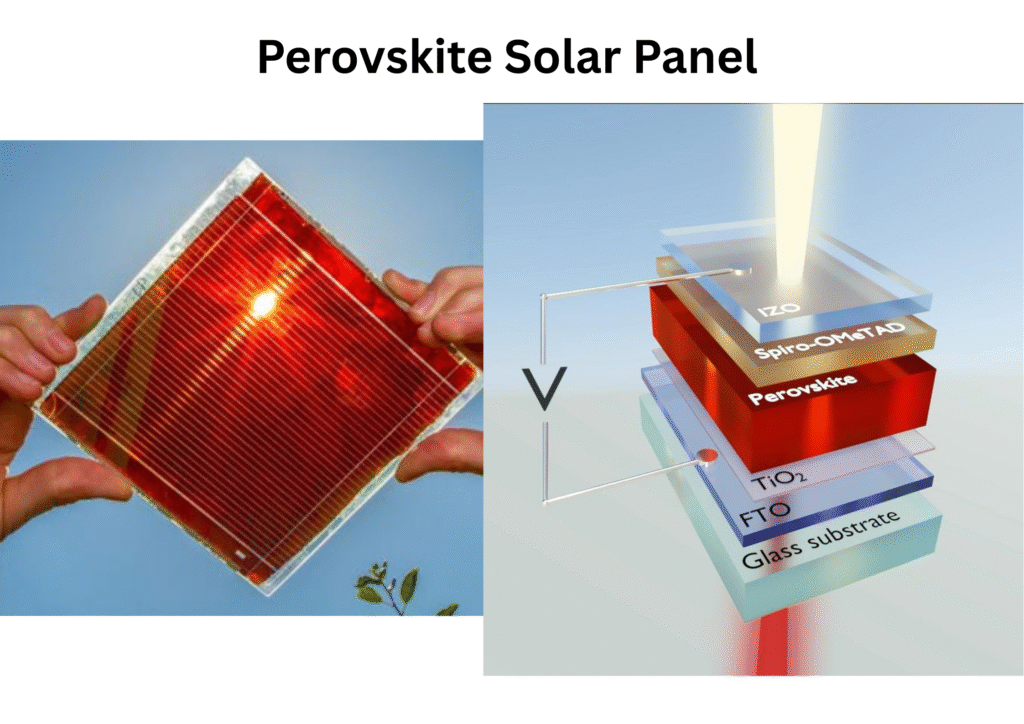
The solar panels that utilize a thin film of synthetic perovskite materials to capture sunlight are known as perovskite solar panels. The panel’s surface, which is made of glass, metal foil, or plastic, is coated with a light-absorbing layer that is also called a perovskite layer. Perovskite panels use a lightweight, flexible coating.
When the sunlight hits the perovskite layer, electrons get excited and are separated from their atoms. This creates electric charges that move through the material to the electrodes and generate an electric current.
These underdeveloped perovskite solar panels have been tested for solar rooftops, building facades, smart windows, wearable electronics, and solar-powered drones.
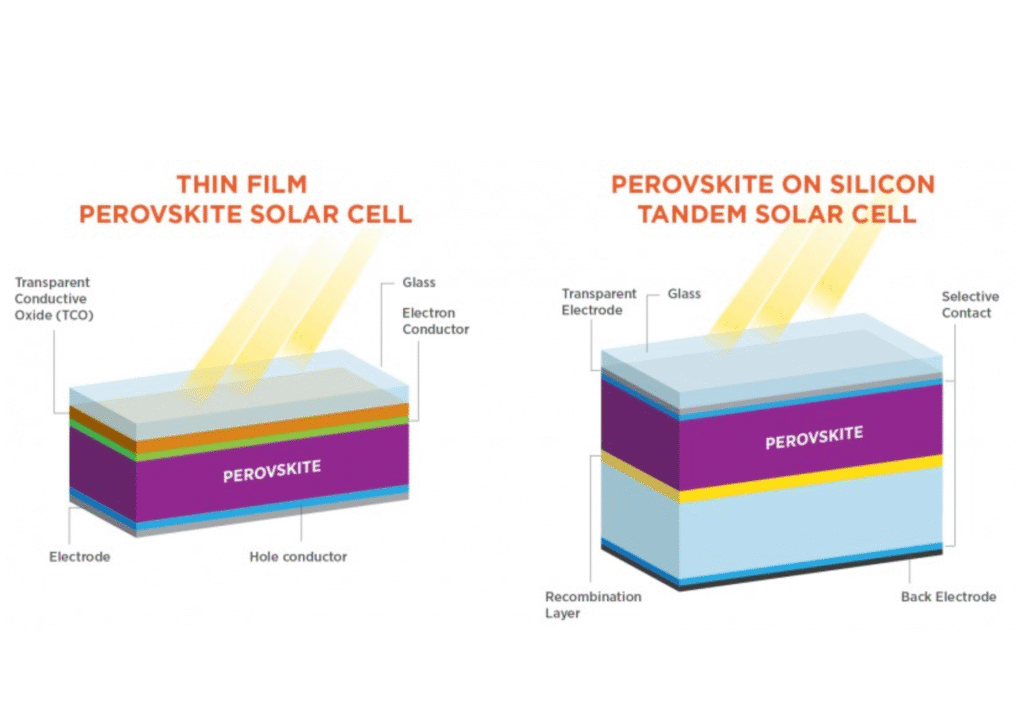
Perovskite Solar Panels Vs Silicon-Based Solar Panels
| Perovskite Solar Panel | Silicon-Based Solar Panel | |
| Materials Used | These solar panels use a synthetic perovskite compound as light light-absorbing layer. | These solar panels are made using crystalline silicon, i.e., either monocrystalline or polycrystalline. |
| Efficiency | These solar panels are still under development, and their efficiency is tested in labs as up as 26%. | These solar panels are 18% to 22% efficient. |
| Cost | Perovskites can be created at low temperatures, which reduces the manufacturing cost. | The energy-intensive crystal growth makes the manufacturing cost higher. |
| Color and Design | The perovskite coatings can be transparent or colorful. | |
| Weight | These are lightweight. | These solar panels are heavy and rigid. |
| Flexibility | Perovskite solar panels are highly flexible and printable. | These solar panels are rigid and for farm mounting. |
| Stability | Perovskite material is sensitive to moisture and heat. These are less stable as compared to traditional solar panels. | Traditional solar panels are stable, and this is proven over time. |
| Lifespan | A shorter life span as compared to traditional solar panels. | It offers a longer lifespan of up to 25 to 30 years. |
| Availability | Still under development and not available in the market till now. | Widely available in the market. |
Advantages of Perovskite Solar Panels
High Energy Conversion efficiency:
Perovskite solar cells can convert sunlight into electricity at high rates. The lab tests report over 25% efficiency, whereas some tandem cells have even passed 30% efficiency, which is much higher than traditional silicon panels.
Low Manufacturing Cost:
The perovskite solar cells can be made using low-temperature and low-energy methods, which lowers material and labor costs. The manufacturing processes involve roll-to-roll coating, solution-based printing, and simple chemical deposition to form perovskite solar cells.
Flexible and Lightweight:
The perovskite solar cells can be made thin, light-weight, flexible, and printable on plastic, glass, metal foil, etc. So, these can also be used in portable solar devices, curved surfaces, car roofs, solar windows, etc.
Improved Light Absorption:
One of the most important features of perovskite solar cells is the tunable bandgap. It allows the solar cells to chemically adjust themselves to absorb sunlight of different wavelengths. This improves energy collection across the entire solar spectrum.
Faster Innovation:
Perovskite materials are easy to synthesize in a lab. This accelerates the pace of innovation by testing new combinations. This rapid testing also improves adaptability and leads to more chances for commercial success.
Ideal for tandem Solar Cell Applications:
The perovskite layer is stacked on top of a silicon cell to form a tandem solar cell. This dual-layer cell has the capability of improving efficiency up to 35% in the future.
Ideal for Building-Integrated Solar Panel:
The perovskite layers are either transparent or semi-transparent, which makes them ideal for building-integrated solar panels.
Limitations of Perovskite Solar Panels
- Durability: The perovskite cells degrade quickly when exposed to air and humidity.
- Lead Content: As the perovskite cells contain a small amount of lead, there is a risk of environmental contamination.
- Mass Production: Producing large, consistent, and reliable modules is still under development.
- Certifications: The perovskite solar panels are still in the process of meeting all the safety and efficiency standards.
Reference: Challenges for commercializing perovskite solar cells
When Will Perovskite Solar Panels Be Ready for Homes?
Presently, the perovskite solar panels are in the pilot production and testing phase. Researchers have developed small-scale modules and some pre-commercial panels for limited applications. They are not approved for full-scale residential use for the following reasons:
- Short lifespan in outdoor conditions
- Sensitivity to moisture, heat, and UV light
- Use of lead
- Certifications are still in progress
Some research institutes and companies are working on commercial perovskite panel development, which is listed below.
- Oxford PV (UK/Germany)
- Saule Technologies (Poland)
- Tandem PV (U.S.)
- GCL Nano (China)
The timeline for perovskite solar panels for home use:
| Progress | Estimated Timeline | |
| Research & Development | Finished | 2019-2022 |
| Pilot-Scale Manufacturing | Ongoing | 2022-2025 |
| Certification & Reliability Testing | In Progress | 2024-2026 |
| Commercial Rollout for Homes | Expected | 2026-2028 |
Should You Wait for Perovskite Solar Panels for Your Home?
If you are not in urgent need, then you should wait for some time. According to experts, the perovskite solar cells are expected to be available for home use between 2026 to 2028. Early products may have some performance issues. So, waiting for 2 to 3 years to get the right product for your home.
If you need to install solar panels urgently, then go for silicon-based systems that are reliable, cost-effective, and readily available with strong warranties in the market.
Researchers are also working on tandem solar panels, which consist of one layer of perovskite over silicon. If the tandem solar panels first enter the market, then the homeowner would not have to worry about reliability. These panels offer higher efficiency, more energy production, and advanced technology, which would be more beneficial for users.
Conclusion
The perovskite solar panels are catching the attention of solar users due to their high efficiency, low production cost, light weight, and flexibility. The research about perovskite solar panels is still in progress, but they are a strong alternative to traditional solar panels. According to experts, homeowners may begin installing certified perovskite panels between 2026 and 2028. These solar panels are going to play a major role in the future of clean, affordable, and accessible energy worldwide.
FAQS
- What are perovskite solar panels?
The solar panels that utilize a thin film of synthetic perovskite materials to capture sunlight are known as perovskite solar panels. The panel’s surface, which is made of glass, metal foil, or plastic, is coated with a light-absorbing layer that is also called a perovskite layer. Perovskite panels use a lightweight, flexible coating.
2. What is the efficiency of a perovskite solar panel?
The perovskite solar panels are still under development, and their efficiency is tested in labs as up as 26%.
Also Read:
- High-Wattage 450W Solar Panels: Are They Worth It for Your Home Roof Space?
- The Rise of 600W+ High-Power Panels in Commercial Solar Farms
- HJT Solar Panels: A Right Solar Investment for Large Businesses
- N-Type TOPCon Solar Panel: A Complete Guide
- TOPCon Vs HJT Vs Tandem Solar Panels: Make The Best Purchase for Your Project
- Case Study: How Bifacial Solar Panels Improved Output in the Nevada Desert?
- Performance of Tandem Solar Cells in Real Pilot Solar Farms: A Case Study
- Flexible Solar Panels: The Ideal Solution for Small and Irregular Spaces
- Crystalline Vs Thin-Film Solar Panels: Which One Is The Best for Your Modern Smart Homes?
- Tandem Solar Panels: The Future of Rooftop Solar
- Self-Cleaning Solar Panels: No More Manual Cleaning from Now On
- Dual Glass Solar Panel: A Simple and Long-Lasting Investment for Homeowners
- Anti-Reflective Solar Panels: A Smart Way to Maximize Rooftop Efficiency
- Graphene-Coated Solar Panels: The Next Big Thing in Residential Solar Panels
- Utilization of AI in Optimal Site Selection of Renewable Energy Projects: A Complete Guide
- A Practical Guide to Transparent Solar Panels: How Home Windows Can Produce Electricity?
- Smart Meters for Solar: The New Real-Time Energy Monitoring System in Rooftop Solar Systems
- Intelligent Solar Tracker: The Secret to More Solar Energy

Pingback: What Size Solar Panel Kit Do You Need? Find the Right Solar Kit for Your Home - science2energy