
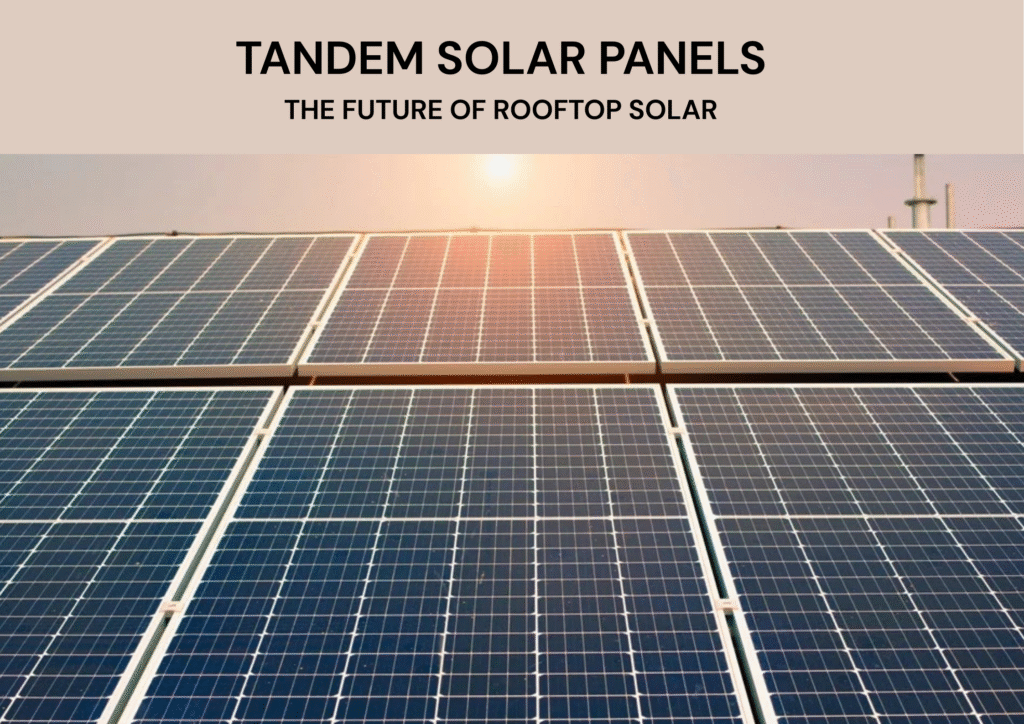
The tandem solar panels are the most promising advancement in solar technology, designed to enhance solar power efficiency. This solar panel has two or more types of solar cells stacked on top of each other. The layered design helps to capture more sunlight than traditional silicon panels. This article provides a detailed examination of tandem solar panels, their working principle, advantages, manufacturing progress, and the timeframe for homeowners to expect installation on their rooftops. It will help homeowners, installers, and energy professionals to understand the current state of tandem solar technology.
What Are Tandem Solar Panels?
The word “Tandem” denotes working together. Tandem solar panels are an advanced solar technology where two or more layers of different solar materials work in tandem or stacked on top of each other to absorb sunlight. Each layer captures energy from different wavelengths of sunlight. This layered structure makes the solar panel highly efficient by converting more sunlight into electricity and reducing energy loss. Thus, the tandem solar panels are more efficient than traditional silicon-only panels.
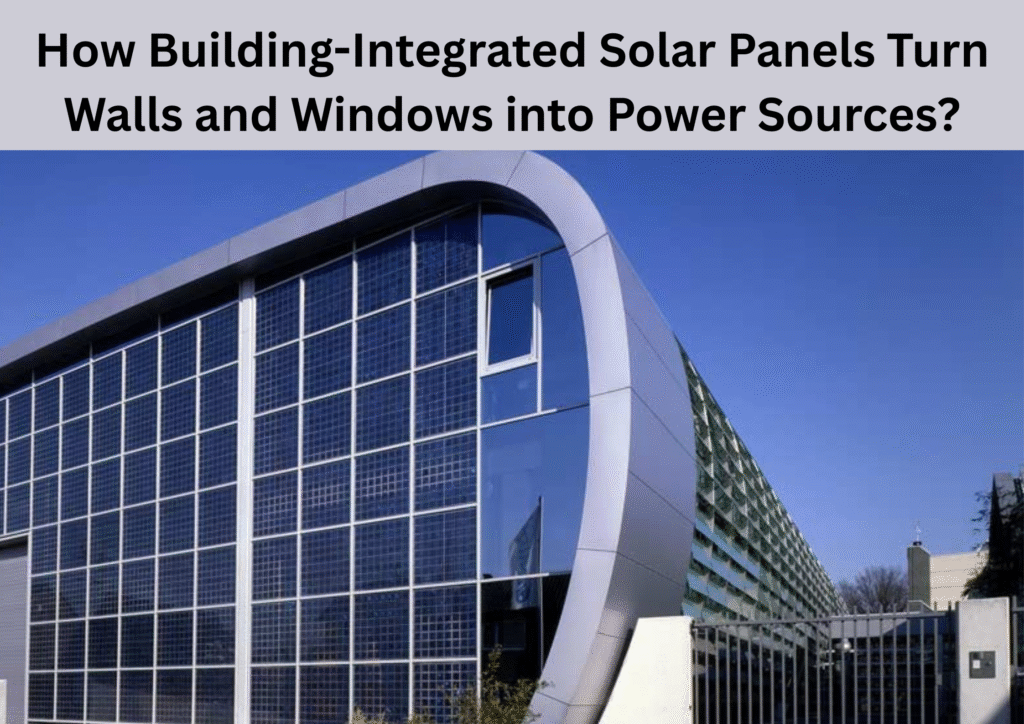
With high energy yield, the tandem solar panels are the future of the solar industry. These types of solar panels can be used in limited rooftop solar systems, commercial buildings, and Building-Integrated Photovoltaics (BIPV) systems.
How Tandem Solar Panels Work?
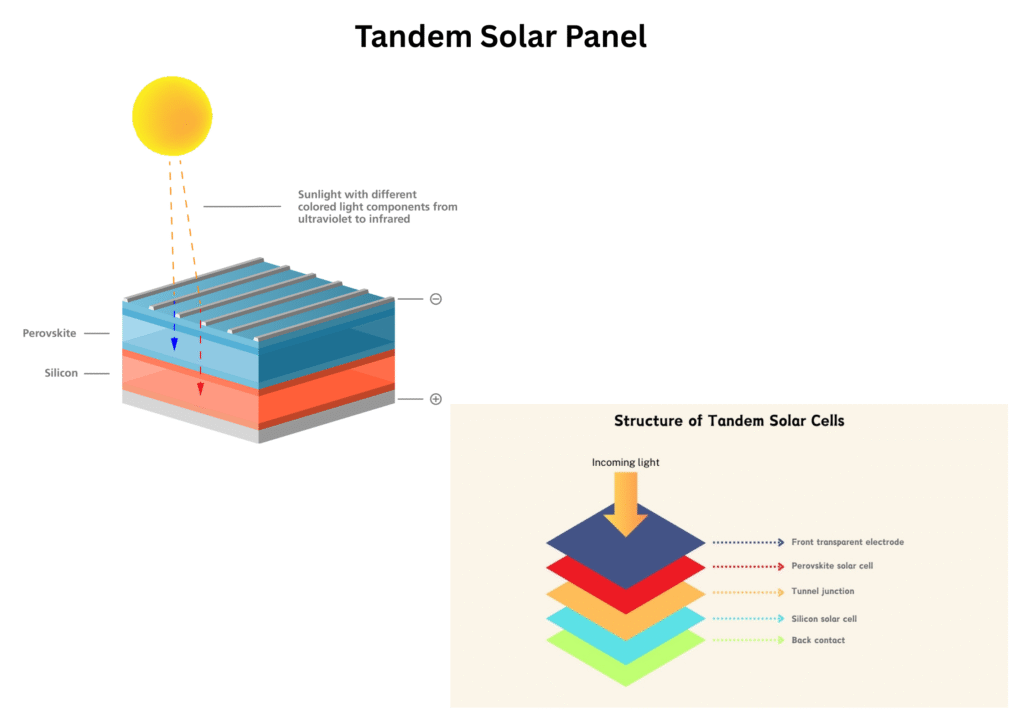
Sunlight consists of light with a wide range of wavelengths, such as infrared (IR), ultraviolet (UV), and visible light. The traditional solar panel with crystalline silicon can absorb only a portion of sunlight, whereas the tandem solar panel can capture more sunlight of various wavelengths.
The tandem solar panel mainly consists of two key sub-cells.
- Top Cell: The top cell consists of high band gap material. It is usually made from perovskite or other thin-film materials. It absorbs light with short wavelengths and high energy, such as blue and green.
- Bottom cell: The bottom cell consists of low band gap material. It is usually made from crystalline silicon or CIGS (copper indium gallium selenide). It absorbs light with longer wavelengths, such as red and near-infrared.
Each layer is connected either mechanically or monolithically. A step-by-step process of how tandem solar panels work is explained below.
- When the sunlight hits the tandem solar panel, different layers absorb different wavelengths of light.
- The top layer, which is made from perovskite or other thin-film materials, traps high-energy light. This excites electrons, creating a flow of electricity.
- The remaining light reaches the bottom layer and is absorbed by the bottom silicon layer. This also generates electricity from low-energy photons.
- In monolithic tandem cells, the electricity is generated from both layers combined through a tunnel junction. Whereas, in the layers that are connected mechanically, the generated electricity is combined by external wiring. Thus, the combined output is a higher voltage or current, depending on the panel design.
Reference: Tandem solar cells beyond perovskite-silicon
Tandem Solar Panels Vs Traditional Solar Panels
| Tandem Solar Panel | Traditional Solar Panel | |
| Materials Used | These solar panels consist of two or more layers of different solar materials. The top layer is made from perovskite, and the bottom layer uses silicon, which are stacked on top of each other. | These Solar panels are made from a single layer of crystalline silicon cells. |
| Efficiency | The laboratory results show approximately 28% to 33% efficiency. | Its efficiency ranges between 16% to 22%. |
| Life span | It offers a longer lifespan than traditional solar panels. | Offers a life span of around 25 to 30 years. |
| Light absorption | Each layer of a tandem solar panel captures energy from different wavelengths of sunlight. This increases its light absorption capacity. | It can absorb only a portion of sunlight. |
| Space Requirement | It can generate more power per square foot. So, these are ideal for roofs with limited space. | For power generation, traditional solar panels require more space. |
| Cost | These are more expensive than the traditional solar panels. | These are less costly than the tandem solar panels. |
| Availability | Tandem solar panels are in the development phase and are not widely available yet. | Traditional solar panels are widely available across the globe. |
Importance of Tandem Solar Panels for Homes
- More Power Output in Limited Space
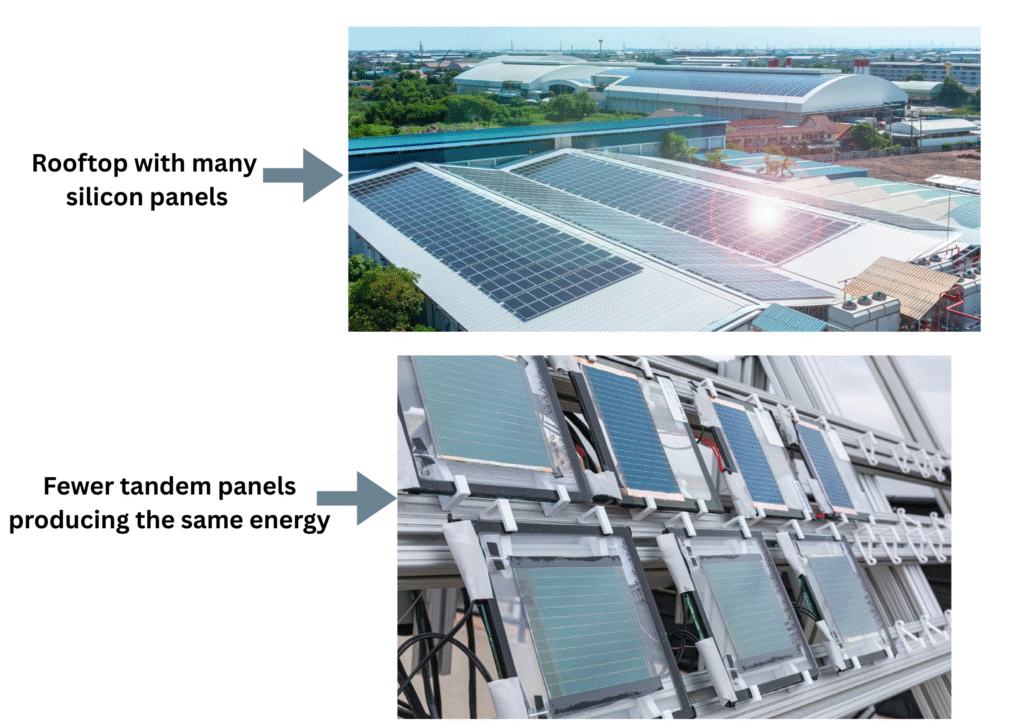
If your rooftop space is limited or has shaded areas, the tandem solar panels are an ideal option for you. This type of solar panel generates more electricity using fewer panels. You don’t have to cover your entire rooftop space to meet energy requirements.
- Lower Electricity Bills
Tandem solar panels are highly efficient, which means more energy production. You don’t have to pay any extra electricity bills. This also leads to better returns over time.
- Ideal for all Weather Conditions
Tandem solar panels can absorb a wider range of sunlight. They can generate a consistent amount of energy even when the sunlight is not strong. They perform well in all weather conditions, such as cloudy days, late afternoons, early mornings, and in shaded regions.
- Enhance Property Value
Properties with energy-efficient systems are usually more attractive to buyers. The tandem solar panels are highly efficient, and they offer long-term energy savings and long-term sustainability. This can increase your home’s resale value.
- Supports Clean Energy Goals
The tandem solar panels offer a more effective way to produce clean energy and reduce the carbon footprint. It offers high energy output by using fewer solar panels, which leads to lower material use and less electronic waste over time.
- Future Proof Technology:
The tandem solar panels use advanced materials such as perovskites and advanced thin films. These materials can be tuned for different light absorption ranges and integrated into next-generation building designs.
- Compatibility with Smart Energy Systems
The tandem solar panels can be easily integrated into smart energy systems such as smart inverters, smart grid technologies, and electric vehicle charging setups.
Reference: How tandem solar cells can speed the energy transition
Limitations of Tandem Solar Panels
- Tandem solar panels require multiple layers of different materials, advanced fabrication techniques, etc., which increases their manufacturing cost. So, these solar panels will be less affordable to average consumers.
- The most common element used in designing tandem solar cells is perovskite, which may degrade when exposed to high temperatures, heat, and moisture.
- The tandem solar panels are not widely available in the commercial market. Small volumes are produced for pilot projects or testing programs.
- These advanced solar systems may not always be compatible with standard solar system components. This may lead to extra installation costs.
- Its complex manufacturing process may slow down its production process.
When Will Tandem Solar Be Available for Homes?
Presently, the tandem solar panels are under development or in the pilot production phase. These are only used in research and test installations. Therefore, early residential availability is expected between 2025 and 2027. According to experts, the tandem solar panels will be widely available in commercial markets in 2028 and beyond.
Is It Worth Waiting for Tandem Panels?
If you are not in a hurry to install solar panels, here are a few reasons why it is worth waiting for tandem solar panels.
- Tandem panels can produce more electricity per square foot. So, if your rooftop space is limited, it is ideal to wait for tandem solar panels.
- It requires fewer mounting materials, reduces rooftop weight, and offers a cleaner design.
- The tandem solar panels offer future-ready performance and can be easily integrated into a smart energy management system. Waiting may allow you to invest in a system that stays relevant for decades.
Conclusion
The advanced tandem solar panels use multiple layers of solar materials and can convert more sunlight into usable electricity. This increases their efficiency far beyond traditional solar panels. Although not widely available commercially, this advanced solar technology is already being tested in real-world applications. With improved power output, enhanced space efficiency, and long-term reliability, tandem solar panels are gaining more attention from solar users. If you’re planning a long-term solar strategy for your home, it’s smart to watch the tandem market closely. These solar panels could soon become a common choice for homeowners and businesses looking to get more from every ray of sunlight.
FAQS
- When will tandem solar be available for homes?
Early residential availability is expected between 2025 and 2027. According to experts, the tandem solar panels will be widely available in commercial markets in 2028 and beyond.
2. What are tandem solar panels?
The word “Tandem” denotes working together. Tandem solar panels are an advanced solar technology where two or more layers of different solar materials work in tandem or stacked on top of each other to absorb sunlight. Each layer captures energy from different wavelengths of sunlight.
3. Why are tandem solar cells better?
Each layer of the tandem solar panel captures energy from different wavelengths of sunlight. This layered structure makes the solar panel highly efficient by converting more sunlight into electricity and reducing energy loss. Thus, the tandem solar panels are more efficient than traditional silicon-only panels. The laboratory results show the efficiency of tandem solar panels to be approximately 28% to 33% efficiency, whereas the efficiency of traditional solar panels ranges between 16% to 22%.
Also Read:
- Self-Cleaning Solar Panels: No More Manual Cleaning from Now On
- Dual Glass Solar Panel: A Simple and Long-Lasting Investment for Homeowners
- Anti-Reflective Solar Panels: A Smart Way to Maximize Rooftop Efficiency
- Graphene-Coated Solar Panels: The Next Big Thing in Residential Solar Panels
- Utilization of AI in Optimal Site Selection of Renewable Energy Projects: A Complete Guide
- A Practical Guide to Transparent Solar Panels: How Home Windows Can Produce Electricity?
- Smart Meters for Solar: The New Real-Time Energy Monitoring System in Rooftop Solar Systems
- Intelligent Solar Tracker: The Secret to More Solar Energy
- How to Optimize Energy Storage with AI Algorithms in Renewable Energy Systems?
- How to Enhance Solar Panel Efficiency with AI-Based Analytics?
- How Smart Inverters Help Balance Solar Power and Grid Supply? A Complete Guide
- Case Study: How Google Uses AI to Accelerate Grid Connections in the U.S.
- Case Study: How Duke Energy Uses AI for Grid Stability?
- How AI Strengthens Cybersecurity in Smart Grids? A Complete Guide
- How AI Is Used to Design the Perfect Rooftop Solar System? A Complete Guide
- How Is AI Used to Develop Advanced Materials for Renewable Energy Technologies?
Pingback: Crystalline Vs Thin-Film Solar Panels: Which One Is The Best for Your Modern Smart Homes? - science2energy
Pingback: Flexible Solar Panels: The Ideal Solution for Small and Irregular Spaces - science2energy
Pingback: Performance of Tandem Solar Cells in Real Pilot Solar Farms: A Case Study - science2energy
Pingback: What Size Solar Panel Kit Do You Need? Find the Right Solar Kit for Your Home - science2energy
Pingback: Microinverters vs String Inverters: Which Solar Inverter Should You Pick for Your Rooftop Solar System? - science2energy