
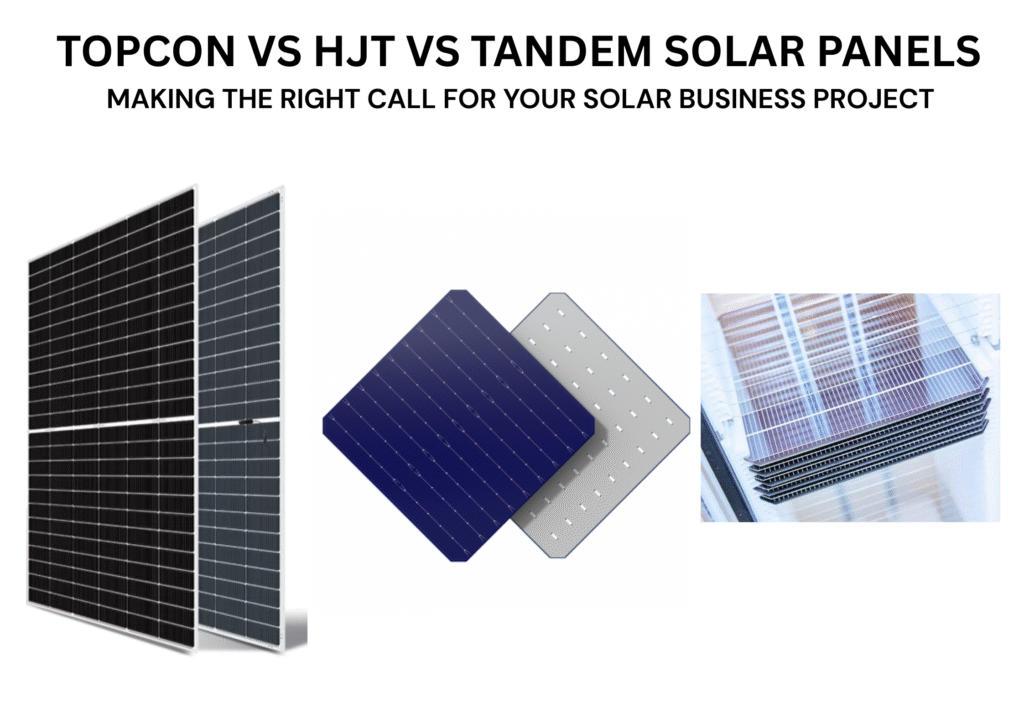
The solar industry is rapidly growing with advanced technologies promising improved performance, higher efficiency, and longer lifespans. Among them, the most prominent ones are TOPCon, HJT, and Tandem solar panels. Each technology has its unique strengths. But understanding their differences can help the commercial solar farm owners and homeowners make the best decision. This article explains the basic idea of each technology and offers a clear difference between “TOPCon Vs HJT Vs Tandem solar panels”. Read the full article, get a clear idea, and make the best purchase for your project.
Basic Idea
What Are TOPCon Solar Panels?
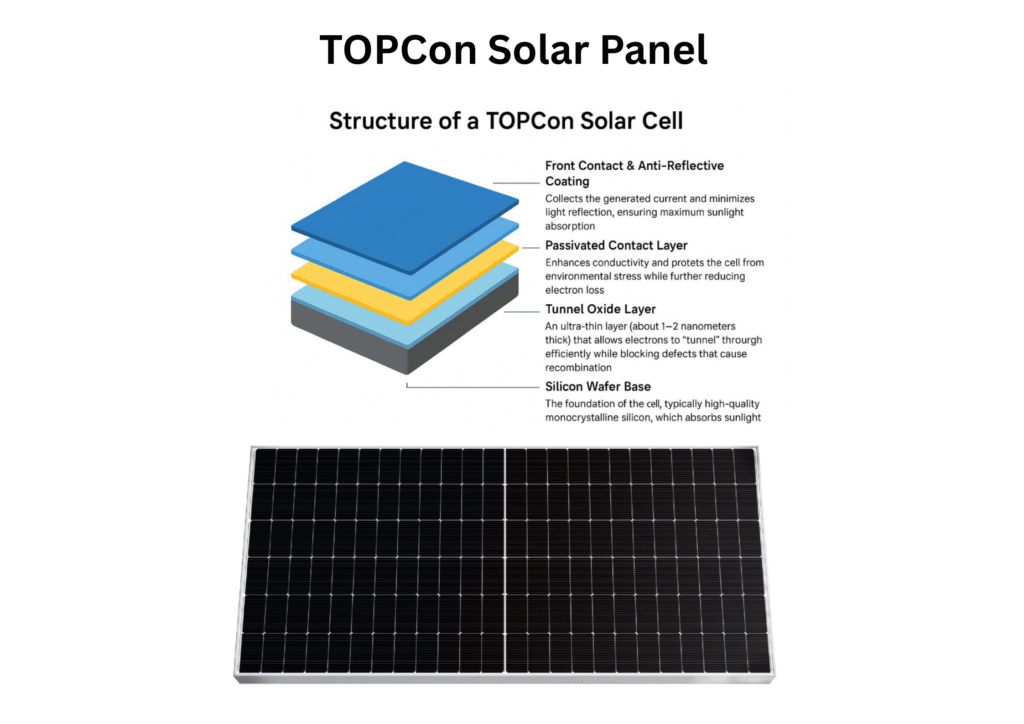
TOPCon denotes Tunnel Oxide Passivated Contact. The traditional solar panels use a P-type PERC (Passivated Emitter Rear Cell) cell, which utilizes a P-type silicon wafer as its base material. Whereas the latest N-type TOPCon solar panel is designed by utilizing an N-type silicon wafer as its base material.
The layered structure of a TOPCon cell includes an N-type silicon wafer, a thin tunnel oxide layer, and a passivated contact layer.
What Are HJT Solar Panels?
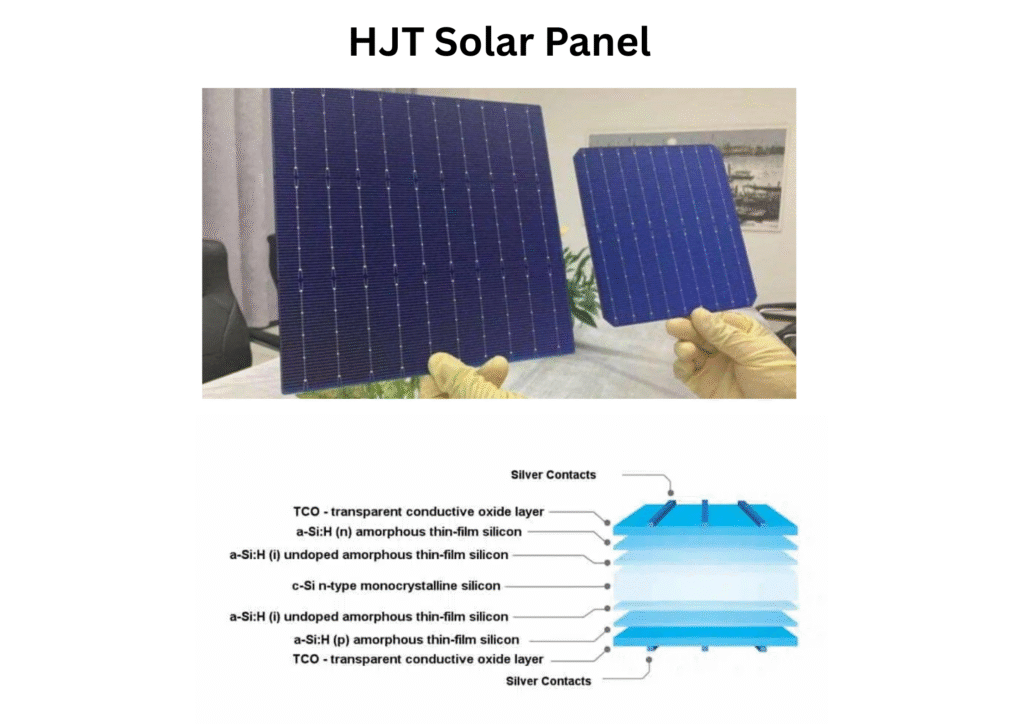
HJT represents Heterojunction solar technology. The HJT solar panel is designed by combining two different types of silicon layers, namely crystalline silicon and amorphous silicon, to form a hybrid solar cell.
The structural layout of the HJT solar panel looks like a sandwich-like structure. The center layer is made of a monocrystalline silicon wafer, and ultra-thin layers of amorphous silicon (a-Si) are applied on both sides of it. Two different types of semiconductor materials meet and form a heterojunction. Each side also has a transparent conductive oxide (TCO) layer and metallic contacts. These layers are used to collect and transport electricity.
What Are Tandem Solar Panels?
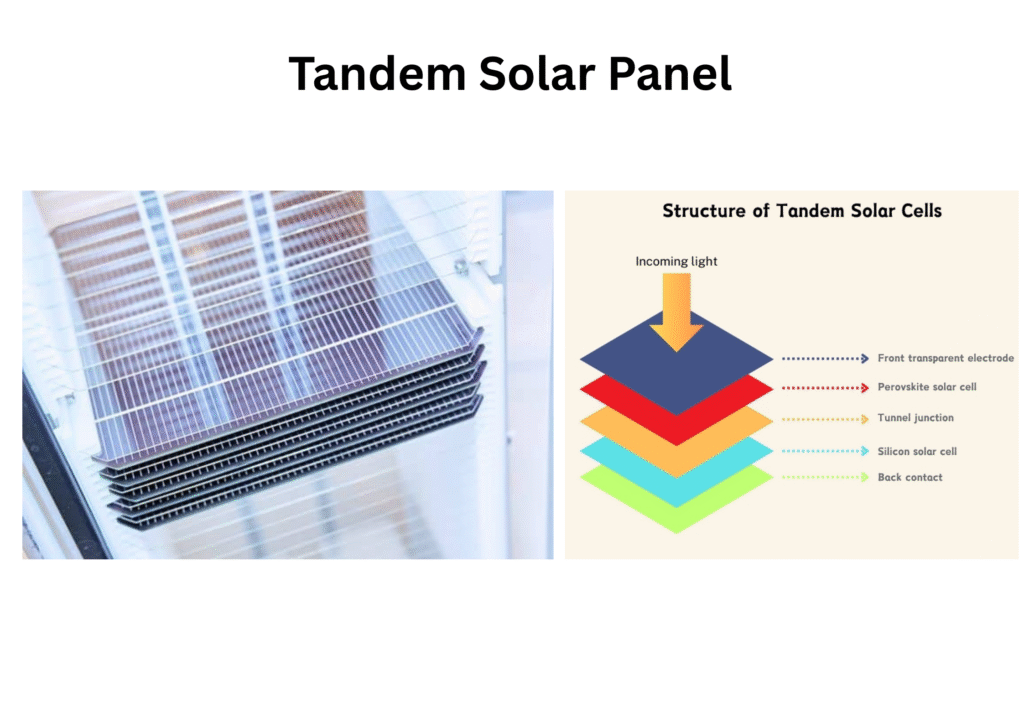
The word “Tandem” denotes working together. Tandem solar panels are an advanced solar technology where two or more layers of different solar materials work in tandem or stacked on top of each other to absorb sunlight. Each layer captures energy from different wavelengths of sunlight. This layered structure makes the solar panel highly efficient by converting more sunlight into electricity and reducing energy loss. Thus, the tandem solar panels are more efficient than traditional silicon-only panels.
TOPCon Vs HJT Vs Tandem Solar Panels: A Comparative Analysis
| TOPCon Solar Panel | HJT Solar Panel | Tandem Solar Panel | |
| Basic Idea | TOPCon denotes Tunnel Oxide Passivated Contact. The N-type TOPCon solar panel is designed by utilizing an N-type silicon wafer as its base material. The layered structure of a TOPCon cell includes an N-type silicon wafer, a thin tunnel oxide layer, and a passivated contact layer. | HJT represents Heterojunction solar technology. The HJT solar panel is designed by combining two different types of silicon layers, namely crystalline silicon and amorphous silicon, to form a hybrid solar cell. | The word “Tandem” denotes working together. Tandem solar panels are an advanced solar technology where two or more layers of different solar materials work in tandem or stacked on top of each other to absorb sunlight. |
| Efficiency | Its efficiency ranges from 23-24%. | Its efficiency ranges from 24% or more. | The efficiency of commercial modules is approximately 28%. |
| Temperature coefficient | The temperature coefficient is very low, i.e., approximately -0.29%/°C. | The temperature coefficient is approximately -0.25%/°C. | The temperature coefficient is approximately -0.26%/°C. |
| Ideal Use for | TOPCon solar panels are ideal for limited space and in sunny climate regions. They offer high efficiency at a moderate cost. | HJT solar panels are ideal for projects in both extremely hot and cold climates. They are ideal for low-light regions and projects that need a longer lifespan. | Tandem solar panels are ideal for locations with highly variable sunlight. |
| Cost | The prices of TOPCon solar panels are falling as production scales. | These solar panels are slightly more expensive. | Tandem solar panels are currently the costliest. |
| Low Light Performance | Good | Excellent | Excellent |
| Market Availability | These solar panels are expected to become the mainstream choice shortly. Availability is high. | The availability of HJT solar panels is growing in the market. | Tandem solar panels are emerging and are still in early commercialization. |
Ideal Conditions to Choose Each Technology
Ideal Conditions to Choose TOPCon Solar Panel
- If your roof space is limited or you have compact rooftops, the TOPCon solar panel is an ideal option for you. It is a highly efficient solar panel with an efficiency of up to 23-24%. It can produce a high amount of electricity from fewer solar panels.
- If you are living in a hot climate region such as Arizona, Nevada, or Texas, then TOPCon solar panels are highly suitable for you. These panels have a lower temperature coefficient and perform efficiently in high temperatures.
- If you are living in an area with frequent cloud cover, such as coastal regions with fog or areas where sunlight is less intense, you should choose TOPCon solar panels for your home. These solar panels can also work in low-light conditions.
- If you are thinking of a long-term investment, TOPCon solar panels are an ideal option for you. These panels work excellently for 25-30 years with a lower annual degradation rate.
- In areas where grid electricity is expensive, TOPCon solar panels help you save more on energy bills.
- TOPCon solar panels are ideal for sustainable building projects.
Ideal Conditions to Choose an HJT Solar Panel
- HJT solar panels are an ideal option for those living in high-temperature environments such as desert regions like Arizona and Nevada.
- The bifacial capability and thin-film layer of HJT solar panels make them ideal for locations with low or diffused light.
- If your rooftop is small or you live in urban commercial buildings with limited roof space, HJT solar panels are a good option for you. They can generate more electricity per square meter.
- For long-term commercial investment or projects requiring a long lifespan, HJT solar panels are ideal.
- HJT solar panels also perform well in cold climate regions. If you live in places like Minnesota, Maine, and Alaska, or high-altitude regions with snow coverage, HJT solar panels are a suitable option for you.
Ideal Conditions to Choose a Tandem Solar Panel
- Because of higher efficiency, tandem solar panels are ideal for space-constrained installations.
- Tandem solar panels can use both high- and low-energy photons efficiently. So, these solar panels are ideal for locations with high solar intensity.
- Areas with changing weather conditions, such as coastal regions or Mountainous regions, tandem solar panels perform better than traditional solar panels.
- For industrial projects or utility-scale solar farms with high power needs, tandem solar panels are an ideal option.
- Tandem solar panels are excellent options for green-certified building projects, research facilities, and universities.
Reference: The 2025 Market Guide to TOPCon, HJT, and Tandem Modules
Conclusion
If you are searching for highly efficient solar panels at competitive pricing with proven reliability, the TOPCon solar panel is an ideal option. HJT solar panels are the best options for people looking for highly durable solar panels with a lower degradation rate and all-weather performance. But if you are focused on achieving the highest possible efficiency and are ready to invest in emerging technology, then tandem solar panels are the most suitable option for you. Select the best one based on your project’s priorities.
FAQS
- Which one is more efficient: TOPCon, HJT, or Tandem solar panels?
Tandem solar panels are more efficient than TOPCon and HJT solar panels. The efficiency of commercial tandem solar modules is approximately 28%.
- Are Tandem solar panels available in the market?
Tandem solar panels are emerging and are still in early commercialization.
- Are HJT solar panels available in the market?
The availability of HJT solar panels is growing in the market.
Also Read:
- Case Study: How Bifacial Solar Panels Improved Output in the Nevada Desert?
- Performance of Tandem Solar Cells in Real Pilot Solar Farms: A Case Study
- Flexible Solar Panels: The Ideal Solution for Small and Irregular Spaces
- Crystalline Vs Thin-Film Solar Panels: Which One Is The Best for Your Modern Smart Homes?
- Tandem Solar Panels: The Future of Rooftop Solar
- Self-Cleaning Solar Panels: No More Manual Cleaning from Now On
- Dual Glass Solar Panel: A Simple and Long-Lasting Investment for Homeowners
- Anti-Reflective Solar Panels: A Smart Way to Maximize Rooftop Efficiency
- Graphene-Coated Solar Panels: The Next Big Thing in Residential Solar Panels
- Utilization of AI in Optimal Site Selection of Renewable Energy Projects: A Complete Guide
- A Practical Guide to Transparent Solar Panels: How Home Windows Can Produce Electricity?
- Smart Meters for Solar: The New Real-Time Energy Monitoring System in Rooftop Solar Systems
- Intelligent Solar Tracker: The Secret to More Solar Energy
- How to Optimize Energy Storage with AI Algorithms in Renewable Energy Systems?
- How to Enhance Solar Panel Efficiency with AI-Based Analytics?
- How Smart Inverters Help Balance Solar Power and Grid Supply? A Complete Guide

Pingback: HJT Solar Panels: A Right Solar Investment for Large Businesses - science2energy
Pingback: High-Wattage 450W Solar Panels: Are They Worth It for Your Home Roof Space? - science2energy
Pingback: Perovskite Solar Panels: The Future of Home Solar - science2energy
Pingback: Breaking Down Each Component of a 5kW Solar Panel Kit - science2energy
Pingback: Can Solid-State Batteries Keep the Lights on at Night? A Complete Guide - science2energy
Pingback: A Complete Guide to How a Wind Turbine Turns Air into Electricity: From Blades to Grid - science2energy