
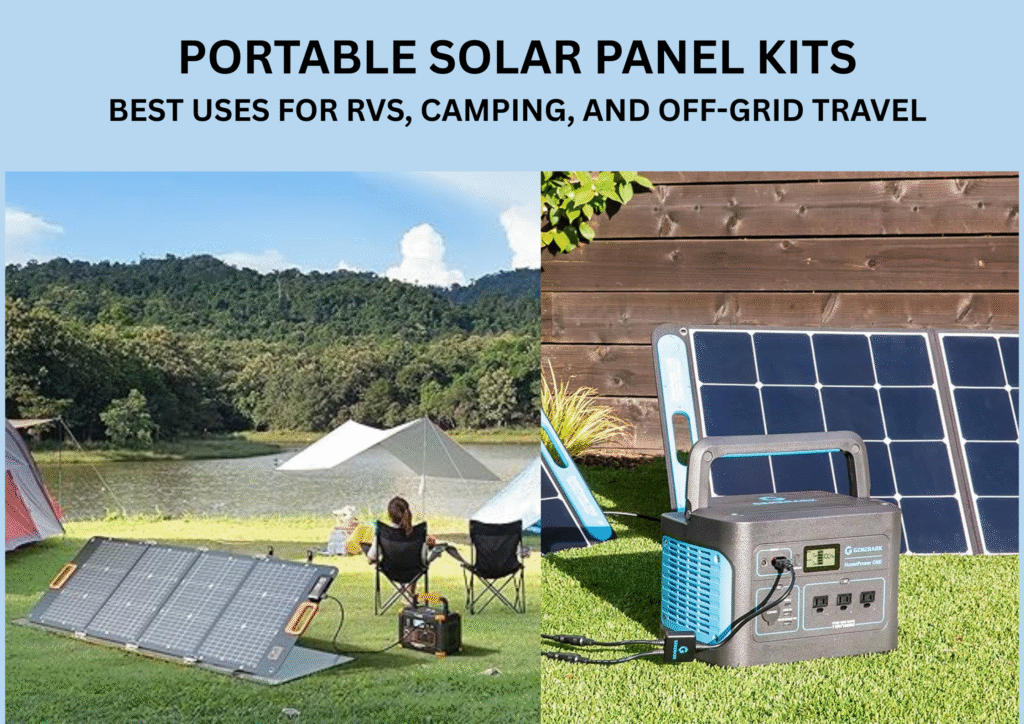
When grid electricity is unavailable, portable solar panel kits are a great option. They are portable, lightweight, and can be quickly installed to provide a flexible and reliable power source. These types of solar panels are an ideal option for individuals who require clean and independent electric power in various environments. These solar panels can directly power small devices or be used to charge a battery that can then run lights and small electronic appliances. This article provides you with a detailed technical explanation of portable solar panel kits.
What Is a Portable Solar Panel Kit?
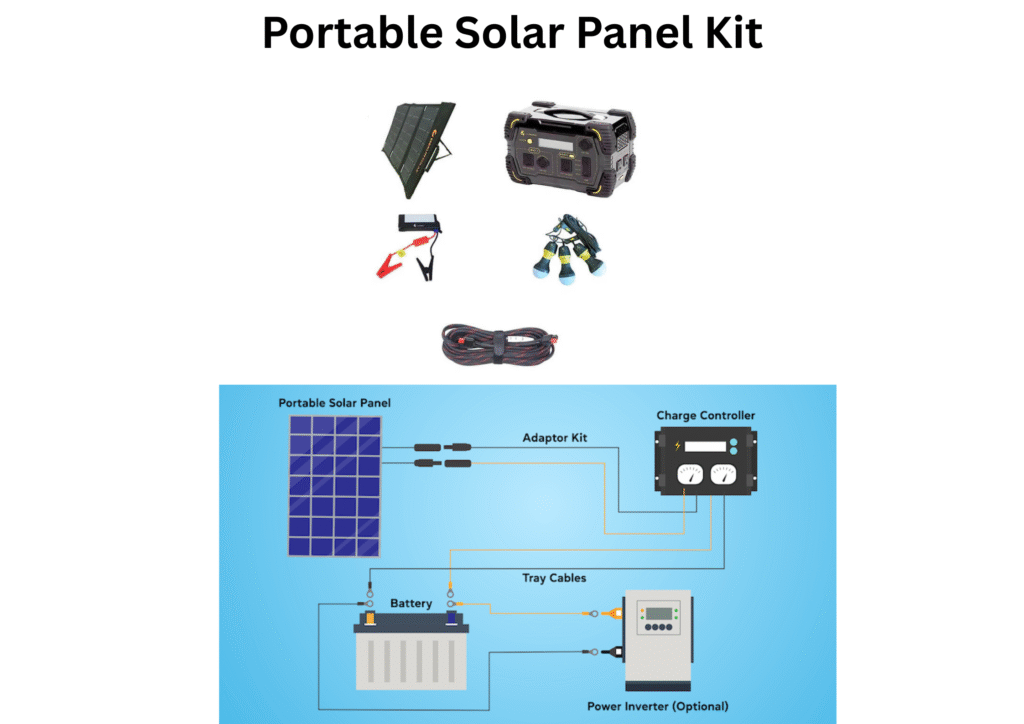
A portable solar panel kit is a self-contained, compact, and lightweight system designed to generate electricity from sunlight in remote or off-grid locations. This kit contains one or more foldable, lightweight pieces of equipment, including solar panels, a charge controller, cables, connectors, and sometimes a battery and an inverter.
With a portable solar panel kit, you can charge a battery and power small devices. This type of solar panel kit is commonly used for camping, emergency backup, RV travel, marine use, and outdoor activities.
When the sunlight hits the solar panel, direct current (DC) electricity is generated. The charge controller regulates the flow of electricity and protects the battery. The stored energy available in the battery is used later. If an inverter is available in the kit, it converts DC to alternating current (AC) for standard devices.
Types of Portable Solar Panel Kits
- Folding Solar Panel Kit
These solar panel kits are designed to fold down into a compact, easy-to-carry format. These kits consist of a built-in handle, 10A or 20A charge controller, multiple thin solar modules, and pre-attached cables. They can be quickly folded or unfolded for fast deployment and are ideal for backpacking, tent camping, and 12V battery charging. The power ratings of these solar panels range from 40W to 200W.
- Briefcase Solar Panel Kit
This type of solar panel kit consists of two or more rigid solar modules packed into a hard aluminum case, and the panels open out like a suitcase. The kit also includes integrated legs for optimal tilt angle, Anderson or MC4 connectors, and is equipped with a kickstand. The power ratings of these solar panels range from 80W to 300W.
- All-in-One Portable Solar Generator Kits
This type of portable solar panel kit consists of a solar panel, a lithium battery, a charge controller, and an inverter in one integrated unit. This kit also features AC outlets and USB ports, allowing users to obtain both AC and DC output immediately. These kits are ideal for emergency backup, medical devices, and mobile office power. The power ratings of these solar panels range from 100W to 400W.
- Flexible Portable Solar Panel Kits
The solar panels in this kit use thin-film or lightweight monocrystalline technology mounted on bendable backing. These are ultra-lightweight systems and are flexible up to 30° curvature for non-flat surfaces. These solar panels can be installed on curved roofs, boat decks, or tents. The power ratings of these solar panels range from 50W to 150W.
- Rollable / Solar Blanket Kits
These are advanced lightweight panels that roll or fold like a blanket. With high portability and easy storage features, these kits are ideally used by field engineers, military operations, and telecom stations. The power ratings of these solar panels range from 40W to 120W.
Best Uses of a Portable Solar Panel Kit
- RV owners and travel trailers use portable solar panel kits to keep onboard batteries charged and run low-power appliances such as lighting, fans, water pumps, and small refrigerators.
- Lightweight and easy-to-carry portable solar panel kits are used for tent camping to charge mobile devices, lanterns, and GPS units.
- These are also used in mobile cabins, survey stations, and monitoring sites to run tools, measurement devices, and communications equipment.
- Portable solar kits are used during natural disaster relief camps to provide emergency backup power. They provide backup power for phones, medical devices, and lighting systems.
- These are used in marine and boat applications to charge on 12V batteries and run navigation and safety equipment.
- Portable solar panel kits are used in outdoor events and mobile businesses such as food stalls, event booths, and mobile service trucks, etc.
How to Select the Right Portable Solar Panel Kit?
Here is a detailed technical guide to help you select the right portable solar panel kit for your home or business.
- Calculate Your Power Needs
Before purchasing, first calculate the total power consumption of the devices you want to run. Calculate the daily usage by multiplying the watt ratings of each device by the number of hours you plan to use it in a day.
Daily Energy Usage (Watt-hours) = watt ratings of each device (Watt) x Number of hours
- Match the Solar Panel Wattage with the Load Demand
While calculating the load demand, also consider weather variations and conversion losses. So, the solar panel rating should always exceed the daily energy usage.
| Daily Energy Usage | Recommend Panel Size |
| Below 200Wh | 40W to 100W |
| 200–500Wh | 120W to 300W |
- Check the Storage Capacity of the Battery
If your portable solar panel kit includes a battery, its storage capacity must be equal to or larger than the daily load. For small electronics and camping gear, the battery capacity should be 200Wh–500Wh. Whereas, for laptops, mini-fridges, and small electronic appliances, the storage capacity should be 500Wh–1000Wh, and for RV appliances, and for emergency use, it should be more than 1000Wh.
- Voltage and Connectors of The Kit
For household devices, the output type should be 120V AC, and for RV batteries and 12V appliances, it should be 12V DC. Whereas, for phones and tablets, the output type should be USB-A / USB-C. While purchasing a portable solar panel kit, also verify the connector type (MC4, Anderson, DC5521, XT60) for compatibility.
- Durability
When selecting a portable solar panel kit, look for its durability, including an IP65 or higher waterproof rating, scratch-resistant tempered glass, and UV-resistant materials.
- Solar panel’s efficiency
| Type of Solar Panel | Efficiency | Advantages |
| Monocrystalline | 18% to 23% | High output in a limited space |
| Polycrystalline | 15% to 18% | Lower cost |
| Thin-Film | 10% to 12% | Lightweight and flexible |
- Check for certifications
While purchasing a portable solar panel kit, always check for certifications and safety compliances such as UL Listed, CE, FCC, etc.
Reference: How to Use Solar Panels for Camping
Advantages of a Portable Solar Panel Kit
- Lightweight and Easy to Carry
The portable solar panel kits are lightweight and designed with foldable or suitcase-style frames for fast deployment. The users can easily carry and set up in minutes. So, these are ideal for travel, camping, and fieldwork.
- Plug-and-play Operation
These solar panel kits consist of connectors, a charge controller, and cables. You don’t need any wiring knowledge or any external tools to fix it. The users just have to plug the devices directly.
- Operates Without Noise
The portable solar panel kits have no moving parts. So, they produce electricity without noise, emissions, or fuel consumption. The clean and silent power generation makes them ideal for quiet zones and protected environments.
- High Energy Efficiency
The portable solar panel kits are highly energy efficient. They use high-conversion monocrystalline or advanced thin-film modules to generate maximum power even under variable sunlight.
- Highly Flexible
These solar panel kits can power a wide range of AC and DC devices. They are used for various purposes, including lighting, charging laptops, navigation tools, small electronic equipment, and emergency equipment. They are used to provide critical power in emergency and disaster situations.
- Requires Minimal Maintenance
The portable solar panels require only occasional cleaning of the panel surface. They don’t need any replacement of oil or spark plugs. As there are no engines, filters, or mechanical parts, they require minimal maintenance.
Disadvantages of a Portable Solar Panel Kit
- The compact design of portable solar panels limits the amount of energy they generate.
- These solar panel kits depend on direct sunlight to generate electricity. So, power output reduces in cloudy weather, shade, and low sunlight hours.
- The lifespan of portable solar panels is shorter than that of fixed panels.
- The storage capacity of batteries associated with these solar panel kits is moderate. They quickly deplete with continuous use.
- The portable solar kits generally cost more per watt than permanent installations.
Conclusion
Portable solar panel kits offer a wide variety of off-grid and outdoor applications. They consist of highly efficient solar panels with essential components like charge controllers and batteries. They provide clean and reliable electricity and can be used for powering small electronic equipment, RVs, camping equipment, and emergency systems. For long-term performance and safe outdoor operation, always select certified products with higher efficiency levels.
FAQS
- What is a portable solar panel kit?
A portable solar panel kit is a self-contained, compact, and lightweight system designed to generate electricity from sunlight in remote or off-grid locations. This kit contains one or more foldable, lightweight pieces of equipment, including solar panels, a charge controller, cables, connectors, and sometimes a battery and an inverter.
- What is a folding solar panel kit?
These folding solar panel kits are designed to fold down into a compact, easy-to-carry format. These kits consist of a built-in handle, 10A or 20A charge controller, multiple thin solar modules, and pre-attached cables. They can be quickly folded or unfolded for fast deployment.
- What is an all-in-one portable solar generator kit?
An all-in-one portable solar generator kit consists of a solar panel, a lithium battery, a charge controller, and an inverter in one integrated unit. This kit also features AC outlets and USB ports, allowing users to obtain both AC and DC output immediately. These kits are ideal for emergency backup, medical devices, and mobile office power. The power ratings of these solar panels range from 100W to 400W.
Also Read:
- Breaking Down Each Component of a 5kW Solar Panel Kit
- What Size Solar Panel Kit Do You Need? Find the Right Solar Kit for Your Home
- Perovskite Solar Panels: The Future of Home Solar
- High-Wattage 450W Solar Panels: Are They Worth It for Your Home Roof Space?
- The Rise of 600W+ High-Power Panels in Commercial Solar Farms
- HJT Solar Panels: A Right Solar Investment for Large Businesses
- N-Type TOPCon Solar Panel: A Complete Guide
- TOPCon Vs HJT Vs Tandem Solar Panels: Make The Best Purchase for Your Project
- Case Study: How Bifacial Solar Panels Improved Output in the Nevada Desert?
- Performance of Tandem Solar Cells in Real Pilot Solar Farms: A Case Study
- Flexible Solar Panels: The Ideal Solution for Small and Irregular Spaces
- Crystalline Vs Thin-Film Solar Panels: Which One Is The Best for Your Modern Smart Homes?
- Tandem Solar Panels: The Future of Rooftop Solar
- Self-Cleaning Solar Panels: No More Manual Cleaning from Now On
- Dual Glass Solar Panel: A Simple and Long-Lasting Investment for Homeowners
- Anti-Reflective Solar Panels: A Smart Way to Maximize Rooftop Efficiency
- Graphene-Coated Solar Panels: The Next Big Thing in Residential Solar Panels
- Utilization of AI in Optimal Site Selection of Renewable Energy Projects: A Complete Guide
- A Practical Guide to Transparent Solar Panels: How Home Windows Can Produce Electricity?

Pingback: Are DIY Solar Panel Kits Worth It? A Complete Guide - science2energy
Pingback: Microinverters vs String Inverters: Which One Is the Best Solar Inverter for Your Rooftop Solar System? - science2energy
Pingback: A Complete Guide to How a Wind Turbine Turns Air into Electricity: From Blades to Grid - science2energy
Pingback: How Wind Direction and Speed Affect Wind Turbine Performance? A Complete Guide - science2energy
Pingback: How Smart Wind Turbine Blades Are Redefining the Future of Wind Energy? - science2energy
Pingback: Machine Learning in Wind Energy Forecasting: The Future of Smart Grids - science2energy