
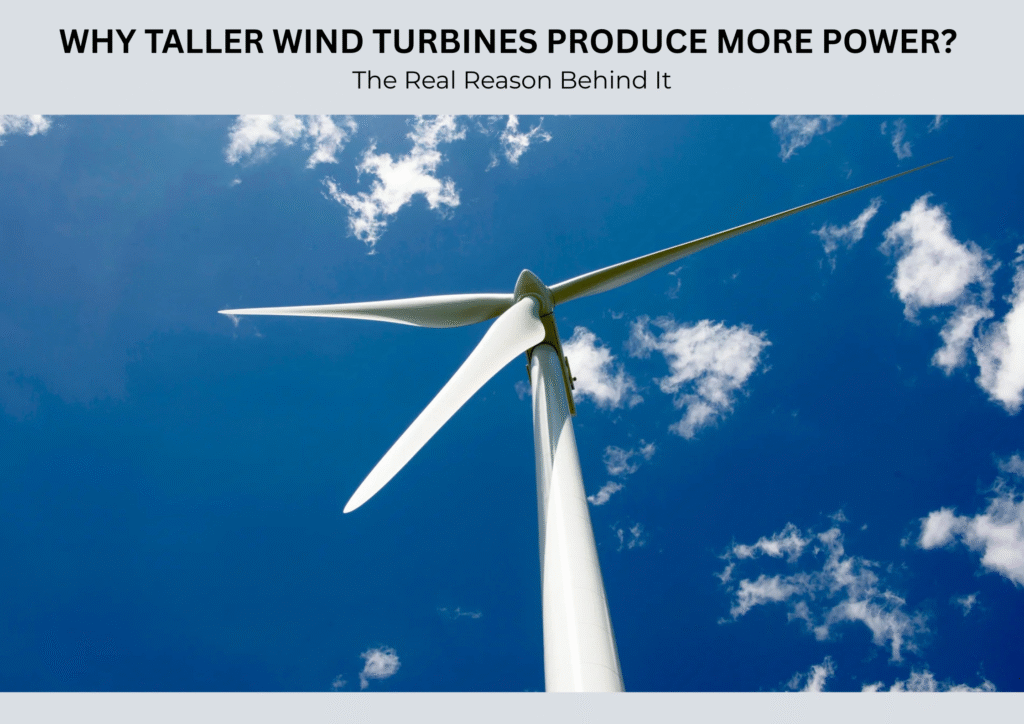
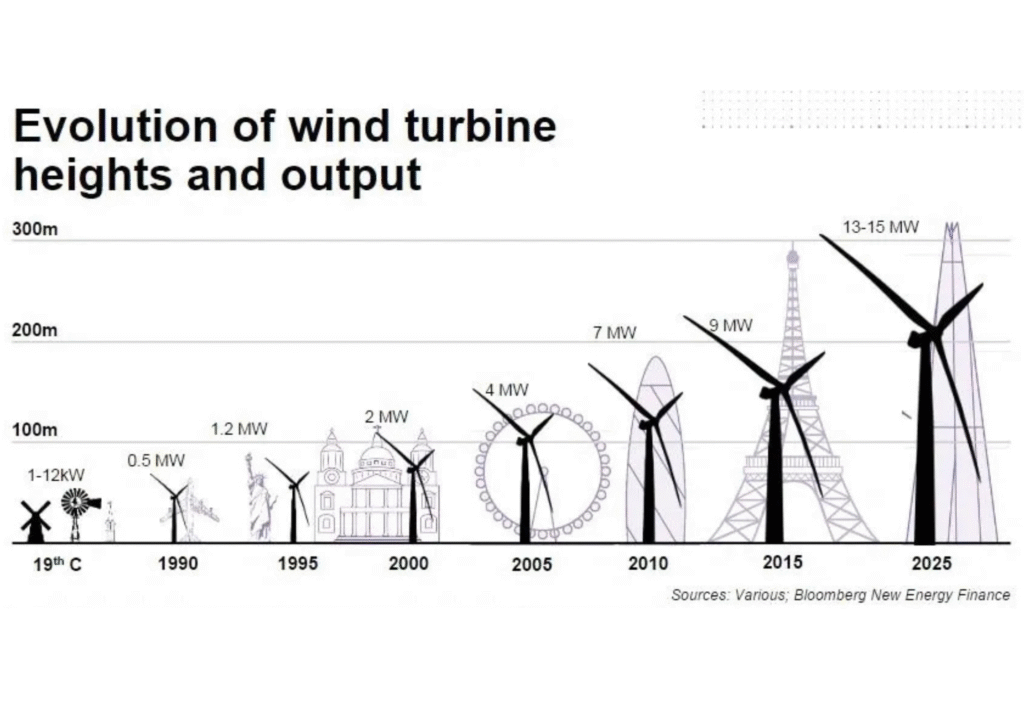
Have you ever noticed that modern wind turbines seem to be getting taller every year? It is not just a design trend. There are some practical reasons behind it. Taller wind turbines produce more power than shorter ones. Nowadays, the utility-scale wind turbines often stand 100 to 160 meters tall, which were 60-80 meters just twenty years ago. Practically, it is seen that raising a turbine by just 20-40 meters can increase power production by 20% to 40%. Why do taller turbines produce more power? This article explains the science behind the turbine height. Read the full article and explore the real reason behind it.
How a Wind Turbine Converts Wind into Electricity?
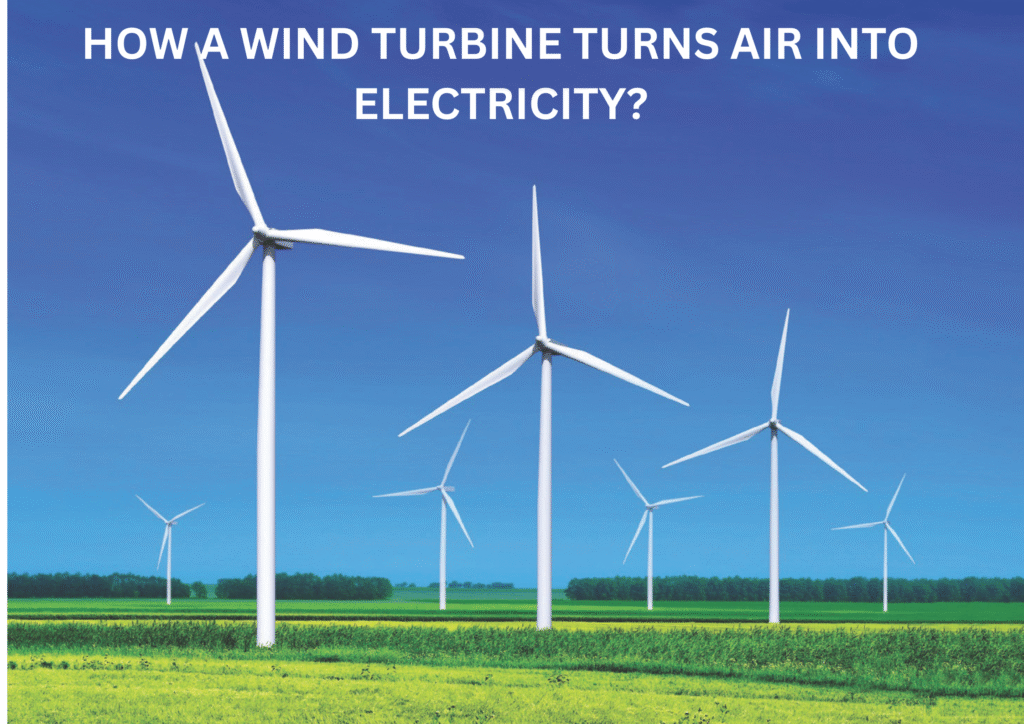
The wind turbines convert the natural movement of air into electricity. When the wind flows across the turbine blades, an air pressure difference is created that lifts and rotates the blades. The blades are connected to a central hub and creating a turbine rotor.
As the rotor turns slowly, a gearbox is connected to increase the rotational speed to a much higher speed suitable for a generator to produce power. The high-speed shaft of the gearbox drives the generator. The generator converts the mechanical rotation into electrical energy by using the electromagnetic induction process.
Relationship Between Wind Speed and Power
Besides the direction and consistency of the wind, it is the speed of the moving air that directly influences the amount of power produced. The mathematical relationship between wind speed and power available in the wind is explained below.
P=ρ×A×V^3
Here, P = Power (Watts)
ρ = Air Density (kg/m³)
A = Area covered by the turbine blades (m²)
V = Wind Speed (m/sec)
The formula represents that as rho and A are constant values, the output power increases with the cube of the wind speed. This means that the power increases exponentially with wind speed, and small speed changes can lead to significant variations in power output.
The power curve graph of wind turbines has 3 main regions. It represents how much power the wind turbine produces at different wind speeds.
- Cut-in Speed: Here, the wind speed usually ranges between 3 to 4 m/sec. This is the minimum amount of wind speed required to start turning the blades and generate power.
- Rated Speed: The rated speed falls between 12 to 15 m/sec. At rated speed, the wind turbine generates maximum power and maintains a constant output even if the wind speed continues to increase.
- Cut-out Speed: The cut-out speed is usually around 25 m/sec. If the wind speed reaches above this safe limit, the wind turbine automatically stops operating to prevent mechanical damage.
At low wind speed, the wind turbine operates at a reduced efficiency and generates very little power. At moderate wind speeds, the turbines operate efficiently and generate stable electricity. Whereas, at high wind speeds, the turbines must limit their rotation speed to avoid damage.
Reference: Evaluation of different turbine concepts for wind power
Explanation of wind shear
Wind shear is defined as a significant change in wind speed and direction while moving vertically upward from the ground. The wind speed is slow near the surface due to the friction between moving air and the ground. Whereas the wind moves faster and more smoothly over open water or flat plains due to less friction.
As height increases, the effect of friction becomes weaker, and the wind moves faster and more smoothly.
Why does wind speed increase with height?
The wind speed increases with height due to the following reasons.
- Fewer obstructions allow the wind to travel faster.
- As height increases, airflow becomes more uniform.
- Wind momentum is preserved more effectively.
So, the wind at 80 feet above the ground moves faster than the wind at 30 feet as it encounters less friction.
Reference: Wind Turbines: the Bigger, the Better
Importance of Blade Length and Swept Area
As the turbine blades rotate around the hub, the circular area covered by the blades is known as the swept area. The swept area can be calculated as
Swept Area=π×(Blade Length)^2
As the swept area is proportional to the square of blade length, a small increase in blade length results in a much larger increase in swept area. This is the main reason why the length of wind turbine blades has grown over the years.
Why do larger blades capture more energy?
As the length of wind turbine blades increases, the swept area increases. The larger swept area means more air the blades can interact with and more energy they can extract. And finally, more energy capture leads to higher power output.
The longer blades can access higher-quality wind. When the blade tips reach higher into the air, they encounter smoother and faster wind with less turbulence. This generates consistent power, improves the turbine’s efficiency, and enhances the system’s reliability.
Significance of the Capacity Factor
Capacity Factor=Actual Energy Output÷Maximum Possible Energy Output
The rated power of a wind turbine refers to the highest amount of electricity it can produce under ideal wind conditions. Due to the varying wind conditions throughout the day and across seasons, the output power continuously changes.
The capacity factor is represented as a percentage. A higher percentage means more efficient use of available wind resources. The capacity factor describes how much useful electricity it actually delivers throughout the year.
The capacity factor is used to compare different turbine models. It helps in estimating the long-term energy production of a wind turbine. It also helps in calculating the economic value of a wind project.
The capacity factor of a wind turbine system depends on
- Wind resource quality
- Blade Design
- Turbine Height
- Location of the Wind Turbine
| Type of Wind Turbines | Capacity Factor (Approximate) |
| Small Residential Turbines | 10% to 25% |
| Onshore Commercial Wind Farms | 25% to 40% |
| Offshore Wind Farms | 40% to 55% |
The capacity factor of offshore wind farms is generally higher as the winds over open water are stronger and more consistent.
Why Taller Wind Turbines Produce More Power?
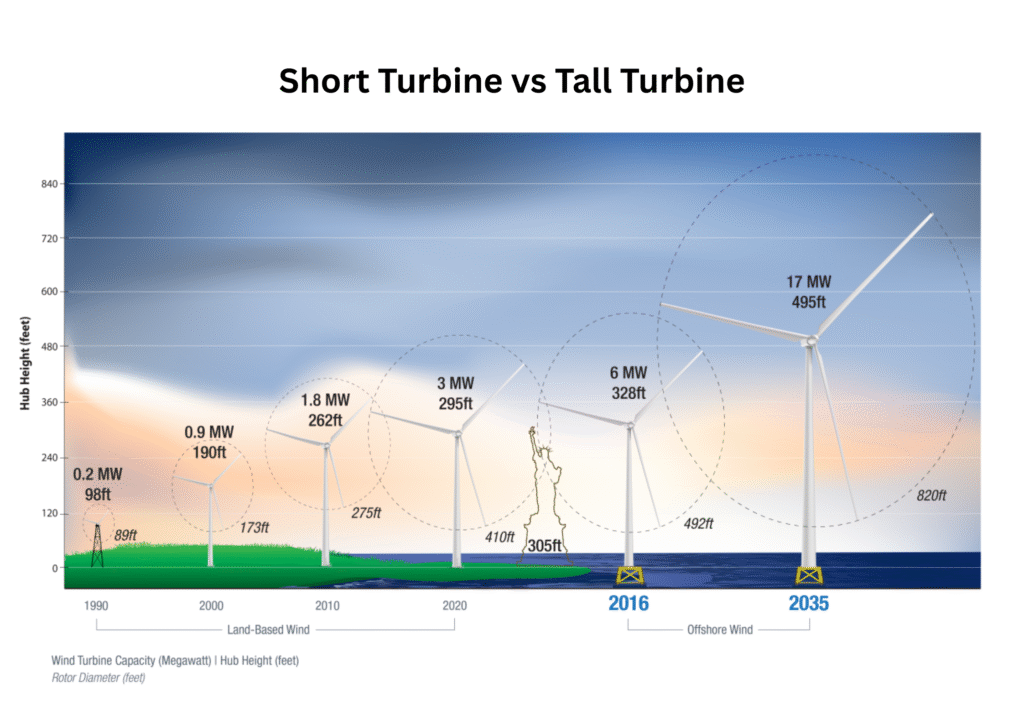
Taller wind turbines produce more power due to the following reasons.
- As you move higher above the surface, there are fewer obstacles such as buildings, trees, and hills. Fewer obstacles allow the wind to move freely. So, the wind speed increases with height.
As the output power increases with the cube of the wind speed, a small increase in wind speed has a large effect on electricity generation.
The taller towers place the wind turbines at a higher place, which leads to much greater energy capture.
- Near the ground, the surface obstacles change the wind speed and wind direction. The uneven forces created by this turbulence can reduce efficiency.
As the height increases, the airflow becomes more stable. This allows the turbine to rotate more smoothly, thereby improving both the performance and reliability of the wind turbine.
- Longer blades cover a larger swept area, and this increases the energy production level. However, longer blades require enough ground clearance to avoid obstacles and ensure safe rotation. The taller towers provide the necessary space for these blades to rotate.
So, a combination of taller towers with larger blades can capture more wind energy per rotation and generate more power. It increases overall energy production without requiring stronger average winds.
- Taller wind turbines get higher average wind speed throughout the year. It offers a consistent performance in varied weather conditions.
- Taller turbines cost more to manufacture and install. However, the cost of energy generated in kilowatt-hours is lower. Installing taller wind turbines is one of the most effective ways to improve wind energy profitability.
Reference: Increasing Wind Turbine Tower Heights: Opportunities and Challenges
Cost Considerations
- Taller wind turbines require more steel, reinforced concrete, and structural support to handle greater forces from wind loading. This increases the manufacturing cost. Along with this, longer blades also need advanced composite materials, which increases the overall cost.
- For taller wind turbines, large components are required, such as heavy nacelles, long tower sections, and oversized blades. Transporting these heavy materials over long distances increases the budget.
- Installation of taller wind turbines requires larger cranes and more advanced construction equipment. This equipment is expensive to rent, operate, and mobilize.
- Accessing components at a greater height is more complex. It needs specialized lifts, climbing equipment, and certified crews. This improves the maintenance cost.
Recent Advancements in Wind Turbine Height, tower materials, and modular tower construction
- Turbine heights are increasing to capture more power
The modern wind turbines are designed with a hub height of 100 to 140 meters, with some utility-scale systems exceeding 160 meters.
- Advanced Tower Materials
- Hybrid steel concrete towers are designed that use concrete at the lower sections of the tower for strength and steel for the upper segments.
- Pre-stressed concrete towers are designed that offer high structural stability and are less affected by environmental wear.
- Advanced composite materials are used to design blades, such as fiber-reinforced polymers. These materials reduce weight while maintaining strength, supporting taller, more flexible designs.
- Modular and Segmental Tower
Towers are built in smaller, manageable sections whose components can be assembled on-site rather than delivered as large, single segments.
Conclusion
At higher altitudes, the wind turbine gets faster, smoother, and more consistent winds. Also, at a greater height, the tower supports larger blades that capture more kinetic energy. So, larger blades paired with taller towers can capture more wind energy per rotation and operate efficiently to produce more power. This is why modern turbines are designed with taller towers and longer, aerodynamically shaped blades that can cover a wide section of air to generate maximum electricity.
FAQS
- What is the relationship between wind speed and the output power of a wind turbine?
The output power increases with the cube of the wind speed. This means that the power increases exponentially with wind speed, and small speed changes can lead to significant variations in power output.
2. What is the meaning of capacity factor?
The capacity factor is represented as a percentage. A higher percentage of capacity factor means more efficient use of available wind resources. The capacity factor describes how much useful electricity the wind turbine actually delivers throughout the year.
Also Read:
- A Step-by-Step Guide to Design a Small Wind Turbine System
- Can a Small Wind Turbine System Power Your Entire House? A Practical Guide
- The Evolution of Wind Power: How Wind Power Is Shaping the Future of Renewable Energy Grids?
- How Wind Direction and Speed Affect Wind Turbine Performance? A Complete Guide
- A Complete Guide to How a Wind Turbine Turns Air into Electricity: From Blades to Grid
- Importance of AI-Driven Predictive Maintenance in Wind Energy Systems
- Are DIY Solar Panel Kits Worth It? A Complete Guide
- Portable Solar Panel Kits: Best Uses for RVs and Camping
- Breaking Down Each Component of a 5kW Solar Panel Kit
- What Size Solar Panel Kit Do You Need? Find the Right Solar Kit for Your Home
- Perovskite Solar Panels: The Future of Home Solar
- High-Wattage 450W Solar Panels: Are They Worth It for Your Home Roof Space?
- The Rise of 600W+ High-Power Panels in Commercial Solar Farms
- HJT Solar Panels: A Right Solar Investment for Large Businesses
- N-Type TOPCon Solar Panel: A Complete Guide
- TOPCon Vs HJT Vs Tandem Solar Panels: Make The Best Purchase for Your Project
- Case Study: How Bifacial Solar Panels Improved Output in the Nevada Desert?
- Performance of Tandem Solar Cells in Real Pilot Solar Farms: A Case Study
Pingback: Can Wind Turbines Operate Efficiently in Low-Wind Regions? What You Need to Know? - science2energy
Pingback: A Technical Look at Offshore Wind Farms - science2energy
Pingback: Liquid Air Energy Storage: How Liquid Air Can Store Renewable Energy for the Grid? - science2energy
Pingback: The Global Clean Energy Race: Who’s Ahead and Why? - science2energy
Pingback: The U.S. Power Shift: Solar Takes the Lead in New U.S. Power Generation - science2energy
Pingback: Solar Rebates Explained: How Solar Rebates Can Save You Money? - science2energy
Pingback: Europe’s Clean Energy: How Wind Deals Are Reshaping Europe