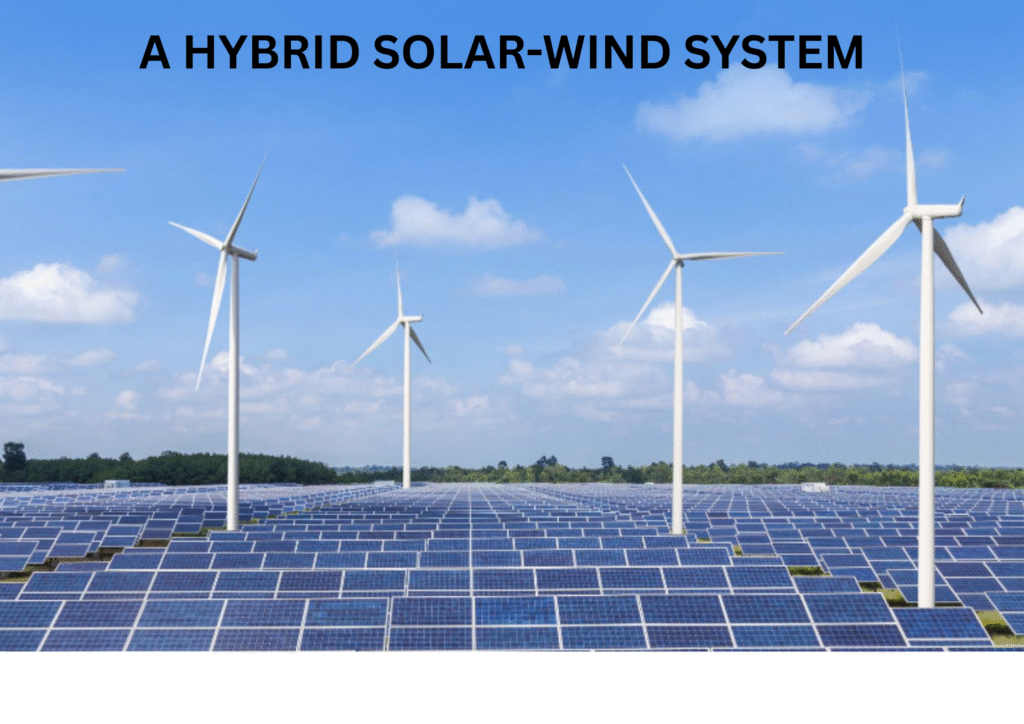
The hybrid solar-wind systems are more common in both urban and remote regions because they deliver steady power throughout the year. They depend on both the sunlight and wind conditions, which can vary throughout the day and across seasons. So, the hybrid system must be well-designed and managed properly to maximize its performance. It should be designed with advanced optimization techniques to deliver a stable energy supply, operate efficiently, and offer a longer lifespan. This article explains how to combine solar panels and turbines to design a hybrid solar-wind system for 24/7 home energy. Read the full article to get a detailed idea about it.
What Is a Hybrid Solar-Wind System?
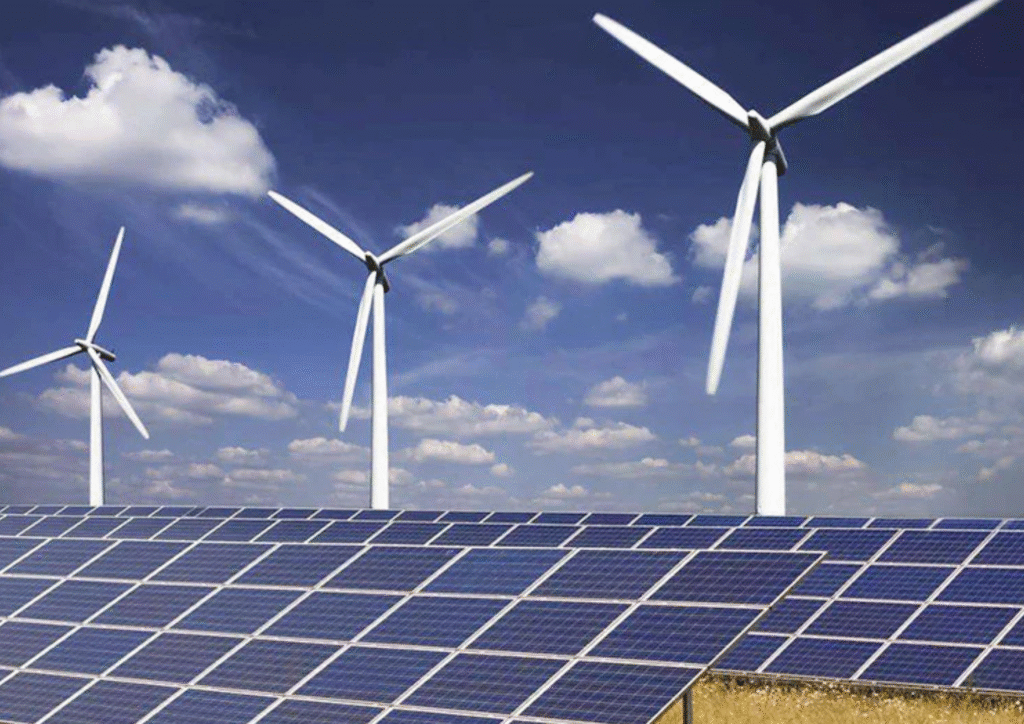
A hybrid solar-wind system is an energy setup that combines two energy sources, sunlight and wind, to generate electricity. These hybrid systems integrate both solar panels and wind turbine systems to generate power throughout the day and night. The main idea behind this technique is to balance power generation even when one source is weak.
The hybrid solar-wind system is a great option for homeowners and small businesses to get a steady and continuous source of electricity. The ideal locations to install these systems are where the sunlight is stronger during the daytime, and the wind may blow harder in the evening.
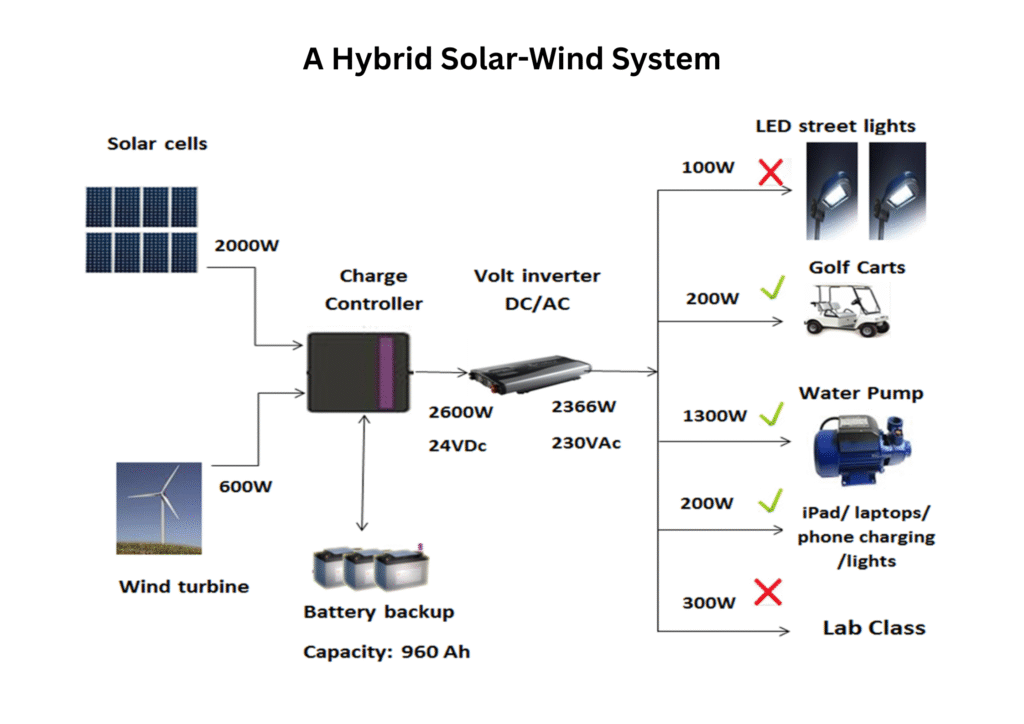
A typical hybrid solar-wind system includes a solar panel, a wind turbine, a charge controller, an energy storage system to store extra energy, and an inverter that converts stored energy into usable electricity. These systems offer energy independence, reliability, environmental benefits, and lower long-term energy costs.
Reference: Wind turbines and solar panels: Hybrid energy systems
How to Combine Solar Panels and Wind Turbines for 24/7 Home Energy?
Step 1: Calculate the Energy Needs of Your Home
Method 1:
To estimate your home’s power needs, you should check your monthly electricity bills. In the electricity bill, the monthly energy consumption is written in kilowatt-hours (kWh).
To calculate the average monthly usage, add them all from January to December and divide by 12. This value indicates the monthly energy consumption of your home.
Method 2:
Create a list of all the electrical equipment, including kitchen appliances, laundry equipment, lighting, entertainment devices, and small appliances. Then note the power rating of each appliance.
To calculate how much energy each appliance consumes per day, use this formula:
Energy (kWh) = (Power (Watts) x Operating Hours)/ 1000
This indicates the total daily energy consumption. Add all the values to find out the daily energy consumption, and multiply this by 30 to find out the monthly energy usage.
Always add 10 – 20% extra capacity to your calculation for energy usage in peak months.
Step 2: Evaluating Solar and Wind Resources at Your Location
How to evaluate solar resources at your location?
It is measured in terms of solar irradiance. It represents the amount of sunlight that reaches the ground surface and is measured in kilowatt-hours per square meter per day (kWh/m²/day).
- Check the peak sun hours per day at your location. A location with 5–7 peak sun hours daily is considered an ideal site for solar power.
- Consider year-round patterns to analyze seasonal variation. It ensures that a hybrid system supports energy needs across all seasons.
- Also, check how sunlight hits your roof from morning to evening on a clear day. Observe shading from trees, tall buildings, or roof angles. It may reduce output.
- Use software tools, apps, and Government and renewable energy research websites that provide local climate data. It helps you evaluate the average long-term sunlight at your location.
How to evaluate wind resources at your location?
Wind energy typically depends on two major factors, i.e., average wind speed and how consistent the wind flow is.
- Measure the average wind speed at your location. The small wind turbines require an average wind speed of 5 to 6 m/sec to operate.
- Open spaces such as farms, coastlines, hilltops, and flat plains are ideal locations to install wind turbines.
- You can get the average wind speed data from wind maps, Government and renewable energy research websites, and weather stations.
- Wind speed increases with height. So, it is ideal to install a taller tower to get maximum output.
Step 3: Designing the Solar Power Component
- Solar Array Size: The output of a solar panel depends on how much direct sunlight the panel gets in one day. It is also known as peak sun hours.
To evaluate the size of the solar array, first divide the daily energy needs (kWh/day) by peak sun hours. Then add an extra 20% margin to adjust for real-world losses.
- Selection of Solar Panels: Usually, there are two types of solar panels available in the market, i.e., monocrystalline and polycrystalline. Select solar panels that offer high efficiency, durability (25-year performance warranties), and that also meet regional electrical safety standards.
- Charge Controller: There are mainly two types of charge controllers available in the market, PWM and MPPT types. The PWM (Pulse Width Modulation) controllers are more cost-effective and suitable for small to moderate systems. The highly efficient MPPT (Maximum Power Point Tracking) controllers are suitable for hybrid systems.
- Battery Bank: Select an energy storage system to store the excess energy generated. Select a battery with a larger capacity and high DoD (Depth of Discharge). For hybrid systems, Lithium iron phosphate (LiFePO4) batteries are often preferred due to reliability and long life.
- Inverter: The Inverter converts the stored DC energy from the batteries to AC electricity for household use. Select an inverter with a continuous power rating, surge rating, and that is compatible with both solar panels and wind energy systems.
Step 4: Designing the Wind Power Component
- Wind Turbine Capacity: The capacity of the wind turbine depends on your daily energy needs and the average wind speed at your location. Generally, a wind turbine with a 1 – 3 kW rating is perfect for small homes, whereas a 5 – 10 kW wind turbine is sufficient for larger energy needs.
- Rotor Diameter and Tower Height: A wind turbine system with larger rotor blades can capture more air and generate more energy. Wind speed increases with height. So, the tower height should be at least 30 feet (9 meters) above any nearby obstruction within 300 feet.
- Wind Charge Controller: Select a wind charge controller with automatic battery protection, compatible with the battery type, and features built-in diversion control to prevent turbine overspeed.
- Energy Storage System: Select a battery whose capacity matches your daily energy needs. The battery must offer a longer cycle life to handle frequent charging and discharging. Lithium iron phosphate (LiFePO4) batteries are a great option for hybrid systems, offering higher efficiency and longer service life.
- Inverter: The inverter should have acontinuous power rating that matches your highest expected usage. It must have some important features like high surge protection and hybrid or multi-input capability to combine wind and solar inputs smoothly.
Step 5: Integrating Solar and Wind Systems
A hybrid solar-wind system integrates both solar and wind energy systems. The solar cells generate power during the day when the sunlight is available. Whereas the wind turbines can generate power at night and in cloudy weather. A successful integration of solar and wind systems depends on proper electrical configuration, power management, and storage planning.
- The solar panel and wind turbine both generate direct current (DC). The DC power is stored in a battery bank. From the battery, the inverter converts the DC to AC (Alternating Current) for household use.
- As the solar panel and wind turbine generate power in different ways, they require separate charge controllers to manage power flows. The solar charge controller adjusts voltage and current from the solar array. The wind charge controller regulates power from the turbine and directs surplus to a dump load to prevent turbine overspeed. Both the charge controllers are connected to the same battery bank.
- For stable operation, you must select a well-sized battery bank.
- For a hybrid solar wind system, the inverter integrates battery charging, power routing, and AC output control. The inverter must be capable of managing variable input conditions. It must be capable of switching between power sources smoothly.
- For a reliable operation, the energy consumption should be planned according to supply patterns. The high-energy appliances should be used during the day when solar power is strongest. The nighttime loads or refrigeration cycles should be covered by using wind energy. If the hybrid system is grid-connected, use grid power only during low renewable output periods.
- For safe operation, use safety equipment such as DC and AC circuit breakers, surge protection devices, earthing, and lighting arrestors.
Step 6: Safety Considerations
- Use grounding and lighting protection to reduce the risk of electric shock and equipment damage during storms.
- As the batteries store large amounts of energy, use a battery management system (BMS) to monitor temperature and charge levels. Always keep them in a dry and cool environment.
- Ensure the tower foundation for the wind turbine installation is strong and stable.
- Use a hybrid inverter designed to manage multiple power inputs.
| Components of a Hybrid Solar-Wind System | Ratings |
| Solar Panels | 3kW to 8kW (Total Capacity) |
| Wind Turbine | 1kW to 10kW |
| Battery Storage | 10kWh to 20kWh |
| Charge Controller | 40A to 80A |
| Inverter | 5kW to 8kW Continuous |
Reference: A Review of Hybrid Solar PV and Wind Energy System
Advanced Techniques to Optimize Performance of a Hybrid Solar-Wind System
- MPPT Controller: The maximum power point tracking (MPPT) controller automatically adjusts operating conditions to extract the maximum energy. This controller helps maximize energy production and balances power flow during fluctuating wind speeds. It also enhances the charging efficiency of the battery storage bank.
- Real-time Monitoring Systems: These advanced systems can trackpower production, battery levels, wind speed, turbine rotation speed, solar output, and energy usage in real-time.
- Advanced Controllers: Advanced controllers are used to maximize power production. The pitch controller is used to adjust the pitch angles of the blades of the wind turbine, and the generator speed controller is used to improve the performance of the turbine.
Conclusion
The hybrid solar-wind systems offer a sustainable and cost-effective way to achieve energy independence. The size of a hybrid solar-wind system depends on your average daily energy use. The ratings of both the solar and wind components are selected carefully to avoid energy imbalance and system strain. To optimize its performance, you need advanced control technologies, smart energy management systems, proper battery utilization, and regular maintenance. A safe and well-designed hybrid system with advanced technologies ensures that the hybrid system operates smoothly across seasonal variations and changing weather conditions.
FAQS
- What is a hybrid solar-wind system?
A hybrid solar-wind system is an energy setup that combines two energy sources, sunlight and wind, to generate electricity. These hybrid systems integrate both solar panels and wind turbine systems to generate power throughout the day and night.
Also Read:
- A Step-by-Step Guide to Design a Small Wind Turbine System
- Can a Small Wind Turbine System Power Your Entire House? A Practical Guide
- The Evolution of Wind Power: How Wind Power Is Shaping the Future of Renewable Energy Grids?
- How Wind Direction and Speed Affect Wind Turbine Performance? A Complete Guide
- A Complete Guide to How a Wind Turbine Turns Air into Electricity: From Blades to Grid
- Importance of AI-Driven Predictive Maintenance in Wind Energy Systems
- Are DIY Solar Panel Kits Worth It? A Complete Guide
- Portable Solar Panel Kits: Best Uses for RVs and Camping
- Breaking Down Each Component of a 5kW Solar Panel Kit
- What Size Solar Panel Kit Do You Need? Find the Right Solar Kit for Your Home
- Perovskite Solar Panels: The Future of Home Solar
- High-Wattage 450W Solar Panels: Are They Worth It for Your Home Roof Space?
- The Rise of 600W+ High-Power Panels in Commercial Solar Farms
- HJT Solar Panels: A Right Solar Investment for Large Businesses
- N-Type TOPCon Solar Panel: A Complete Guide
- TOPCon Vs HJT Vs Tandem Solar Panels: Make The Best Purchase for Your Project
- Case Study: How Bifacial Solar Panels Improved Output in the Nevada Desert?
- Performance of Tandem Solar Cells in Real Pilot Solar Farms: A Case Study
- Flexible Solar Panels: The Ideal Solution for Small and Irregular Spaces