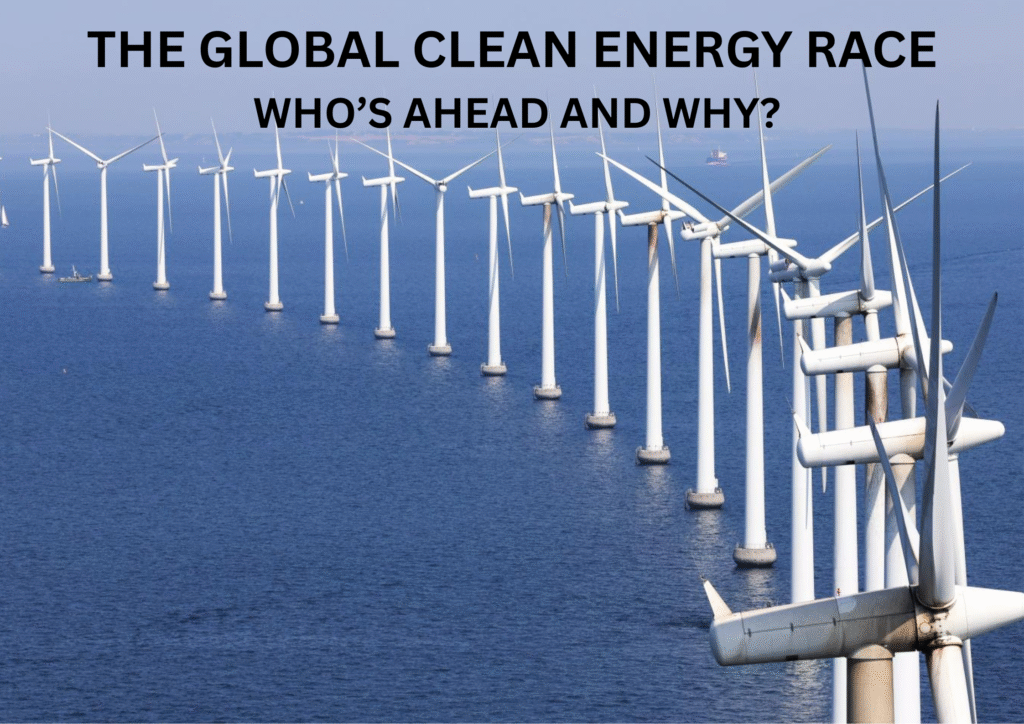
In 2024, the world added over 500 GW of new renewable power capacity. The solar panels are now installed on the deserts, rooftops, and parking lots. And the installation of both the onshore and offshore wind turbines is growing at a faster rate. But, in the global clean energy race, who is ahead and why?
Leadership in the clean energy race is not solely about the amount of power installed, but also about technological development, manufacturing dominance, policy strength, and growth speed. The global clean energy race is reshaping economies, geopolitics, and energy security worldwide.
This article outlines the real-world progress and strategies employed by various countries, as well as the leading clean energy players, including China, the United States, Europe, and India.
Solar, wind, hydro, and storage growth trends
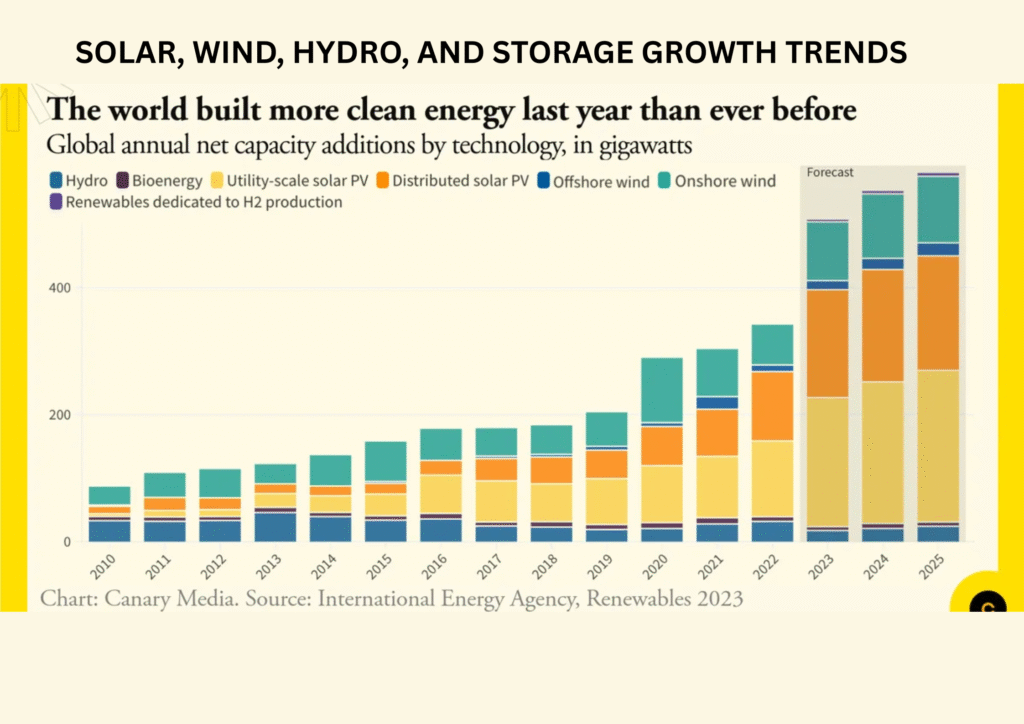
As the world moves towards clean energy, solar and wind energy are expected to supply an increasingly larger share of electricity worldwide. Whereas the storage systems include batteries, Liquid Air Energy Storage (LAES) systems, etc., will make clean grids more reliable.
Solar Energy:
According to IRENA, in 2024, the solar photovoltaic capacity increased by more than 450 GW. This number is more than 75% of all new renewable capacity added globally. According to the researchers, by 2033, solar and wind capacity together could more than triple to around 8 TW.
Solar energy is leading due to the following reasons
- Cost-effective equipment and solar modules
- Quick permitting and deployment
- Strong policy support offered by various countries
Wind Energy:
According to IRENA, by the end of 2024, global wind capacity exceeded 1100 GW. According to the researcher, in the next decade, the installation of offshore wind turbines in the oceans and large lakes will increase. By 2030, the offshore wind turbine installation capacity will rise to more than 37 GW.
Hydropower:
Hydropower is the oldest large-scale renewable technology. According to IRENA, in 2024, the total hydro power capacity reached approximately 1283 GW worldwide. The main advantage of hydropower is reliability. It continuously generates electricity even when the sun isn’t shining or the wind isn’t blowing.
Energy Storage:
The energy storage systemhelps balance the grid by storing excess power and releasing it when demand is high. In the U.S., by April 2025, the battery energy storage capacity reached approximately 30,000 MW, which was only 2000 MW in 2020. In the next decade, it is expected to grow by more than 600% globally.
China: Leading in Scale and Manufacturing
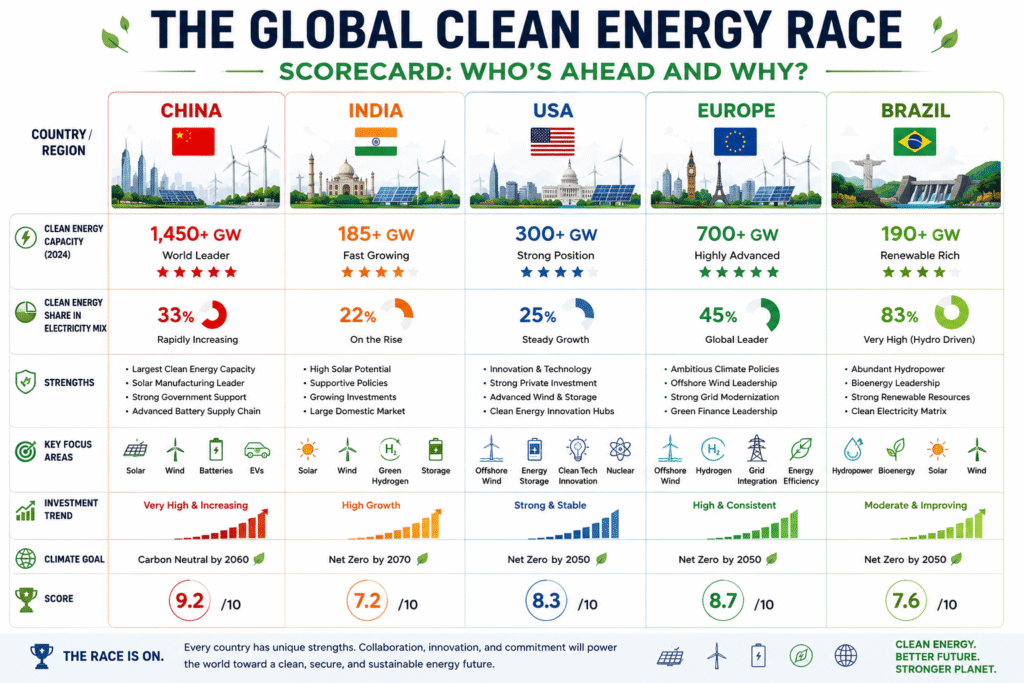
China is not only adding more renewable power to the global renewable energy market, but also building and exporting the technologies the world depends on. From solar panels to wind turbines, China’s manufacturing capacity is unmatched. According to the International Energy Agency, approximately 80% of the world’s PV manufacturing capacity is in China. India and the U.S. each hold only 5%. Over 60% of global wind turbine components are produced by China.
China has exceeded its 2030 goal of 1200 GW of renewables six years early. In 2024, the country installed 357 GW of solar and wind projects. In the first quarter of 2025, the country’s clean sources produced 951 TWh of power.
China is dominating solar PV manufacturing globally, i.e., more than 80% of global PV production capacity. China is manufacturing various types of solar panels, including polysilicon, wafers, cells, and modules.
Chinese solar panels, batteries, and other clean technologies are major exports to various countries globally, such as Africa, Southeast Asia, and Europe. Its production capacity helps ensure affordable clean technologies are available to markets everywhere.
United States: Innovation and Large-Scale Deployment
In the second quarter of 2025, the United States added renewable energy with a capacity of about 8.75 GW. This brings the total energy capacity to around 334 GW. In that quarter, the new solar energy added was 4.56 GW, the new wind energy added was 0.63 GW, and battery storage contributed 3.56 GW of new capacity.
In the year 2024, the U.S. installed around 48.7 GW of renewable energy, which is a 33% increase over 2023. The U.S. companies and research institutes are developing innovative technologies for solar, wind, storage, and grid management systems. The advanced technologies include hybrid solar-storage systems, high-capacity batteries, etc.
According to The Verge, in 2024, the country produced more electricity from solar and wind than from coal. 17% of total electricity is produced from renewable sources, 15% from coal.
The U.S. stands out for technology integration, grid modernization, and storage solutions with large-scale deployment. The country’s clean energy growth is due to its strong federal and state incentives. The country is focusing its development on domestic clean technology.
Europe: Policy-Driven Clean Energy Leadership
Europe is rapidly increasing its renewable energy production and leading the global market by combining strong government policies with clear long-term goals. Its policy-driven models and ambitious clean energy strategies are driving the energy shift.
By 2030, the European Union targets to achieve at least 42.5% energy from renewable resources. The key policies of Europe include:
- European Green Deal to transform Europe into the first climate-neutral continent by 2050.
- Renewable Energy Directive (2023 revision) to raise renewable targets and introduce faster permitting rules for clean energy projects.
Europe has become a global hub for wind power. In 2024, the newly installed wind capacity was 12.9 GW. According to Energy, Europe is planning to install tens of gigawatts more by 2030. It is planning to emphasize both onshore and offshore wind. It is also planning to add 120 GW of offshore capacity by 2030 and up to 300 GW by 2050.
According to Icp.com, Europe had installed around 89 GW of energy storage, including 53 GW of pumped-hydro storage and 35 GW of electrochemical battery storage.
With the policy goals, clean targets,coordinated investment strategies, and public support, Europe has set a global standard for clean energy leadership.
India: Fastest Growth Among Emerging Economies
India is emerging as one of the fastest-growing clean energy markets in the world. The country has made rapid progress with strong government policy, market demand, and falling technology costs.
In 2025, India added 48 GW of new renewable energy capacity, which brings the country’s total renewable energy capacity to about 207 GW. According to the Times of India, solar power is leading this race with a new installation of 38 GW, and the new installation capacity of wind energy is 6.3 GW.
The total renewable energy installation capacity has grown from 76 GW in 2014 to nearly 243 GW by 2025. It has been increased three times. The total installation capacity of solar energy has increased from 2.82 GW in 2014 to around 177 GW by 2025. It is a thrilling 4000% increase in 11 years. Thus, the total wind energy installation has grown from 21 GW in 2014 to over 51 GW today.
In the first half of 2025, the renewable power generation increased 24.4% to 134.43 billion kilowatt-hours. The power generation from coal declined by 3%.
India has set a target to increase the non-fossil fuel capacity by 2030. The country is also planning to increase domestic production of solar and wind manufacturing.
Advanced Technology That Is Shaping the Global Clean Energy Race
- Advanced solar power technologies, including tandem and perovskite solar cells
- Next-generation energy storage systems, including advanced battery technology, flow batteries, and solid-state batteries
- Smart grid technology, including sensors, advanced control systems, artificial intelligence, digital twin technology, and real-time communication
- Floating offshore wind turbines
- Green hydrogen and electrolyzers
Who’s Ahead In Global Clean Energy Race: China, the United States, Europe, or India?
In terms of total installation capacity and manufacturing scale, China leads as the world’s largest renewable capacity and equipment production country. The United States stands strong for its innovation, advanced technologies, and storage integration. The policy-driven models of Europe have helped the continent rapidly increase renewable energy generation. India is known for the fastest-growing clean energy market among major emerging economies.
However, the technology, policy, and investment of the leading countries are evolving together to shape the world’s low-carbon future.
Conclusion
Several major economies, including China, the U.S., Europe, and India, are competing to lead in clean energy deployment, innovation, and policy impact. China’s increasing production capacity, along with its industrial strength, has reshaped the clean energy landscape. The U.S. excels in technology integration with large-scale deployment and rapid advances in storage and grid management. The policy-first approach of European nations helped the region rapidly scale renewables. Whereas India is representing how an emerging economy can rapidly scale renewable generation through aligned policy, large-scale deployment, cost efficiencies, and investment support.
FAQs
- Which country is ahead in terms of total renewable energy installation capacity and manufacturing scale?
In terms of total installation capacity and manufacturing scale, China leads as the world’s largest renewable capacity and equipment production country.
- Which country excels in developing advanced technology in renewable energy sector?
The United States excels in technology integration with large-scale deployment and rapid advances in storage and grid management.
Also Read:
- Liquid Air Energy Storage: How Liquid Air Can Store Renewable Energy for the Grid?
- Bikaner 1.4 GW Solar Project by Tata Power in Rajasthan
- Solar Farms on Old Landfills: How Unused Lands Are Powering Solar Energy Projects?
- Payback Period for Residential Wind Power: What Homeowners Can Expect
- Incentives and Rebates for Home Wind Turbine Installation
- What Are the Most Efficient Small-Scale Wind Turbines for Home Use?
- Where can I buy residential wind turbines with installation services?
- AI-Powered Wind Turbine: How It Optimizes Power Output?
- How Smart Wind Turbine Blades Are Redefining the Future of Wind Energy?
- A Technical Look at Offshore Wind Farms
- Can Wind Turbines Operate Efficiently in Low-Wind Regions? What You Need to Know?
- Why Taller Wind Turbines Produce More Power? The Real Reason Behind It
- A Step-by-Step Guide to Design a Small Wind Turbine System
- Can a Small Wind Turbine System Power Your Entire House? A Practical Guide
- The Evolution of Wind Power: How Wind Power Is Shaping the Future of Renewable Energy Grids?
- How Wind Direction and Speed Affect Wind Turbine Performance? A Complete Guide
- A Complete Guide to How a Wind Turbine Turns Air into Electricity: From Blades to Grid
- Importance of AI-Driven Predictive Maintenance in Wind Energy Systems
- Are DIY Solar Panel Kits Worth It? A Complete Guide
- Portable Solar Panel Kits: Best Uses for RVs and Camping
Pingback: For the First Time, Renewables Beat Coal - science2energy
Pingback: The U.S. Power Shift: Solar Takes the Lead in New U.S. Power Generation - science2energy
Pingback: Solar Rebates Explained: How Solar Rebates Can Save You Money? - science2energy