
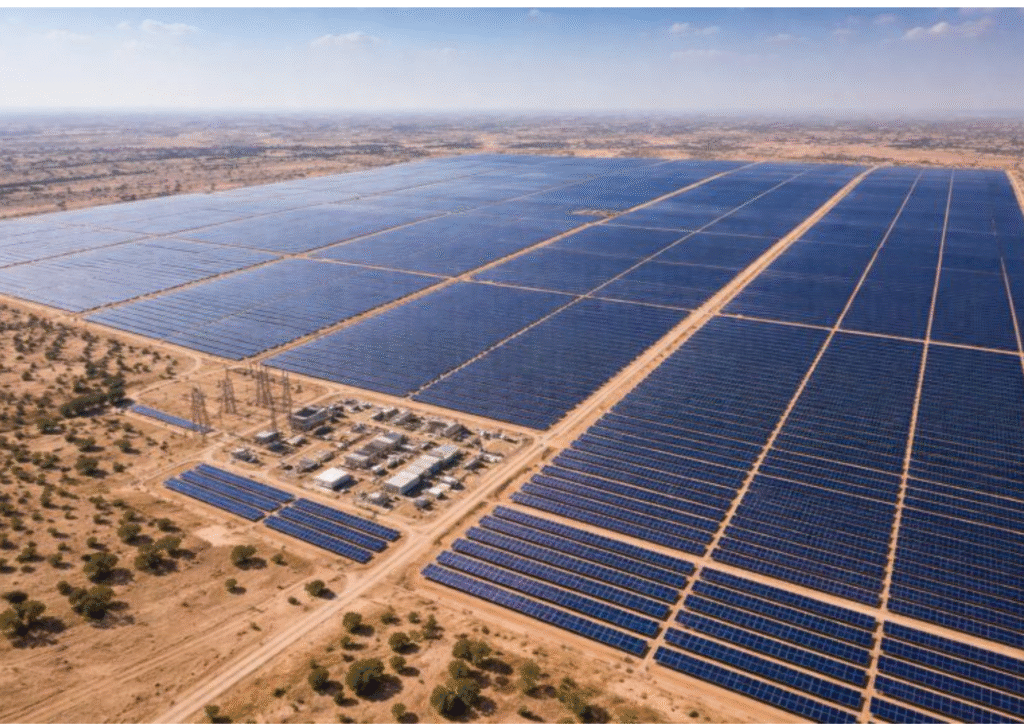
Do you know that a single solar power plant can generate enough clean electricity to make a measurable impact on a nation’s energy mix? Think about the millions of solar panels with advanced technology that can power multiple states. At the end of 2025, Tata Power Renewable Energy Limited (TPREL) commissioned India’s mega solar farm, which is the Bikaner 1.4 GW solar project. This solar project is designed with 2.4 million domestically manufactured solar modules and can generate a massive amount of clean electricity, 1,000 MW AC (1,400 MWp DC).
This article describes everything in detail about the Bikaner 1.4 GW Solar Project, including the technical details, power generation capacity, and economic and environmental benefits. Read the full article to learn how Tata Power in Rajasthan is reshaping India’s electricity future.
Solar Power Growth in India
Over the last decade, India’s solar power sector has experienced significant growth, making it one of the largest solar markets in the world. This solar power growth is driven by the government’s strong policy support, affordable technology, and ambitious renewable targets.
In 2014, the solar power capacity of India was only 2.82 GW. This number has increased 40 times, and by 2025, India’s solar capacity had surged to over 132 GW.
In 2024, India added around 24.5 GW of solar capacity, and in 2025, about 35 GW of solar capacity was added.
In India, Rajasthan has taken the lead in solar development by contributing around 27% India’s solar capacity with an installed capacity of 36 GW. The second one is Gujarat with nearly 25 GW. Other states that have also contributed significantly are Maharashtra and Tamil Nadu.
The rooftop solar installations have reached over 23 GW. These are also growing quickly because of the Government policies like PM Surya Ghar Muft Bijli Yojna.
India has ranked among the top solar power markets globally. India is ranked third in solar power capacity worldwide. The country aims to reach 500Gw of non-fossil fuel capacity by 2030.
Bikaner 1.4 GW Solar Project by Tata Power in Rajasthan
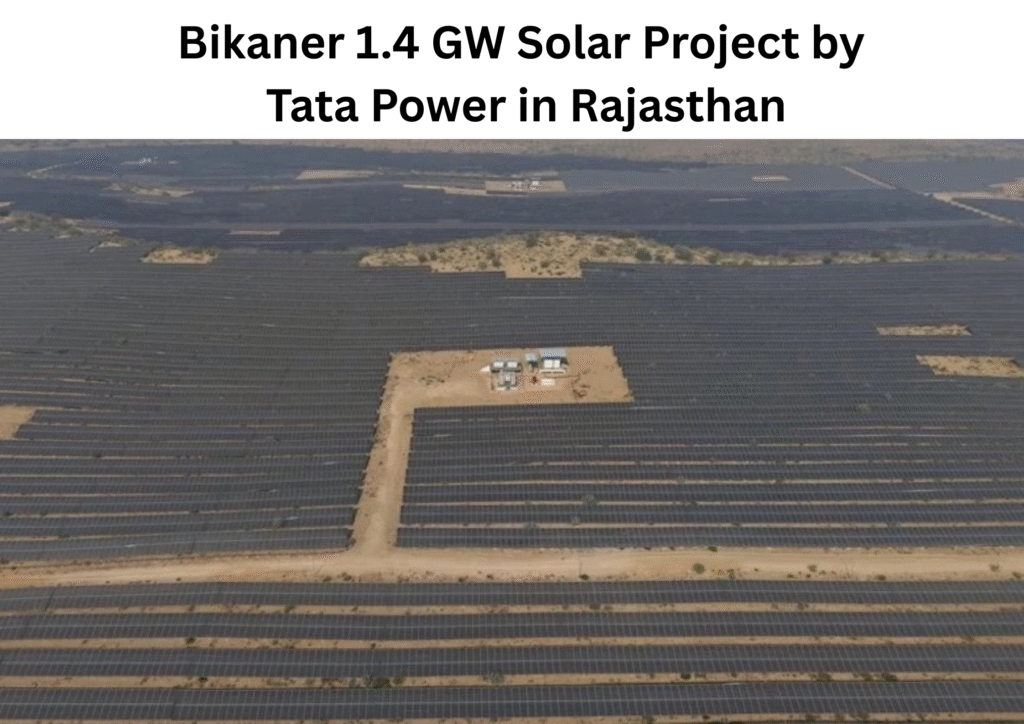
According to Tata Power, in late 2025, Tata Power Renewable Energy Limited (TPREL) commissioned a 1 GW (1,000 MW AC / 1,400 MWp DC) solar power project in the Bikaner district of Rajasthan, India. The Bikaner 1.4 GW solar project is being expanded through two major sites in Bikaner, namely Bandarwala and Karnisar Bhatiyan. These locations were selected for the mega solar farm due to their abundant sunlight and desert climate.
This mega solar project globally represents how utility-scale solar can replace fossil fuels at the grid scale. This solar project has implemented some advanced solar technology, like mono-bifacial modules and DCR components. It helps lower carbon emissions and meets the international climate targets. It represents a major leap forward for solar energy deployment in India.
Reference: Tata Power Commissions 1.4-Gigawatt Solar Farm Just Before Year End
Why Bikaner Was Chosen for This Solar Project?
Bikaner was chosen for this solar project because of the following reasons:
- This location gets exceptionally strong, consistent sunshine most of the year. This improves the efficiency of the solar panels. It gets an average global horizontal irradiation (GHI) of around 5.5–6.0 kilowatt hours per square meter per day (kWh/m²/day).
- There are vast areas of open and unused land. This makes it easy for developers to install vast arrays of solar panels.
- The government here offers strong support. The Government policies include long-term power purchase agreements (PPAs), grid connectivity support, and leased land with infrastructure support.
- Bikaner already has a strong electrical grid infrastructure with high-capacity substations nearby. So, to connect new solar projects to the national grid and to distribute clean energy to other locations is easy.
Technical Details of Bikaner 1.4 GW Solar Project
The Bikaner 1.4 GW solar project is a major advancement in solar technology deployment at large scale. It is developed by Tata Power Renewable Energy Limited (TPREL).
Installed Capacity:
The solar plant’s DC peak power is 1.4 GWp (1400 MW). This is the power the solar plant produces before conversion losses.
The power solar plant delivers to the grid in AC form is 1 GW (1000 MW).
The difference between DC and AC ratings is due to the real-world losses in inverters, wiring, and plant operations.
Solar Modules:
Around 2.4 million solar modules are installed in the Bikaner 1.4 GW solar plant. The solar modules use the Domestic Content Requirement (DCR) compliant cells. The type of solar panels used is monocrystalline bifacial modules. These bifacial solar panels can capture sunlight from both the front and back sides.
All the solar modules were manufactured at TP Solar Limited’s manufacturing facility in Tirunelveli, Tamil Nadu.
Inverters:
The inverters convert the DC power generated from solar panels into AC power suitable for the grid. In this project, high-performance inverters are used to handle the temperature extremes of the desert environment in Bikaner.
Power Generation of Bikaner 1.4 GW Solar Project
According to Tata Power, once fully commissioned, the Bikaner solar project is expected to generate approximately 2454.85 million units (MU) of clean energy in the first year.
1 MU = 1000000 kilowatt-hours (kWh)
2454.85 million units (MU) = 2.45 billion kWh of electricity in one year, which can power millions of typical households annually.
The 1 GW of electricity produced by the solar plant is allocated to key state electricity utilities. 500 MWof electricity isallocated to Rajasthan Urja Vikas and IT Services Limited (RUVITL), 300 MW to Jammu & Kashmir Power Limited (JKPL), and 200 MW to Uttarakhand Power Corporation Limited (UPCL).
Contribution of Bikaner 1.4 GW Solar Project to India’s total solar capacity
The Bikaner 1.4 GW solar project is contributing approximately 0.75% to the nation’s total solar capacity.
Challenges and How They Were Addressed
- Bikaner experiences very high temperatures above 50 degree Celcius in summer, cold winters, and frequent sandstorms. To withstand extreme heat conditions, high-performance solar modules and inverters are installed.
- The hard and uneven land of Bikaner’s landscape was first prepared and graded before equipment installation to create level surfaces.
- Detailed logistics planning was implemented to transport 2.4 million solar modules and various equipment a desert location.
Economic and Environmental Benefits
Economic Benefits:
- The mega solar farm creates many local jobs training in solar installation, operations, and maintenance.
- The solar modules used in this project are manufactured in India. India’s Make in India strategy aims to boost domestic manufacturing and reduce import dependency for clean energy equipment.
- The solar farm generates electricity at lower operational costs. So, it helps stabilize electricity costs and offers affordable electricity for users in multiple states.
- The mega Bikaner solar farm strengthens energy supply across states such as Rajasthan, Jammu & Kashmir, and Uttarakhand. It reduces energy shortages during peak demand and helps local households access steady electricity.
Environmental Benefits:
- The Bikaner solar project is expected to reduce around 1.74 million tonnes of CO2 emissions. It helps improve the air quality and climate change mitigation.
- Solar energy generation produces no air pollutants such as sulfur dioxide (SO₂), nitrogen oxides (NOx), or particulate matter.
- The electricity generated from solar panels requires no water for fuel combustion. This is particularly valuable in dry regions like Bikaner, where water is scarce.
Conclusion
India’s solar power capacity has grown from less than 3 GW in 2014 to more than 130 GW by 2025. Among the largest utility-scale solar installations, the Bikaner 1.4 GW solar project has become the game changer. This solar project stands out because of its large-scale power production, advanced technologies, and improved performance. This project also contributes to carbon emission reductions, regional economic benefits, and grid reliability. This mega solar power project represents how solar power can serve millions of people with clean energy.
Also Read:
- Solar Farms on Old Landfills: How Unused Lands Are Powering Solar Energy Projects?
- Payback Period for Residential Wind Power: What Homeowners Can Expect
- Incentives and Rebates for Home Wind Turbine Installation
- What Are the Most Efficient Small-Scale Wind Turbines for Home Use?
- Where can I buy residential wind turbines with installation services?
- AI-Powered Wind Turbine: How It Optimizes Power Output?
- How Smart Wind Turbine Blades Are Redefining the Future of Wind Energy?
- A Technical Look at Offshore Wind Farms
- Can Wind Turbines Operate Efficiently in Low-Wind Regions? What You Need to Know?
- Why Taller Wind Turbines Produce More Power? The Real Reason Behind It
- A Step-by-Step Guide to Design a Small Wind Turbine System
- Can a Small Wind Turbine System Power Your Entire House? A Practical Guide
- The Evolution of Wind Power: How Wind Power Is Shaping the Future of Renewable Energy Grids?
- How Wind Direction and Speed Affect Wind Turbine Performance? A Complete Guide
- A Complete Guide to How a Wind Turbine Turns Air into Electricity: From Blades to Grid
- Importance of AI-Driven Predictive Maintenance in Wind Energy Systems
- Are DIY Solar Panel Kits Worth It? A Complete Guide
- Portable Solar Panel Kits: Best Uses for RVs and Camping
- Breaking Down Each Component of a 5kW Solar Panel Kit
- What Size Solar Panel Kit Do You Need? Find the Right Solar Kit for Your Home

Pingback: Liquid Air Energy Storage: How Liquid Air Can Store Renewable Energy for the Grid? - science2energy
Pingback: The Global Clean Energy Race: Who’s Ahead and Why? - science2energy
Pingback: For the First Time, Renewables Beat Coal - science2energy