
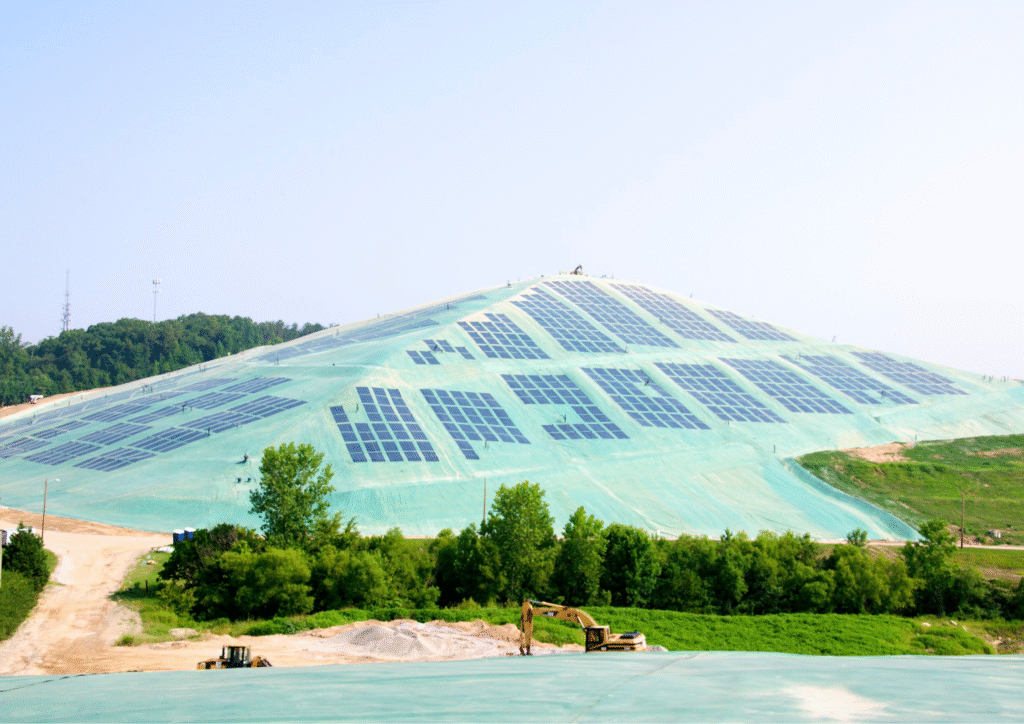
Could a land once filled with trash help power thousands of homes with clean electricity? Yes, it is possible. The old and closed landfills are being transformed into productive solar energy sites. According to the experts, the U.S. has over 4300 closed landfills that can generate more than 60 gigawatts of solar power. This can power nearly 8 million homes every year.
The solar panels can safely operate on land filled with buried waste without consuming valuable natural and farming lands. This article discusses two case studies and explains how the unused lands are powering solar energy projects. Read the full article to know about the solar farms on old landfills and how they are becoming a key player in the global shift toward renewable energy.
What qualifies as an old or closed landfill?
A landfill refers to a legacy disposal site that is used for disposing of waste materials from household trash to commercial and industrial waste. When a landfill stops accepting waste, it means that no new waste will be placed without a formal regulatory process, and then the landfill is designated as an old or closed landfill. In closed landfills, no additional waste will be added without official permission.
Why are construction and farming not allowed in Old Landfills?
Construction and farming are not allowed in old landfills because:
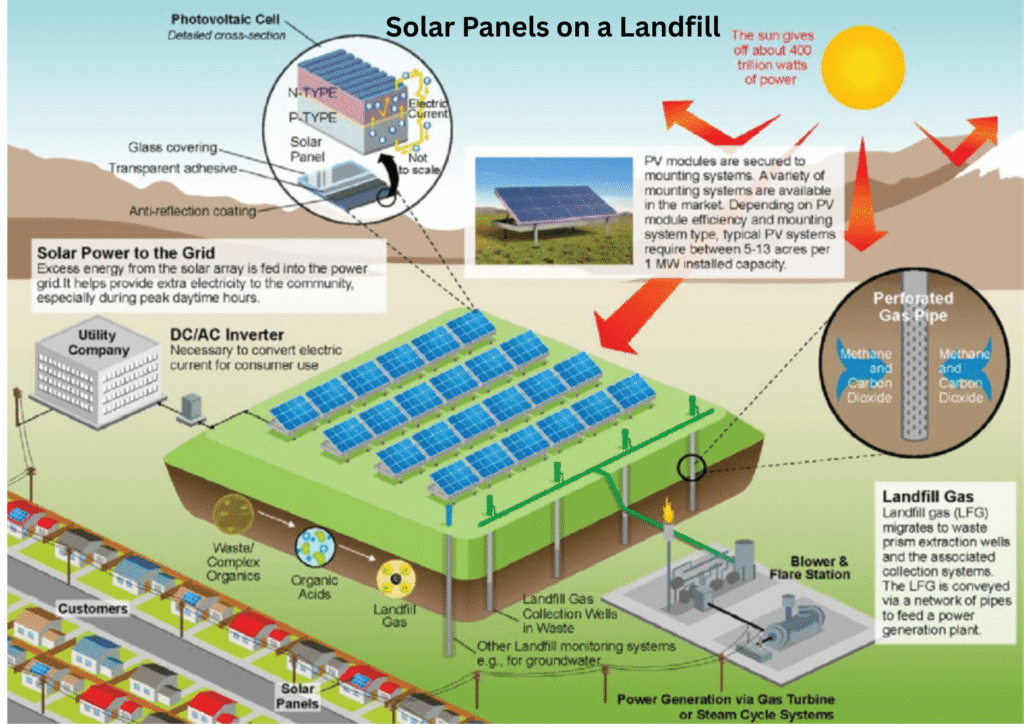
- Even after a landfill is closed, the organic wastes continue to decompose and slowly release gases like methane and carbon dioxide. Methane is explosive and a serious safety hazard for buildings or structures built over the landfill.
- Old landfills also contain leachate, which can contaminate groundwater and soil.
- Even when the landfills are closed, they remain unstable and don’t become solid ground. The construction of buildings and structures needs stable ground.
Why Closed Landfills Are Suitable for Solar Energy Projects
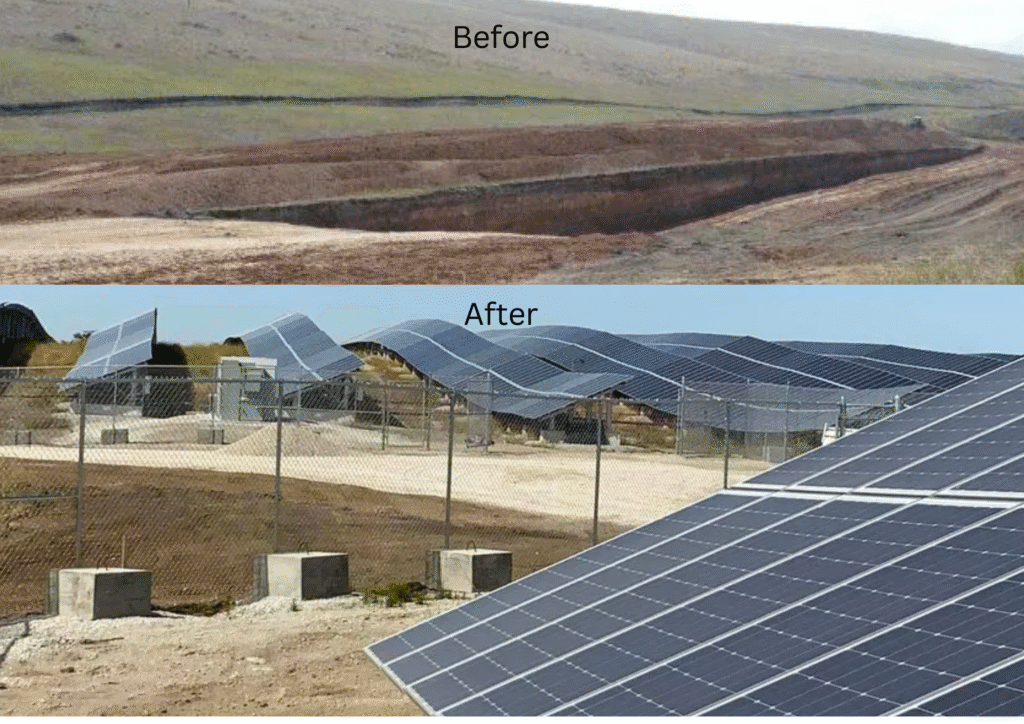
- Large Areas: The closed landfills cover large open areas and are not suitable for buildings, farming, or residential development. So, they are perfect for laying out solar panels.
- Don’t Require High Quality Land: Solar panels do not need fertile soil or deep foundations. They can be installed as a ballasted system that sits on top of the ground. You don’t need to penetrate the landfill cap, which protects the integrity of the landfill cover.
- Near Electrical Infrastructure: Closed landfills are near roads and electrical infrastructure. The solar developers don’t need to build long transmission lines to connect to the grid.
- Environmental Benefits: Solar panels on closed landfills turn the unused lands into clean energy assets.
- Ideal Solar Exposure: As the wide landfills have low vegetation and little shading, the solar panels can get strong and consistent sunlight throughout the day.
- Incentives: Solar projects on closed landfills can qualify for renewable energy incentives, tax credits, and grants. It helps reduce upfront costs and improve long-term returns.
Reference: Solar on Closed Landfills: Engineering Solutions and Case Studies
Case Study 1: Mount Trashmore Solar Landfill – Broward County, Florida, USA
History of the Mount Trashmore landfill
The local nickname of Mount Trashmore is “Monarch Hill Renewable Energy Park. It is a large landfill located in northern Broward County, Florida. Initially, it was a small waste pile in a then-remote area. And gradually it expanded into a 500-acre area and serves as a legacy disposal site. In 2011, the name of this disposal site was officially registered as “Monarch Hill Renewable Energy Park”. According to the Tampa Bay Times, the landfill is expected to remain operational into the mid-21st century, with a projected closure around 2050.
Why was the Mount Trashmore landfill chosen for solar redevelopment?
The Mount Trashmore landfill was chosen for solar development because:
- It is a large, open land area that covers hundreds of acres, but is not suitable for buildings or farming due to soil stability and environmental concerns.
- The grid interconnection is easier due to the existing infrastructure, such as the roads and electrical connections.
- It helps reduce carbon emissions and foster clean energy. According to SolSmart, it is generating 3.1MW of power with 14 solar projects.
Solar Project Design and Installation
The main challenge the engineers face while installing solar panels on a landfill is to avoid penetrating the landfill’s engineered cap layer. Because any disturbance could lead to environmental issues. So, the solar designers use ballasted racking systems. These systems sit on top of the ground, supported by concrete blocks rather than deep-driven piles.
The photovoltaic models are used to design solar projects. The Panels and racks are mounted on concrete blocks
Energy Output and Performance
The Mount Trashmore Solar Landfill is projected to generate millions of kilowatt-hours of clean energy annually. This project is aimed at powering thousands of homes each year.
Case Study 2: Sunnyside Solar Project in Houston, Texas
History of the Sunnyside Solar Project in Houston, Texas
In 1930, the Sunnyside site in Houston was first started as Holmes Road Landfill. It was a municipal dump that served the city for decades. In 1964, another landfill called the Reed Road landfill was added to it. After years of operation, this landfill was closed in the 1970s.
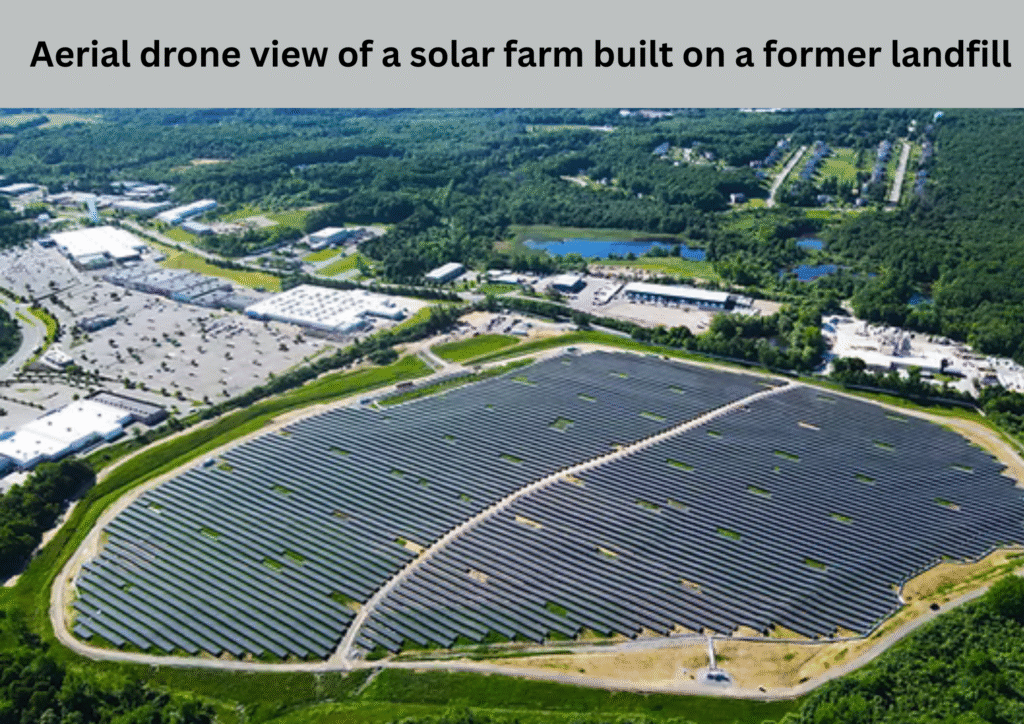
In 2017, the city joined the C40 Reinventing Cities Competition to redevelop underutilized urban land for sustainable projects. In 2019, Sunnyside Energy LLC was selected by the city to convert the former landfill into a large solar energy installation. This solar project is developed on a 240-acre landfillsite.
The Sunnyside solar project is one of the largest urban solar projects in the U.S., designed to power thousands of homes.
Why was the Sunnyside landfill chosen for solar redevelopment?
The Sunnyside landfill was chosen for solar development because:
- It was unused for over 50 years and was also not suitable for housing, farming, or other commercial development.
- This is a large flat area of 240 acres. It is located near existing roads and electrical infrastructure, which would make grid integration easier.
- This project offered a way to generate clean energy while creating local jobs.
Solar Project Design and Installation
The solar system installation on a closed landfill requires specialized design. The installers are not allowed to use the ground-penetrating mounts to protect the landfill cap. For this, the Sunnyside Solar Projects use ballasted racking systems, which are supported by weighted blocks.
Energy Output and Performance
This project is developed on 240 acres of land. The project is designed as a utility-scale photovoltaic (PV) installation. The solar capacity of PV panels is 50 to 70 MW. This project can generate enough electricity to power around 5000 to 12000 U.S. homes annually.
Economic and Environmental Benefits of Landfill Solar Projects
Economic Benefits:
- Landfill solar projects can generate new revenue for local governments. Local governments can lease capped landfill land to solar developers, generating a steady income over decades.
- The local government buys this electricity at a lower rate than grid power, and this helps reduce energy costs.
- The landfill solar projects create a variety of jobs, including engineers, technicians, construction crews, etc. This helps improve the local economy.
Environmental Benefits:
- Solar systems generate clean energy and reduce greenhouse gas emissions. One megawatt (MW) of solar panels can produce more than 2,000 megawatt-hours (MWh) of clean electricity each year, which offsets hundreds of metric tons of CO₂ emissions.
- By using the landfills for building solar projects, we avoid converting forests, farmland, or natural ecosystems into energy infrastructure. This preserves the ecosystem.
- Landfill solar projects support global climate goals.
Conclusion
Advanced technology is turning old landfills into large solar farms. This helps in generating clean energy and reducing carbon emissions. Solar farms on old landfills are proven models of sustainable land reuse and renewable power generation. From methane-producing waste hills to megawatts of solar electricity, these solar projects are helping the communities around the world to unlock renewable power and economic growth.
FAQS
- Why solar designers use ballasted racking systems while installing solar panels on a landfill?
The main challenge the engineers face while installing solar panels on a landfill is to avoid penetrating the landfill’s engineered cap layer. Because any disturbance could lead to environmental issues. So, the solar designers use ballasted racking systems. These systems sit on top of the ground, supported by concrete blocks rather than deep-driven piles.
- What is an old or closed landfill?
When a landfill stops accepting waste, it means that no new waste will be placed without a formal regulatory process, and then the landfill is designated as an old or closed landfill.
Also Read:
- Payback Period for Residential Wind Power: What Homeowners Can Expect
- Incentives and Rebates for Home Wind Turbine Installation
- What Are the Most Efficient Small-Scale Wind Turbines for Home Use?
- Where can I buy residential wind turbines with installation services?
- AI-Powered Wind Turbine: How It Optimizes Power Output?
- How Smart Wind Turbine Blades Are Redefining the Future of Wind Energy?
- A Technical Look at Offshore Wind Farms
- Can Wind Turbines Operate Efficiently in Low-Wind Regions? What You Need to Know?
- Why Taller Wind Turbines Produce More Power? The Real Reason Behind It
- A Step-by-Step Guide to Design a Small Wind Turbine System
- Can a Small Wind Turbine System Power Your Entire House? A Practical Guide
- The Evolution of Wind Power: How Wind Power Is Shaping the Future of Renewable Energy Grids?
- How Wind Direction and Speed Affect Wind Turbine Performance? A Complete Guide
- A Complete Guide to How a Wind Turbine Turns Air into Electricity: From Blades to Grid
- Importance of AI-Driven Predictive Maintenance in Wind Energy Systems
- Are DIY Solar Panel Kits Worth It? A Complete Guide
- Portable Solar Panel Kits: Best Uses for RVs and Camping
- Breaking Down Each Component of a 5kW Solar Panel Kit
- What Size Solar Panel Kit Do You Need? Find the Right Solar Kit for Your Home
- Perovskite Solar Panels: The Future of Home Solar
Pingback: Bikaner 1.4 GW Solar Project by Tata Power in Rajasthan - science2energy
Pingback: Liquid Air Energy Storage: How Liquid Air Can Store Renewable Energy for the Grid? - science2energy
Pingback: The Global Clean Energy Race: Who’s Ahead and Why? - science2energy
Pingback: For the First Time, Renewables Beat Coal - science2energy
Pingback: Solar Panels: Latest Technology and Current Price Trends - science2energy